

Audio By Carbonatix
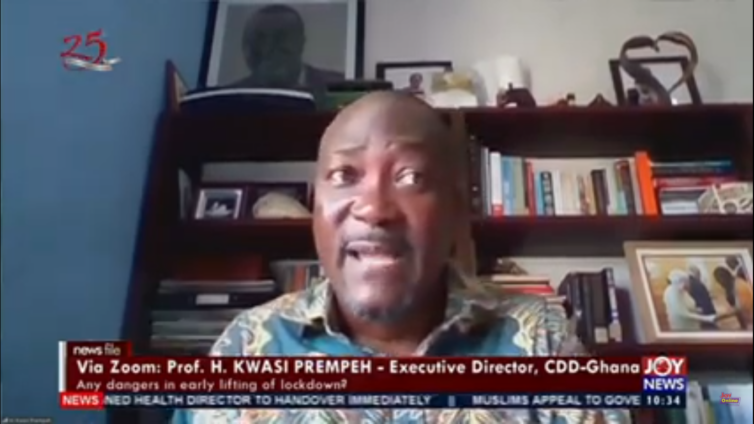
The Executive Director of the Centre for Democratic Development (CDD) has debunked claims that government’s annulment of the partial lockdown is ill-timed.
Professor Henry Kwasi Prempeh said there is no science-informed directive on when the best time is to implement or lift national lockdowns.
“This is an evolving situation and there is a whole lot of variation to countries’ responses,” he said on Joy News’ Newsfile, Saturday.
“I don’t have an answer to whether or not the lockdown was lifted too soon or not. I don’t know what another week or two would have accomplished,” he said.
Prof. Prempeh noted that the varying measures being experimented across the world provides an opportunity to choose the most suitable way to deal with the spread of coronavirus.
His comments come after a massive outcry followed President Nana Akufo-Addo's lifting of the restriction on movement after three weeks of enforcing a partial lockdown.
The decision was to enable the country contain cases of Covid-19 which keeps rising. The lockdown according to government was to give it time to do more testing and contact tracing of people who may have come into contact with some affected persons.
While some Ghanaians were relieved to get back to work, others were left fretting after Ghana became the first in Africa to lift a coronavirus lockdown.
Commenting on the development, Prof. Prempeh said, “The political authorities based on their own estimate had a particular view of a lockdown and we as a country could not go for the India- style or Wuhan style lockdown.
"When you look at the Ghana lockdown, in some parts, even the limited one wasn’t being enforced. Our capacity to mitigate the social consequences was considerably weak” Kwasi Prempeh said.
The law Professor added that behavior modification by individuals is key in trying overcoming the Covid-19 outbreak.
According to him, it appears the state has reached it’s the limit of its capacity in terms of enforcing a lockdown.
Meanwhile, he has called for the intensification of public education on the need to protect oneself by adhering to the WHO protocols of staying safe.
He appealed for more uncompounded information on the spread of Covid-19 in the country to enhance attitudinal change.
“I think the information has been aggregated at the national level. We need a lot of disaggregated data to know how the virus is behaving in our midst.
"We need to know where it is in terms of hotspots, clusters because it is about us and our livelihood,” he stated.
Latest Stories
-
Ghana must lead AfCFTA implementation by example – Trade Minister Ofosu-Adjare
5 minutes -
Strong Judiciary key to business confidence – Chief Justice Baffoe-Bonnie
8 minutes -
Mahama announces 60-Hectare irrigation project to boost tomato production
15 minutes -
WPL: Hasaacas Ladies win on last day to set up final with Ampem Darkoa
16 minutes -
Chisora beaten by Wilder in captivating bout
40 minutes -
One dead, six maimed as bloody land feud tears Krachi Nchumuru apart
1 hour -
Missing service member rescued by US forces after jet downed in Iran, Trump announces
1 hour -
Gomoa Easter Carnival: Sarkodie, Kuami Eugene, Tinny, set festival ablaze as Day 3 ends on high note
2 hours -
“Feels amazing” – Antoine Semenyo reveals after Manchester City dismantle Liverpool
2 hours -
Mahama calls for emergency cabinet meeting over rising fuel prices
3 hours -
Asante Gold reports US$345million loss for 2025
4 hours -
Prof. Naana Jane Opoku-Agyemang provides update on Women’s Development Bank
5 hours -
‘It’s not easy’ – Mother of late Dr Omane Boamah breaks silence
5 hours -
Gov’t making progress in clearing $1.7bn power debt – Mahama
5 hours -
Justice is the engine of growth – Chief Justice
5 hours