

Audio By Carbonatix
US President Donald Trump's deployment of the National Guard in Democratic-led cities, against the will of local officials, faced two key legal tests on Thursday.
Judges heard arguments in Portland, Oregon, and Chicago, Illinois, where local leaders have sued the government, arguing the use of military force on civilian streets is unconstitutional.
A federal judge in Illinois went on to partially block the deployment, saying the administration's assessment of events in the city was "unreliable," though the ruling is likely to be appealed.
The White House has defended the deployments, with Press Secretary Karoline Leavitt saying, "We're very confident in the president's legal authority to do this".
Portland is still awaiting a ruling.
In Chicago, US District Judge April Perry said there was "significant doubt" about the Department of Homeland Security's credibility and assessments of what has happened in the city recently, as she announced her ruling from the bench, CBS News, the BBC's US partner, reported.
She, however, did not lay out the limits she would place on the deployment, according to CBS.
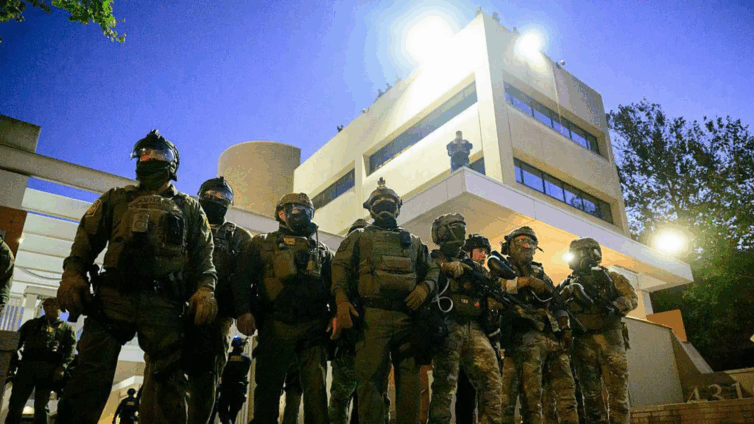
Trump has previously sent the National Guard to Los Angeles and Washington DC, arguing troops were needed to crack down on illegal immigration and crime.
The president has also said the National Guard troops are necessary to protect federal immigration officers carrying out deportation operations.
In Portland, protests outside of an Immigration and Customs Enforcement (ICE) building have grown increasingly tense, described by some local residents as a "war zone".
After Trump directed the deployment of 200 members of the Oregon National Guard in September, a judge temporarily blocked the manoeuvre. And when Trump subsequently threatened to send National Guard members in from another state, the judge expanded the court's order to stop him again.
A three-judge panel on the Ninth Circuit Court of Appeals heard arguments on Thursday about whether to lift the lower court's order temporarily blocking the use of Oregon's National Guard.
In court, Oregon prosecutors described Trump's desire to summon the military to US cities as a worrisome breach of power from the executive branch, which one judge on the panel referred to as a "slippery slope".
State lawyers argued that protests in Portland did not meet the standard required for military intervention, describing the protests as "less than 30 people" and "largely sedate".
Judge Ryan D Nelson, a Trump appointee, challenged that notion, saying in response: "That's clearly erroneous, because there's clearly been protests that were above 30."
Lawyers from the Trump administration argued that protests outside of Portland ICE facilities "significantly impeded" officers, describing the work environment as "unsustainable and unsafe" due to violence and threats.
Oregon Governor Tina Kotek, a Democrat, has previously said, "There is no insurrection in Portland, no threat to national security".
Similarly, in Judge Perry's court, lawyers for Illinois said that "there is no rebellion in Illinois", while lawyers representing the Trump administration said the US president was responding to "the urgent need for safety for law enforcement personnel and property".
Chicago has been a particular flashpoint in the Trump administration's effort to detain and deport undocumented migrants, with reports of federal agents descending from Black Hawk helicopters during an immigration raid and using chemical irritants on non-violent protesters.
One woman was shot by a federal agent during a protest in the city. Hundreds of Texas National Guard troops have since arrived in the area.
The lawsuit by Illinois officials argues that the Trump administration's efforts are not only illegal but also an attempt to manufacture a crisis by stirring civil unrest.
Chicago Mayor Brandon Johnson told BBC News that "handpicking National Guard people from another state, the state of Texas, and then sending them to the state of Illinois - this is illegal, unconstitutional, and dangerous".
Judge Perry appeared to agree, saying in her ruling that there is overwhelming evidence that deploying troops would lead to civil unrest. The judge noted that immigration agents' actions have already led to an increase in protest activity.
Latest Stories
-
John Boadu is ‘an exceptionally gifted political figure’ – Prof Mike Ocquaye
50 seconds -
NDC must study NPP congress closely for strategic lessons – Mustapha Ghande
7 minutes -
NDC has built strong structures to face any electoral challenge – Mustapha Gbande
17 minutes -
John Boadu can appeal across Ghana’s social groups – Prof Mike Oquaye
25 minutes -
‘Electing Kojo Bamba is backward politics’ – Mustapha Gbande
39 minutes -
Government must order payment of promoted teachers’ salaries – GNAT
49 minutes -
Meet Sethina Edem Sunu, the healthcare professional eyeing the NDC UK & Ireland deputy organiser role
53 minutes -
The myth of ‘sophisticated customer experience’ in the digital age
57 minutes -
What happened to lands reserved for sanitary sites? -WasteCare CEO calls for audit
57 minutes -
Manasseh Writes: The shift in the NPP
1 hour -
The price of a seat: Financial barriers and the structural quality of Ghana’s Parliament
1 hour -
Government targets October 16 for first tranche of teacher arrears – Haruna Iddrisu
1 hour -
Daily Insight for CEOs: The CEO’s role in driving innovation
1 hour -
Audit existing sanitary sites to address waste management land shortages – WasteCare CEO urges assemblies
1 hour -
Two-bin household waste system could support waste-to-energy in Ghana – Waste Care Associates CEO
2 hours