

Audio By Carbonatix
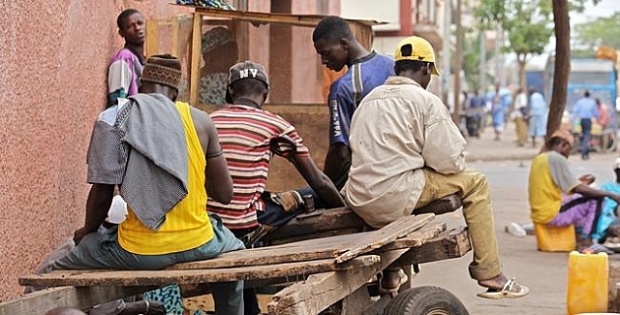
The increasing rate of unemployment in Ghana has becoming alarming in subsequent weeks.
From the staggering 1.85 million Ghanaians being unemployed in the third quarter of 2023, as reported by the Ghana Statistical Service to the silence of the President on the matter during the presentation of the 2024 State of the Nation Address (SONA), unemployment remains a major threat in Ghana.
But recent development has escalated these concerns even more as “unemployment” is now considered the highest risk factor in Ghana, according to the World Economic Forum 2024 Global Risk Report.
This report shows the possibility of the occurrence of an event or condition which could negatively impact a significant proportion of global GDP, country specific GDP, population or natural resources.
It looks at the economic, environmental, geopolitical, societal and technological risk areas with 34 risk factors.
With regards to Ghana, the Global Risk Report indicated a structural deterioration of work prospects or standards of work which includes, but is not limited to: erosion of workers' rights; stagnating wages; rising unemployment and underemployment; displacement due to automation or the green transition; and stagnant social mobility.
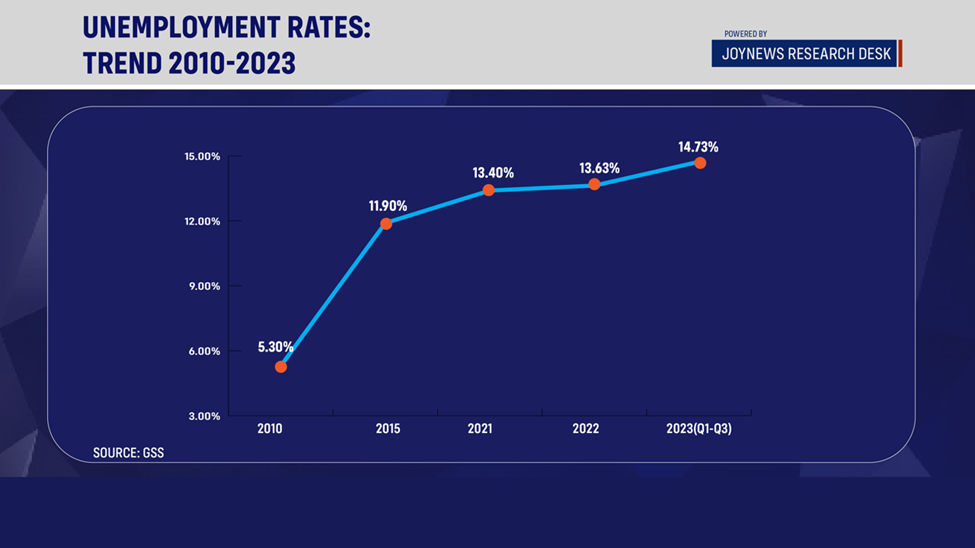
The Ghana Statistical Service in their third quarter 2023 labour statistics showed that Ghana’s unemployment rate has been on an upward trajectory from a rate of 5.3% in 2010 to 14.7% as at the third quarter of 2023.
This translates to about 1.85 million Ghanaians not having jobs.
Details of the report indicates that public debt, inflation, cybercrime and cyber insecurity, and economic downturn occupy the 2nd, 3rd, 4th and 5th risk factors respectively.
Currently, the nation’s total public debt stands at GHS 567.3 billion. This means every Ghanaian on per capita basis owes GHS 18,300. Inflation continues as a double digit at 23.2% as of February 2024.
Meanwhile, Ghana ranks third in cyber security readiness in Africa behind Mauritius and Tanzania according to the latest cyber security report by the International Telecommunications Union.
Globally, the nation ranked 43rd with a score of 86.69 out of 100. This means that Ghana is 86.69% ready in the event of a cyber-security attack.
The Media Foundation for West Africa in their Internet Freedom Report 2021 indicted that Ghana lost $105 million in 2019 and $9.8 million in 2018 due to internet fraud and cybercrime.
The Bank of Ghana financial fraud report 2023 also showed about GH¢4.3 million in 2022 as compared to GH¢2.6 million in 2021, an increase of 65.55%.
These statistics show a pressing need to look at the cyber security concern.
Latest Stories
-
Church of Pentecost supports over 2,000 BECE candidates in Obuasi with career guidance seminar
20 minutes -
Brandon Asante and Coventry all but promoted to Premier League despite Sheffield Wednesday draw
42 minutes -
GPL 2025/26: Late Kwartemaa strike downs Hearts in Tema
48 minutes -
Ghana Faces Sierra Leone Moment as Prosecutorial Powers come under strain
58 minutes -
Don’t consume fish or seafood from Tema Shipyard until further notice – FDA warns
1 hour -
Why volunteering might be Africa’s most underrated career accelerator
1 hour -
ActionAid Ghana raises concern over gender gaps in Feed Ghana Programme
1 hour -
Windstorm wreaks havoc in Gushegu, displacing nearly 2,000 residents and damaging schools
1 hour -
Friends of Bridget Bonnie Marks her 35th birthday with donation to Kasseh Model Health Centre
2 hours -
From Ekumfi Kokodo to the Pulpit Stage: Essi Donkor’s gospel journey takes shape
2 hours -
Landfilling waste management creates no value, it’s an economic waste
2 hours -
Photos: Speaker Bagbin Commissions MPs constituency office under parliamentary decentralisation programme
3 hours -
Black Stars technical advisor Winfried Schäfer sacked as GFA shakes up backroom staff
3 hours -
Wenchi water project almost complete, critical to gov’t agenda – GWL MD
3 hours -
Anti-LGBTQ+ bill not part of government’s legislative agenda – Inusah Fuseini
3 hours