

Audio By Carbonatix
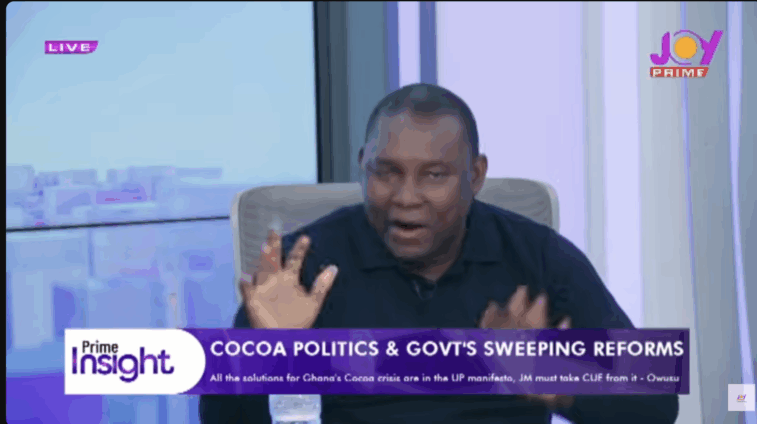
Director of Communications for the United Party, Solomon Owusu, has accused figures linked to the previous administration, NPP, of exploiting weaknesses in the current government’s cocoa sector reforms to incite protests among farmers.
Speaking on The Prime Insight on Joy Prime, Owusu said individuals who once played key roles in managing the sector were now leading press conferences and demonstrations after “seeing the weaknesses” of the present administration.
“And it’s the same people who are organizing the press conference because they have seen your weaknesses. I have told this administration that if you want to cover up for the previous administration, it will come back to hunt you,” he said.
Owusu was reacting to the government’s latest structural reforms in the cocoa sector, which are aimed at addressing falling production, financial difficulties at the Ghana Cocoa Board, and growing discontent among farmers.
In recent weeks, the government, led by Finance Minister Cassiel Ato Forson, announced a new reform package focusing on pricing, financing, governance, and local processing of cocoa beans. The measures include a revised producer pricing formula aligned with international market trends, plans to introduce an automatic price adjustment mechanism, and a shift towards domestic financing to reduce reliance on external syndicated loans.
The reforms also involve the absorption of some legacy debts of COCOBOD by the state, a renewed push for at least half of Ghana’s cocoa beans to be processed locally, and the launch of audits and investigations into past operations of the sector to improve transparency and accountability.
These changes come against the backdrop of protests by cocoa farmers in parts of the country over low incomes, high production costs, and concerns about payment delays and bonuses.
Owusu argued that while farmers’ frustrations are understandable, the political narrative surrounding the protests has been shaped by individuals who contributed to the sector’s decline in the past.
“It will come back to hunt you. Again, I agree with their strategy that they are not going to put in place a pricing mechanism. It’s very important,” he added, endorsing the government’s move to link farmgate prices more closely to global benchmarks.
According to him, previous administrations failed to establish sustainable pricing and financing systems, leaving the sector vulnerable to market shocks and financial strain.
He maintained that the current government must confront these inherited problems directly rather than shielding former officials from scrutiny.
Latest Stories
-
The illusion of a good deal: Why some everyday money-saving habits may be costing you more
14 minutes -
Family seeks autopsy, police investigation into death of student 12 days after Abomosu SHS enrolment
22 minutes -
Trade Minister urges employers to leverage industrial opportunities to create jobs
29 minutes -
Asantehene plants trees to commence Jimi Watercourse Rehabilitation destroyed by galamsey
53 minutes -
15 arrested, 6 trucks impounded over sandwinning activities on Kumasi-Accra Expressway
53 minutes -
OFFICIAL: Vinicius will miss El Clásico, suspended four games
57 minutes -
Prayer vigil held after four arson attack murders
1 hour -
GRA fully recovers $154k legacy debt owed by foreign entities between 2022 and 2024
1 hour -
Kwesi Pratt Jr warns bus preachers are adding to passengers’ stress with accident prophecies
1 hour -
MTN Ghana to spend $1.1bn in 3 years, build 500 new sites as MoMo hits 44% Growth
1 hour -
I have no regrets joining Assemblies of God – Mahama
1 hour -
Starlink restrictions in Ukraine war linked to political situation, Zelensky aide says
1 hour -
Furniture boost for Techiman North schools as MP donates to 20 institutions
1 hour -
Assemblies of God to loan 10,000-seater dome for Ghana@70 celebrations
1 hour -
Government to audit 2,016 community network sites – Communications Minister
1 hour