

Audio By Carbonatix
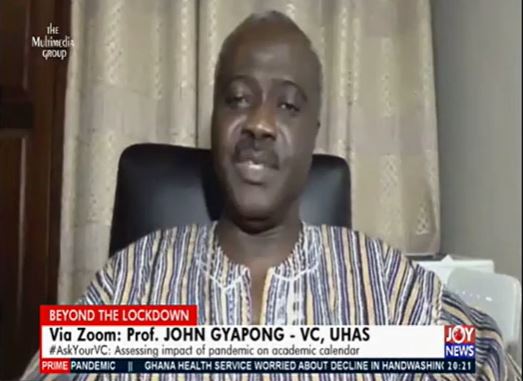
The Vice Chancellor of the University of Health and Allied Sciences (UHAS) Prof John Owusu Gyapong says closing down universities across the country will be a last resort for many school heads.
According to him, though the possibility of universities closing down due to the UTAG strike has been discussed in the various universities, it is being delayed for as long as possible.
Meanwhile, he says due to the strike action universities may have to pay double for expenses which would ‘definitely’ affect their bottom line.
Speaking on JoyNews’ Pm Express, he explained that “In terms of losing the inflows per se, one would not expect that to happen because if you have a 100 students and everybody were supposed to pay a 100cedis, the fact that there are some disruptions doesn’t mean that students will not pay their fees.
“They’ll pay their fees so you’ll get your [ten] thousand cedis, however, as we speak now all our bills for Municipal services and all that are being paid for. Every other week I get a bill on cleaning material for our hostels and all that.”
“The students are living there, they’re not doing what they’re supposed to be doing but we have to be doing all the cleaning and the other services that we have to provide. Then the strike is over and then the students come back and then again we have to pay for that bill again.
“So we end up paying double. But you cannot ask the students to pay double fees, so clearly there’s some loss of money through unexpected expenditure,” he said.
Professor Gyapong stated that a key reason why the universities have refused to close down is to avoid inconveniencing students that travel far distances just to get to school.
He said a school closure could present some cost of travel and risk of travel challenges.
“The issue has been that there has been a lot of talking behind the scenes, engaging UTAG, engaging the Ministry of Education and the Ministry of Employment, and that almost always you get the impression oh it’s almost over, we’re at the end. But it never happens you know. So we also need to be very careful.
“I mean, look, here in Ho, I have students who have come all the way from Wa, from Tamale, from Sekondi, from all over the country. And then you ask them to go home. The cost and the risks involved are quite challenging.
“I know those who live pretty close would have gone home to go and live with their parents to save on the little money that they’re supposed to use to take care of themselves, but it’s a decision that we make after a lot of consideration,” he said.
“We want to ensure that there is minimum infliction of undue challenges to the students in particular and that is the reason why we’re hastening slowly as far as closing the universities are concerned,” he added.
Latest Stories
-
Trade Minister applauds GUTA as a pillar of economic growth; Prez Mahama honoured
10 minutes -
President’s brother’s takeover of Damang Mines is ‘untidy’ – Alhassan Tampuli
16 minutes -
It’s not true that gov’t decided not to renew the lease for Gold Fields – Bobby Banson
20 minutes -
Ghana to boost tomato production with 60-hectare irrigated farms and processing initiatives
38 minutes -
E&P’s takeover process of Damang Mines was very clean – Inusah Fuseini
41 minutes -
Damang takeover: There is not going to be any job loss; it is a lease change – Bobby Banson
1 hour -
Gold Fields didn’t stop mining at Damang mines; such claims are untrue – Bobby Banson
1 hour -
Engineers and Planners currently operate only in Ghana – Bright Simons
1 hour -
Lands Minister has no legal basis to restrict lease to Ghanaian firms – Bright Simons
2 hours -
Gov’t’s refusal to renew Gold Fields’ lease was simply untenable – Bright Simons
2 hours -
SOS Children’s Villages Ghana deepens partnership with Gender Ministry
2 hours -
Gender Ministry celebrates Christina Koch, reaffirms commitment to empowering girls
2 hours -
Live stream: Newsfile digs into E&P’s takeover of Damang Mines, OSP powers and Anti-LGBTQ Bill
2 hours -
Moody’s maintains Ghana’s rating at Caa1, revises outlook to positive
3 hours -
Zambia elevates tourism education to national priority as President Hichilema backs continental summit
4 hours