

Audio By Carbonatix
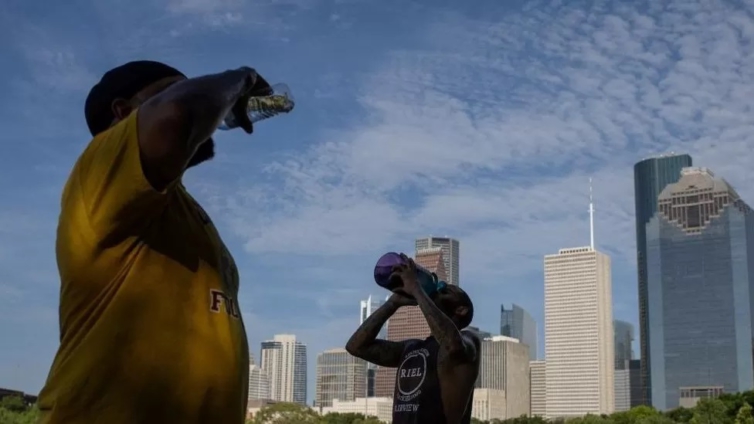
Parts of the US are expected to see record temperatures on Sunday, with warnings of "dangerous" heat levels into next week across the south-west.
Nearly a third of Americans - about 113 million people - are currently under heat advisories, from Florida to California and up to Washington state.
The country's National Weather Service (NWS) has urged people not to underestimate the risk to life.
On Saturday, a sweltering 118F (48C) was recorded in Phoenix, Arizona.
It means temperatures have hit 110F (43C) for 16 days running, which is almost a record.
Mobile clinics there have reported treating homeless people suffering from third-degree burns.
Meanwhile, Death Valley in California - one of the hottest places in the world - is forecast to reach 129F (54C), nearing the hottest temperatures ever reliably recorded on Earth.
The NWS has said that local records could also be set on Sunday in the San Joaquin Valley, Mojave Desert, and Great Basin regions.
Its Saturday-evening update said the temperatures would "pose a health risk and are potentially deadly to anyone without effective cooling and/or adequate hydration."
About 700 people are estimated to die each year from heat-related causes in the US, according to the Centers for Disease Control and Prevention (CDC).

In neighbouring Canada, officials say wildfires stoked by above-average temperatures - which have covered parts of the US in smoke - have now burned nearly 10 million hectares (25 million acres) of land.
The temperatures in America's south-west are the result of an upper-level ridge of high pressure, which typically brings with it warmer temperatures, the NWS said earlier, adding that the heatwave was "one of the strongest" systems of its kind to hit the region.
Las Vegas, Nevada, may also match its all-time high of 117F (47C) in the next few days.
Weather officials there warned locals who thought they could handle the temperatures that this was "not your typical desert heat".
'It's the desert, of course it's hot'- This is a DANGEROUS mind set!", the NWS in Las Vegas tweeted."
"This heatwave is NOT typical desert heat due to its long duration, extreme daytime temperatures, & warm nights. Everyone needs to take this heat seriously, including those who live in the desert."

The NWS also warned that "strong to severe thunderstorms, heavy rain and flooding will be possible in several locations," including America's north-eastern New England region.
Parts of the south-western US have already grappled with intensely hot temperatures over the past week. In El Paso, Texas, temperatures have been in the triple-digits Fahrenheit for 27 consecutive days.
Air conditioner use in the state has topped its previous record for power consumption as people try to stay cool, while parks, museums and zoos have either closed or shortened their hours.
Hospitals were also seeing heat-related admissions.
"We're getting a lot of heat-related illness now, a lot of dehydration, heat exhaustion," said Dr Ashkan Morim, who works in the emergency room at Dignity Health Siena Hospital, outside of Las Vegas.
Overnight temperatures were expected to remain "abnormally warm" in some areas, offering little night-time relief from the heat.
The US heatwave mirrors similar searing conditions in Europe, which forced Greece to close one of its major tourist attractions, the Acropolis, on Friday and Saturday.
The first week of July saw a global average temperature of 63F (17.23C), according to the UN - the highest ever recorded.
Scientists say the temperatures are being driven by climate change and the naturally occurring weather pattern known as El Niño, which happens every three to seven years and causes temperatures to rise.
The world has already warmed by about 1.1C since the industrial era began and temperatures will keep rising unless governments around the world make steep cuts to emissions.
Speaking to the BBC, Paolo Ceppi, a lecturer in climate science at Imperial College London, said higher global temperatures were undoubtedly contributing to the increased incidence of extreme weather.
"Of course it's not unusual to have a heatwave in the summer, per se, but what's becoming really unusual is the collection of heatwaves," he said.
"We have this event in southern Europe, but at the same time, we're having another major heatwave in the southern US. Recently we had heatwaves in south Asia, India, China and so on. And unfortunately, this is not surprising. "We have the baseline temperatures shifting upwards, and so you are shifting the odds towards more severe extreme events, and fewer cold extreme events."
Latest Stories
-
GH₵1 fuel levy: Gov’t should move from consideration to action to cushion Ghanaians – Minority
6 minutes -
World Cup and friendlies are different – Hans Sarpei on Ghana’s form under axed Otto Addo
11 minutes -
Hans Adu Sarpei calls for improvement after Black Stars losses to Austria and Germany
16 minutes -
UniMAC-IFT introduces special certification courses for non-certified photographers
16 minutes -
University of Ghana students turn class project into environmental campaign
16 minutes -
Why Ghana must prioritise vocational training to tackle youth unemployment – Chris Addy-Nayo
20 minutes -
Confidence and experience missing in current Black Stars team – Hans Sarpei
31 minutes -
Ghana to roll out national AI strategy on April 24, $250m AI centre approved
42 minutes -
Okyeame Kwame to build paediatric centre at Manhyia Hospital to mark 50th birthday
47 minutes -
Iran war economic shocks will last ‘months’, says Australia’s PM
52 minutes -
Gov’t can cushion fuel consumers without derailing budget – Bokpin
60 minutes -
Autism awareness event held to mark World Autism Day on April 2
1 hour -
Okyenhene bans burial in private homes, tasks MMDCEs to enforce laws
1 hour -
Power outage in Accra West and scheduled maintenance in Ashanti Region
1 hour -
Life is consequences – Counselor Perfect on confession, infidelity and difficult choices
1 hour