

Audio By Carbonatix
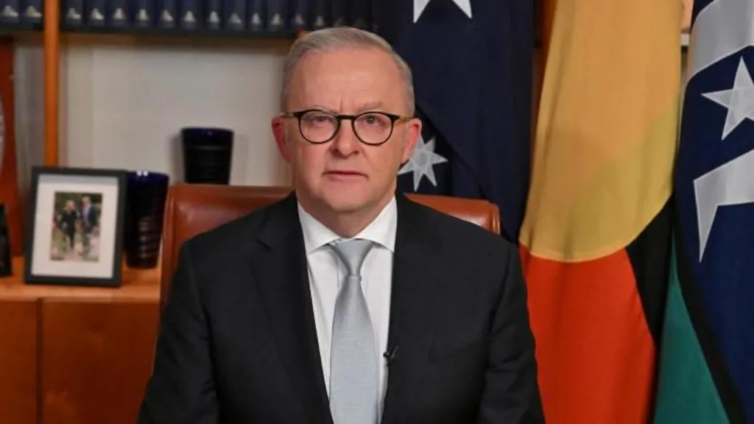
Australia's Prime Minister has warned the economic shock from the war involving Iran will "be with us for months", as he delivered a rare televised address to the nation.
Speaking on Wednesday, Anthony Albanese said the conflict had driven the biggest spike in petrol and diesel prices in history, and households were already feeling the strain.
"Australia is not an active participant in this war. But all Australians are paying higher prices because of it," he added.
Addresses of this kind have been used at moments of international importance, last seen in the country during the Covid pandemic and before that the 2008 financial crisis.
Australia is among a host of nations that have seen fuel prices increase sharply since the start of the US-Israel war with Iran and the effective closure of the Strait of Hormuz.
The near-total blockade of international shipping in the vital waterway - through which around 20% of the world's oil and natural gas flows - has led governments around the world to begin implementing measures to conserve fuel.
Albanese has previously sought to reassure motorists following reports of panic-buying and petrol stations running dry.
During the address, he acknowledged that the "months ahead may not be easy", and said that no government could fully shield Australians from the global pressures.
The Australian government has announced a series of temporary measures aimed at easing immediate cost pressures, including halving fuel excise - a sales tax - and scrapping road user charges for heavy vehicles for three months.
Officials are also seeking to shore up domestic supply and increase fuel imports through regional partners as part of a newly agreed National Fuel Security Plan.
Alongside government action, Albanese urged Australians to limit unnecessary usage of fuel, including switching to public transport where possible to preserve supplies for essential industries.
"You should go about your business and your life, as normal", he said.
"Enjoy your Easter. If you're hitting the road, don't take more fuel than you need - just fill up like you normally would. Think of others in your community, in the bush and in critical industries.
"And over coming weeks, if you can switch to catching the train or bus or tram to work, do so".
The address ended on a note of unity and said the country will "deal with these global challenges, the Australian way".
Latest Stories
-
Benedict Okyere Yeboah: Ghana’s football problem goes beyond sacking a coach
4 minutes -
GPL 2026/27: Darkwah Wiafe’s winner sees All Blacks beat Kotoko
10 minutes -
ITF World Tour : Patel Wins Boys’ Singles Final at J100 Accra
22 minutes -
Ghana must pursue BRICS partnership if it brings economic benefits – Kpebu
25 minutes -
Success and Wright Claims J100 Accra Girls’ Doubles Championship
26 minutes -
ITF J100: America’s Wright wins J100 Accra Girls’ Singles Title
32 minutes -
Expedition hopes to find aviator Amelia Earhart’s plane on remote island
33 minutes -
US seeks changes to rejected $109m health compact with Ghana – Mahama
1 hour -
Nine dead in mass shooting at Pennsylvania home
1 hour -
‘Time for Ukraine to get new president,’ says Trump after Zelensky condemns diesel deal
1 hour -
Hincapie injury adds to Arsenal issues after Guimaraes rescue act
2 hours -
Henderson scores twice as Chelsea thumb Bournemouth
2 hours -
Photos: Mentapulse Africa convenes health and labour summit to address talent retention
2 hours -
Mahama inspects Nkokɔ Nketenkete plant, eyes Bechem as chicken capital
2 hours -
Ghana not seeking full BRICS membership, applying as Partner Country – Ablakwa
2 hours