


Audio By Carbonatix
The Vatican is to open its archives on the wartime papacy of Pius XII, kept secret for decades amid accusations that he turned a blind eye to the Holocaust.
Critics say Pius XII, sometimes labelled "Hitler's Pope", knew Nazi Germany was murdering Jews but failed to act. He reigned from 1939 to 1958.
But the Vatican says Pius XII worked behind the scenes to save Jews.
Dozens of scholars are preparing to pore over the many documents.
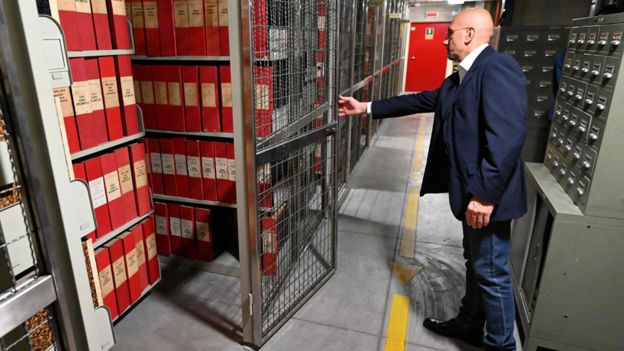 Journalists were shown a section of the Pius XII archive last week
Pope Francis took the decision a year ago to open up the archives on one of the Roman Catholic Church's most controversial figures.
"The Church is not afraid of history," the Pope told Vatican researchers.
Pope Francis said the Pius XII papacy was marked by "moments of grave difficulties, tormented decisions of human and Christian prudence, that to some could appear as reticence".
Bishop Sergio Pagano, prefect of the Vatican's Apostolic Archives, said the World War Two documents ran into millions of pages, divided into 121 sections according to topic.
All the space in the consulting area has been booked for the rest of the year, said Bishop Pagano, quoted by Reuters news agency. The scholars include some from the Holocaust Memorial Museum in Washington DC and award-winning German historian Hubert Wolf, a specialist on the Pius XII pontificate.
The BBC's Mark Lowen in Rome reports that the controversy over this papacy is thought to have halted his elevation to sainthood.
"There is no doubt that the pope was aware of the murder of Jews," said Hubert Wolf, quoted by AFP news agency.
Journalists were shown a section of the Pius XII archive last week
Pope Francis took the decision a year ago to open up the archives on one of the Roman Catholic Church's most controversial figures.
"The Church is not afraid of history," the Pope told Vatican researchers.
Pope Francis said the Pius XII papacy was marked by "moments of grave difficulties, tormented decisions of human and Christian prudence, that to some could appear as reticence".
Bishop Sergio Pagano, prefect of the Vatican's Apostolic Archives, said the World War Two documents ran into millions of pages, divided into 121 sections according to topic.
All the space in the consulting area has been booked for the rest of the year, said Bishop Pagano, quoted by Reuters news agency. The scholars include some from the Holocaust Memorial Museum in Washington DC and award-winning German historian Hubert Wolf, a specialist on the Pius XII pontificate.
The BBC's Mark Lowen in Rome reports that the controversy over this papacy is thought to have halted his elevation to sainthood.
"There is no doubt that the pope was aware of the murder of Jews," said Hubert Wolf, quoted by AFP news agency.
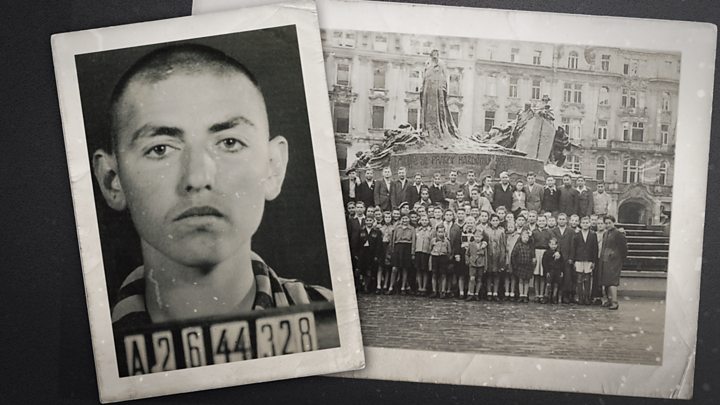 Holocaust survivors: The families who weren’t meant to live
In the 1920s the then Cardinal Eugenio Pacelli had witnessed the rise of Nazism as Holy See ambassador in Germany, before returning to the Vatican and becoming pope.
There are Jesuit documents sent to the pope which informed him about Nazi concentration camps, but historians have not yet seen any of his replies.
Holocaust survivors: The families who weren’t meant to live
In the 1920s the then Cardinal Eugenio Pacelli had witnessed the rise of Nazism as Holy See ambassador in Germany, before returning to the Vatican and becoming pope.
There are Jesuit documents sent to the pope which informed him about Nazi concentration camps, but historians have not yet seen any of his replies.
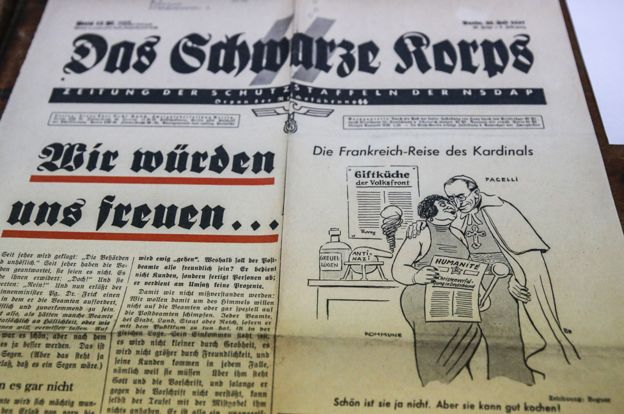 A Nazi SS cartoon in 1937 lampoons Cardinal Pacelli - shown embracing a communist woman
Mr Wolf says he is also keen to see any letters the pope received from his ambassadors during the war.
In addition, historians still have many questions about the notorious "ratline" - an escape route facilitated by some Catholic clergy who helped Nazi war criminals flee to South America after the war.
A Nazi SS cartoon in 1937 lampoons Cardinal Pacelli - shown embracing a communist woman
Mr Wolf says he is also keen to see any letters the pope received from his ambassadors during the war.
In addition, historians still have many questions about the notorious "ratline" - an escape route facilitated by some Catholic clergy who helped Nazi war criminals flee to South America after the war.
Journalists were shown a section of the Pius XII archive last week
Pope Francis took the decision a year ago to open up the archives on one of the Roman Catholic Church's most controversial figures.
"The Church is not afraid of history," the Pope told Vatican researchers.
Pope Francis said the Pius XII papacy was marked by "moments of grave difficulties, tormented decisions of human and Christian prudence, that to some could appear as reticence".
Bishop Sergio Pagano, prefect of the Vatican's Apostolic Archives, said the World War Two documents ran into millions of pages, divided into 121 sections according to topic.
All the space in the consulting area has been booked for the rest of the year, said Bishop Pagano, quoted by Reuters news agency. The scholars include some from the Holocaust Memorial Museum in Washington DC and award-winning German historian Hubert Wolf, a specialist on the Pius XII pontificate.
The BBC's Mark Lowen in Rome reports that the controversy over this papacy is thought to have halted his elevation to sainthood.
"There is no doubt that the pope was aware of the murder of Jews," said Hubert Wolf, quoted by AFP news agency.
Holocaust survivors: The families who weren’t meant to live
In the 1920s the then Cardinal Eugenio Pacelli had witnessed the rise of Nazism as Holy See ambassador in Germany, before returning to the Vatican and becoming pope.
There are Jesuit documents sent to the pope which informed him about Nazi concentration camps, but historians have not yet seen any of his replies.
A Nazi SS cartoon in 1937 lampoons Cardinal Pacelli - shown embracing a communist woman
Mr Wolf says he is also keen to see any letters the pope received from his ambassadors during the war.
In addition, historians still have many questions about the notorious "ratline" - an escape route facilitated by some Catholic clergy who helped Nazi war criminals flee to South America after the war.DISCLAIMER: The Views, Comments, Opinions, Contributions and Statements made by Readers and Contributors on this platform do not necessarily represent the views or policy of Multimedia Group Limited.
DISCLAIMER: The Views, Comments, Opinions, Contributions and Statements made by Readers and Contributors on this platform do not necessarily represent the views or policy of Multimedia Group Limited.
Latest Stories
-
President Mahama is not sincere with Ghanaians on LGBTQ bill matter – Hassan Tampuli
11 minutes -
Gov’t to establish Prison Industrial Hub to equip inmates with income-generating skills – Prison Service boss
30 minutes -
Alhassan Tampuli donates cement, roofing sheets to support storm victims in Gushegu
31 minutes -
Alhassan Tampuli appeals for urgent support for storm victims in Gushegu
34 minutes -
The hypocrisy must stop; pass Anti-LGBTQ+ Bill now – Alhassan Tampuli to Mahama
37 minutes -
Imprisonment should be rehabilitative, not punitive – Ghana Prisons boss at UNGA
59 minutes -
Ga Adangbe traditional priests petition Mahama over McDan aviation licence revocation
1 hour -
Anti-LGBTQ Bill: NDC’s arrogance is worrying – Hassan Tampuli
1 hour -
Let’s give OSP time to mature, not to scrap it – Hassan Tampuli
1 hour -
Nigeria convicts 386 Islamist militants in mass trials
1 hour -
Djibouti president wins election with 97.8% of vote, state media says
2 hours -
We don’t have mandate to deduct tax from rent allowance of security services personnel – Interior Ministry clarifies
2 hours -
Ablakwa receives Presidential Special Envoy on Reparations to advance global agenda
2 hours -
Christina Koch becomes first woman to travel around the moon on Artemis II
2 hours -
Epstein survivors’ calls to meet King Charles and Queen harder to ignore as US visit approaches
2 hours