

Audio By Carbonatix
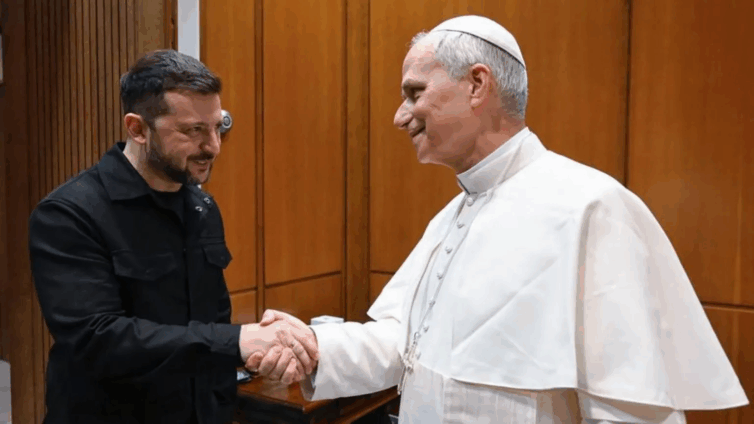
Italy has backed President Donald Trump's suggestion that the Vatican might mediate talks on negotiating a ceasefire in Ukraine, while he appears keen to step back from the process himself.
Prime Minister Giorgia Meloni's office said Italy was ready to "facilitate contacts and work towards peace" in Ukraine and it "viewed positively" what it said was the Pope's willingness to host the talks at the Vatican.
In fact there's no firm agreement yet on further discussions: last Friday's meeting between Russian and Ukrainian officials in Istanbul brought additional demands from Moscow, not progress.
Pope Leo said last week the Vatican was "always ready" to bring enemies together and he would "make every effort" for peace to prevail.
But the Holy See says the idea of hosting, or even mediating, talks, which Trump suggested was an option, is more a hope for now than any concrete plan.
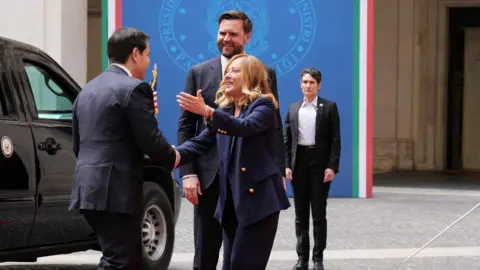
If direct engagement does continue, Ukraine seems open to the notion of the Vatican as host.
Volodymyr Zelensky posted on X on Tuesday that he had talked to Giorgia Meloni, including about "possible platforms for talks with the Russians".
The Italian prime minister had, he said, "as always, cool ideas", although he has raised Turkey and Switzerland as alternative venues too.
The Kremlin might prefer to stay in Turkey. It talks about a process called "Istanbul Plus", styling any talks as a follow-up on the deal initially discussed in Turkey shortly after the full-scale invasion.
Those terms, which included Ukraine drastically reducing its own military, would represent capitulation for Kyiv now.
But Russia has added more: the "plus" part means recognition of its annexation of four partially occupied regions of Ukraine, as well as Crimea.
The actual venue matters little to the Kremlin: all it wants is for the discussion to be on Vladimir Putin's terms.
The prospect of meaningful progress, bluntly, looks slim.
But might the Vatican lend some extra moral authority in the push for some kind of compromise?
The Catholic Church has a history of helping to mediate conflicts and it has already been involved in talks to free prisoners and return Ukrainian children abducted by Russia.
Its real input there isn't clear, though, as others have fulfilled the same role.
On the other hand, the Vatican – especially any involvement of the new Pope – would introduce a different tone to proceedings.
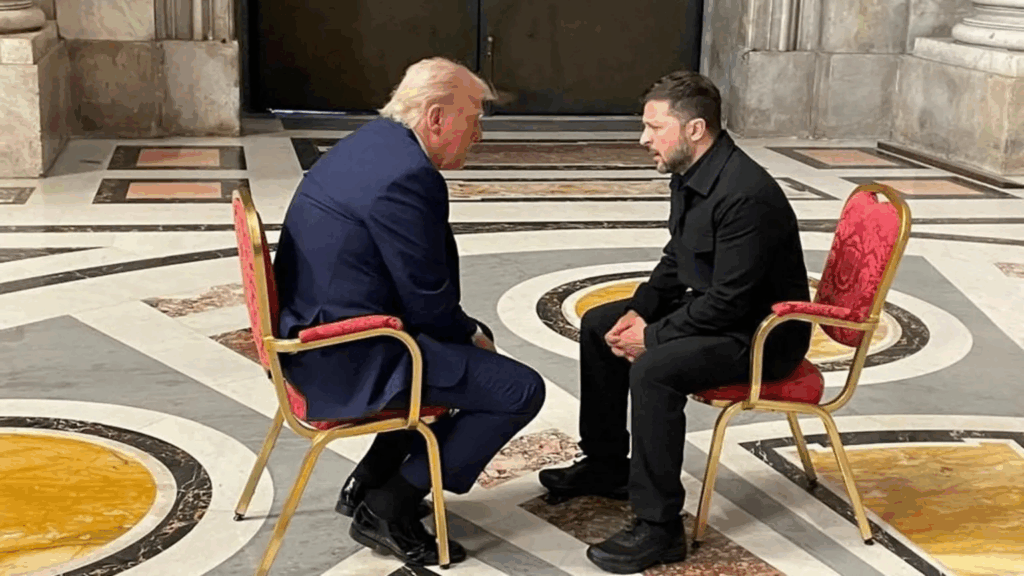
Its quiet style couldn't be further from Donald Trump's capitalised social media posts and his brutal public showdown with Zelensky in the Oval Office. And the setting already seems to have worked wonders on the men's relationship.
It was at Pope Francis' funeral that they were snapped deep in conversation, heads close, inside St Peter's Basilica.
The Vatican prides itself on its diplomacy: that's why, when others severed ties with Moscow after it began bombing Ukraine, the Catholic Church sent a cardinal envoy to talk to the Kremlin. It made no impact.
Pope Francis, like Donald Trump, always avoided openly identifying Russia as the aggressor. Vatican sources say that was to keep the door for dialogue ajar, even when it seemed hopeless.
But Francis upset Ukrainians more by suggesting that Russia had been "provoked" by NATO into its invasion. He then agreed it might be wise for Kyiv to "raise the white flag" and surrender.
For Kyiv, Pope Leo might be a preferable potential peace-broker. He is on record as a bishop denouncing Russia's invasion as an imperialist war and condemning crimes against humanity being committed by Putin's troops.
That's unlikely to faze the Kremlin, if the Vatican were ever to host talks.
"Putin can explain his position to the Pope, he believes it's just. In his mind, it's Ukraine that's not serious about peace talks," argued Tatiana Stanovaya, from the Carnegie Russia Eurasia Centre.
"I don't believe for one second that the Pope could affect Putin's understanding in any way."
At this point, Russia is under no major pressure to give ground: all Donald Trump's talk of punishing Putin for his intransigence has turned into talk of trade with Russia. Offering incentives, not threating sanctions.
It's true that Moscow wanted a lot more.
"They want Zelensky removed and for the US and EU to stop military aid, but on this, the US has been on Ukraine's side – from the Russian perspective," Tatiana Stanovaya says.
So Russia is prepared to play the long game - which doesn't involve compromise.
"If the Pope could help pressure Ukraine, Putin wouldn't have a problem [with his involvement]," she says.
That seems to be the real issue here. It runs far deeper than whether the two sides eat meze or antipasti between hypothetical rounds of fresh talks.
Latest Stories
-
Power restoration fault suspected in Kumasi Central Market fire
5 hours -
The 7-foot giant of Ngleshie Amanfro: Seven-foot Ghanaian Ephraim Saawa dreams of joining the national basketball team
5 hours -
Government promises support for Kumasi Central Market fire victims
5 hours -
Vibes The Movie: Big Ghun’s Ghanaian film earns five nominations at 2026 REFFA
6 hours -
MamaCare CEO warns unresolved conflicts among health workers could undermine maternal and neonatal care
6 hours -
Health professionals urged to translate medical knowledge into practice to save mothers
6 hours -
Retired judge Justice Francis Korbieh charges 1,568 new lawyers to uphold integrity
8 hours -
Conflicts among care providers linked to maternal, neonatal deaths – Expert
8 hours -
GIS marks 10th TIME conference, champions improved teaching practices
8 hours -
BRICS Or Balance? What Ghana’s bid really means
9 hours -
GPRTU wants full TRAFFITECH-GH implementation to start in 2027
9 hours -
How 10-mile walks for basic education birthed a 50-year legal career for Justice Korbieh
9 hours -
Mahama announces plans to import electric wheelchairs for PWDs
9 hours -
KGL U17 Colts 2026: Western beat Prempeh Elite Academy to set up final final with Greater Accra Region
9 hours -
Late Solanke strike salvages 10-man Spurs draw at Man United
9 hours