

Audio By Carbonatix
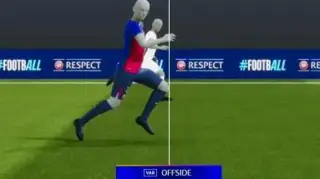
Former Arsenal manager Arsene Wenger has proposed a change to the offside rule that would mean attackers are onside if any part of their body is in line with the last outfield defender.
Wenger, head of global development at world governing body Fifa, said it would restore an advantage to the attacker that many feel was eroded by the introduction of the video assistant referee (VAR).
Players are currently ruled offside if any part of the body, apart from hands and arms, is beyond the last defender.
Wenger compared the suggested change to a similar move taken after the 1990 World Cup.
Before and during that tournament, a player was considered offside if he was level with the last defender before the goalkeeper.
There were an average of 2.21 goals per match in 1990, the lowest in World Cup history.
"It was in 1990 after the World Cup in Italy when there were no goals scored," Wenger told Bein Sports, recalling the rule change.
"We decided that there is no offside any more when you are on the same line of the defender.
"In case of doubt, the doubt benefits the striker. That means when there's a fraction, the striker did get the advantage.
"With VAR this advantage disappeared and for many people it's frustrating."
Trials of the system have taken place in Italian youth football, and Wenger said further trials will happen before a final decision, which could come in 2026.
Any change to the offside rule rests with the sport's law-makers, the International Football Association Board (Ifab).
Ifab agreed to further trials, conducted by Fifa, at its annual general meeting in March.
It says the aim of the trials is to see whether they "foster attacking football and encouraging goalscoring opportunities while maintaining the game's attractiveness".
Any potential rule change would only come after consultation with football stakeholders and advice from Ifab's football and technical advisory panels.
Those panels include experienced members from the football world such as former players and referees.
The Premier League, Champions League and other major European leagues currently use semi-automated technology when a tight offside decision goes to a VAR review.
Bespoke cameras monitor a variety of key elements that determine whether an attacking player's body was beyond the last defender at the exact time the ball was played.
The technology was first used in elite-level football in England in the FA Cup in February, before being adopted by the Premier League in April.
As well as changes to the offside law, the modern back-pass rule and three points for a win as the global standard came in following the 1990 World Cup in an effort to encourage attacking play.
There were an average of 2.71 goals per match at the 1994 World Cup.
Latest Stories
-
Gold edges lower with focus on Fed minutes, rate path clues
40 minutes -
Oil prices rise as storms and air strikes threaten supply
49 minutes -
Nigeria nears 2,000 repatriations from South Africa after latest evacuation flight
58 minutes -
World Bank maintains Ghana’s growth rate forecast at 4.8% in 2026
2 hours -
Cedi was worst African currency in quarter 2, 2026 – World Bank
2 hours -
AI gains can lift three times as many people out of poverty in Ghana – World Bank
3 hours -
Scammers target ECG customers with fake meter sales and MoMo payment calls
4 hours -
We did not take security issues seriously – Abanga Fusani reflects on NPP’s 2024 election loss
4 hours -
Nigeria’s Dangote refinery aims to draw more retail investors than Aramco IPO, CEO says
5 hours -
Banker in court for allegedly stealing GH¢1 million
5 hours -
Police arrest suspect over jewellery theft during fire outbreak
5 hours -
EOCO returns Hanan’s £6,700, GH¢2,750 and devices after defence challenge
5 hours -
Opplift Youth Entrepreneurs Summit 2026 equips entrepreneurs with skills, mentorship and support
5 hours -
Rival clubs want range of punishments for Man City
5 hours -
Tear gas in Paris and Marseille as school protests grow across France
6 hours