

Audio By Carbonatix
As threats against journalists intensify, from war zones to courtrooms, the fight for press freedom is no longer abstract. It is a defining test of whether democracy can still hold.
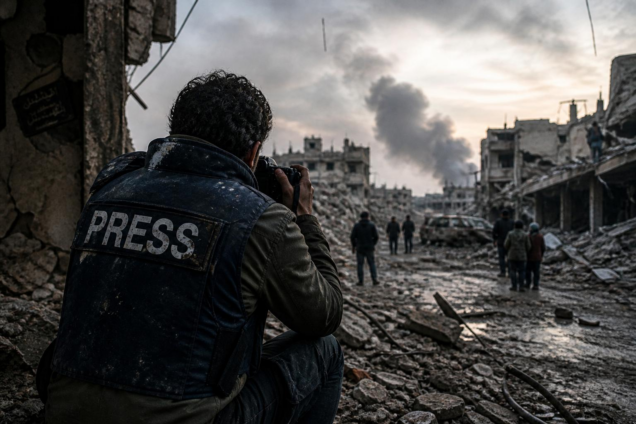
On a grey morning in a conflict zone, a journalist crouches behind a shattered wall, phone in hand, trying to send one last update before the signal disappears. There is no certainty that the story will reach the world. There is even less certainty that they will make it out.
This is not an exception. It is the reality of modern journalism.
Each year, on World Press Freedom Day, the global conversation returns to a simple but urgent truth: democracy cannot exist without a free press. Yet across continents, that principle is being tested in more visible ways, and more dangerously than ever before.
The threats are no longer confined to authoritarian states or distant war zones. They are global, layered, and evolving.
In 2025, the number of journalists killed, detained, or forced into exile reached one of the highest levels ever recorded. From Russia’s war in Ukraine to ongoing conflicts in Gaza and Lebanon, and across fragile regions in Africa, journalists have continued to document what others cannot, or will not.
They report on civilian suffering, expose the human cost of war, and, at times, uncover evidence of potential war crimes.
Their work is not just about storytelling. It is about accountability. Without independent reporting, the consequences are immediate. Atrocities go unrecorded. Narratives become controlled. Silence replaces scrutiny.
But the pressure on journalism does not begin or end on the battlefield.
In many parts of the world, the most effective weapon against journalists is not violence—it is the law. Strategic Lawsuits Against Public Participation (SLAPPs) are increasingly used to drain reporters and media organizations of time, resources, and resolve. These cases are rarely about justice. They are about intimidation, and they are working.
The result is subtle but dangerous: self-censorship. Stories are softened. Investigations are delayed. Some truths are never pursued at all.
At the same time, the digital space, once seen as a tool for expanding press freedom, has become another front line. Online harassment campaigns, particularly targeting women journalists, are widespread, systematic, and designed to silence. Abuse is no longer incidental. It is structural.
And while credible journalism is under pressure, another force is rising to fill the gap.
Outlets that mimic the structure of legitimate media, but operate without its principles, are spreading disinformation at scale. Amplified by algorithms and political interests, these narratives blur the line between fact and fiction. For audiences, the distinction becomes harder to make. For democracy, the consequences are profound.
When truth becomes contested, power stops answering.
Institutions are responding, but the challenge is immense. The European Union has reaffirmed its commitment to defending independent, pluralistic media, working with partners such as the European Endowment for Democracy to support journalists operating under pressure.
Globally, efforts led by UNESCO continue to push for stronger protections for media workers. Regional bodies like the Council of Europe and the Organization for Security and Co-operation in Europe are working to uphold standards and monitor violations.
These efforts matter. But they are not enough on their own.
Press freedom cannot be sustained by declarations alone. It requires enforcement. Governments must build legal systems that protect journalists, not just in principle but in practice. Media organizations must invest in safety, verification, and independence. Audiences must demand more than speed—they must demand truth.
Because the erosion of press freedom is rarely dramatic. It does not always arrive with a headline. More often, it unfolds quietly, through pressure, fear, and compromise.
Until one day, the silence is complete. And when that happens, the cost is not borne by journalists alone. It is carried by every citizen who relies on information to understand the world, to question authority, and to make informed choices.
In the end, press freedom is not about the right to publish. It is about the right to know.
Because when journalism is silenced, it is not just stories that disappear—it is accountability itself.
Latest Stories
-
Schizophrenia-related disorders lead mental health cases recorded in Ghana
14 minutes -
Dutch authorities enlist Ghana in hunt for fugitive drug lord Bolle Jos
37 minutes -
Ghana housing finance conference adopts communiqué to improve affordable housing access
5 hours -
Special Initiatives Minister urges Wa Technical Institute to enrol more girls as EU-backed solar training lab opens
5 hours -
In the matter of my first year at the Bar
6 hours -
ActionAid Ghana calls for an end to child marriage, greater investment in girls’ rights
6 hours -
Newsfile to tackle World Cup visa scandal, beach demolitions, education strikes, BRICS bid
6 hours -
UK-Ghana Trade & Investment Summit: Trade Resource Centre to help businesses maximise UK-Ghana trade opportunities
6 hours -
Embassy of Denmark celebrates World Maritime Day
7 hours -
Linking LEAP to productive inclusion could cut extreme poverty by 2030 – UNICEF
8 hours -
Trade Ministry backs use of creative arts to rehabilitate prison inmates
8 hours -
Negotiations with government to continue despite strike suspension – GNAT
8 hours -
‘Ghana cannot afford to waste public resources; every cedi has a job’ – Ato Forson
8 hours -
Ghana expects economic boost as World Assemblies of God Congress brings 10,000 delegates to Accra
8 hours -
Joy in Nayilifong as Farouk Aliu Mahama donates 100kVA transformer to improve power supply
8 hours