

Audio By Carbonatix
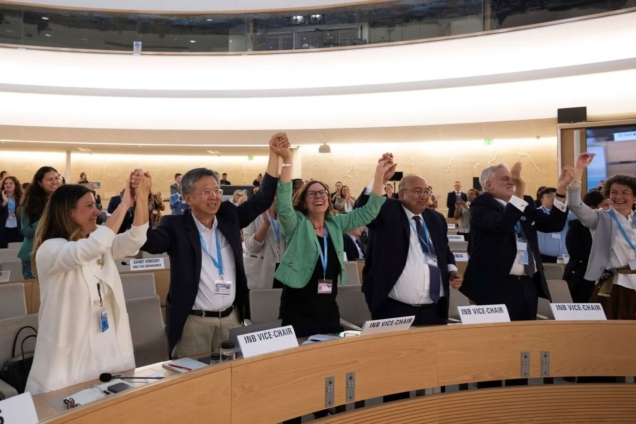
Member States of the World Health Organization (WHO) have adopted the world’s first Pandemic Agreement, during the 78th World Health Assembly in Geneva, a process driven by lessons learned from the COVID-19 pandemic and the need to ensure a safer, and fairer global response to future health crises.
The adoption follows a committee vote on Monday, where 124 Member States voted in favour, none opposed, and 11 abstained.
The WHO Pandemic Agreement outlines a framework for stronger international coordination in pandemic prevention, preparedness, and response.
It prioritises equitable and timely access to vaccines, therapeutics, and diagnostics, and lays out the principles and tools necessary to strengthen the global health architecture.
The agreement is only the second international legal agreement negotiated under Article 19 of the WHO Constitution, the first being the WHO Framework Convention on Tobacco Control, adopted in 2003 and entered into force in 2005.
WHO Director-General Dr. Tedros Adhanom Ghebreyesus welcomed the adoption, calling it a victory for public health, science, and multilateralism.
“It is also a recognition by the international community that our citizens, societies and economies must not be left vulnerable to again suffer losses like those endured during COVID-19,” Dr. Ghebreyesus said.

Secretary of Health for the Philippines and President of this year’s Assembly, Dr. Teodoro Herbosa, praised the dedication of governments worldwide indicating that, "at the height of the COVID-19 pandemic, governments acted with purpose and urgency, exercising their national sovereignty to negotiate this historic agreement.”
He added that while COVID-19 was a once-in-a-generation crisis, the WHO Pandemic Agreement offers a once-in-a-lifetime opportunity to prevent similar devastation in the future.
The Agreement clearly upholds national sovereignty. It states, “Nothing in the WHO Pandemic Agreement shall be interpreted as providing the Secretariat of the World Health Organization, including the Director-General of the World Health Organization, any authority to direct, order, alter or otherwise prescribe the national and/or domestic law, as appropriate, or policies of any party, or to mandate or otherwise impose any requirements that parties take specific actions, such as ban or accept travellers, impose vaccination mandates or therapeutic or diagnostic measures or implement lockdowns.”
The World Health Assembly also adopted a resolution outlining the next steps toward implementing the Agreement. These include, launching negotiations on a Pathogen Access and Benefit-Sharing (PABS) system through an Intergovernmental Working Group (IGWG), with outcomes to be reviewed at the next Assembly.
Once the PABS annex is adopted, the full Agreement will be open for signature and ratification by national legislative bodies. The Agreement will enter into force after receiving 60 ratifications.
Member States also directed the IGWG to begin steps toward creating a Coordinating Financial Mechanism and a Global Supply Chain and Logistics Network (GSCL). These systems are intended to enhance access to critical pandemic-related health products, ensuring affordability, safety, and timely delivery, especially to countries in need during public health emergencies.
Under the Agreement, pharmaceutical manufacturers participating in the PABS system are expected to provide the WHO with rapid access to 20% of their real-time production of vaccines, therapeutics, and diagnostics. Distribution will be based on public health risk and need, with a strong focus on developing countries.
Latest Stories
-
Tyson Fury dominates Makhmudov, calls out Joshua next
11 minutes -
I have supported highway authority financially to fix roads in my constituency – A Plus
1 hour -
US, Iran fail to reach peace agreement after marathon talks in Pakistan
2 hours -
ECG kicks off Phase Two of transformer upgrades at Lashibi; brief outages expected
2 hours -
Port crises loom as 11,000 drivers threaten four-day strike
3 hours -
A source of excellence across generations – Vice President Opoku-Agyemang lauds Mfantsipim
4 hours -
(Photos) Mfantsipim School launches historic 150th anniversary
4 hours -
Knights and Ladies of Marshall group backs Catholic Bishops’ stance on anti-LGBTQ+
5 hours -
Bright Simons writes: All the Filla in the Ibrahim Mahama/E&P – Gold Fields Saga
6 hours -
Monetise Idiocy In Ghana
6 hours -
The Ghanaian prophet and the mysterious death of his scottish wife Charmain Speirs
7 hours -
Nearly 400 sentenced in Nigeria for links to militant Islamists
7 hours -
Ghana’s recovery supported by gold strength despite global oil price pressures – Standard Bank Research
7 hours -
Methodist Church hails Mfantsipim@150; calls for “fresh consecration” to excellence
7 hours -
‘Excellence is our inheritance’ – Nana Sam Brew-Butler hails Mfantsipim’s 150-year reign in leadership
7 hours