

Audio By Carbonatix
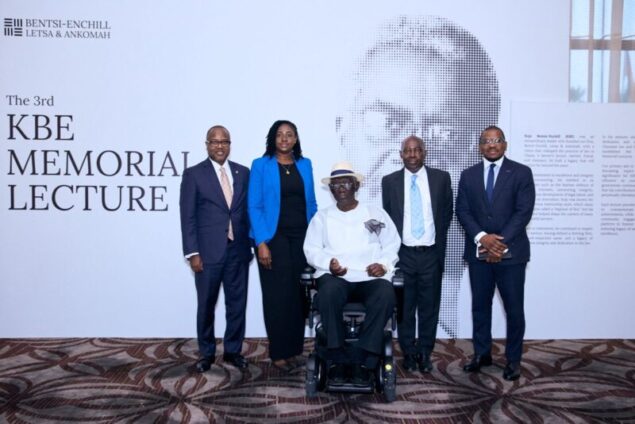
The 3rd Kojo Bentsi-Enchill (KBE) Memorial Lecture was held in Accra on September 5, 2024, focusing on the history and evolution of monetary policy in Ghana and its impact on economic development. Organised by Bentsi-Enchill, Letsa & Ankomah, a leading law firm in Ghana, the lecture honours the memory of the late Kojo Bentsi-Enchill, a visionary, who contributed significantly to the transformation of law practice in Ghana.
The annual lecture series aims to foster dialogue on critical national issues by bringing together academics, legal professionals, government officials, and technocrats. This year’s lecture focused on Ghana’s monetary policy, addressing this often-complex area that plays a crucial role in the country’s economic stability, particularly in light of the current economic downturn and challenges.
The lecture held under the theme: “The Evolution of Monetary Policy in Ghana and its Impact on Economic Development,” was delivered by Ivor Agyeman-Duah, a renowned historian of economics with extensive expertise in the history of Ghana’s economic policies. Mr. Agyeman-Duah delved into the various theories that underpinned the development of monetary policy in Ghana and its evolution.
The lecture aimed to clarify the often-misunderstood topic, particularly amidst Ghana's current economic challenges, fuelling various speculations among the public.
In his presentation, Mr. Agyeman-Duah highlighted that monetary policy, which involves actions taken by a nation’s central bank to regulate the money supply, aims to achieve specific economic goals, such as controlling inflation, managing interbank lending rate levels, and maintaining financial stability. He highlighted that different models are used across the world to meet these public interest goals.
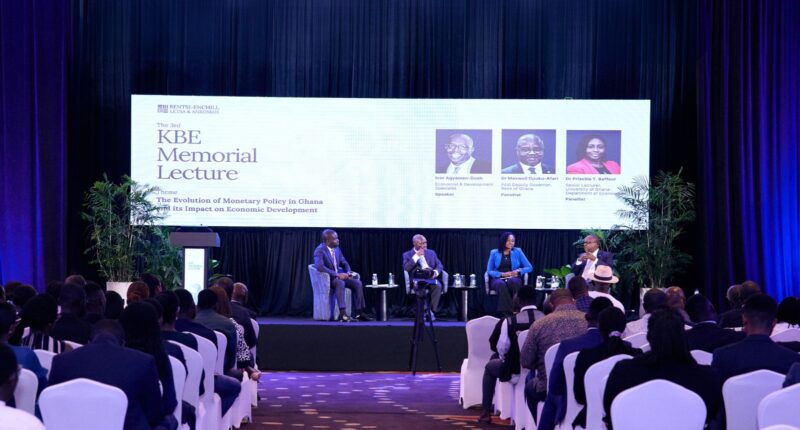
He emphasised that, regardless of the model implemented, monetary policy plays a crucial role in the economy and has far-reaching implications on its overall stability and growth. He also highlighted key areas such as inflation control, exchange rate, financial market stability, credit availability, and economic growth as factors impacted by monetary policy.
The lecture set the stage for a panel discussion which featured Dr. Maxwell Opoku-Afari, the First Deputy Governor of the Bank of Ghana; Dr. Priscilla Twumasi-Baffour, a Senior Lecturer at the Department of Economics of the University of Ghana; and Mr. Agyeman-Duah.
The session was intellectually invigorating, explaining the various models of monetary policies and how they correlate with fiscal policy and their impact on the economy.
Dr. Twumasi Baffour argued that strong coordination between fiscal policy and monetary policy is required to deliver the intended results of controlling inflation and addressing currency volatility. Therefore, if the fiscal policy handled by the executive arm and the monetary policy seem not to speak to each other as expected operationally, then regulation may be needed to enforce that.
She added that the Ghanaian economy cannot continue as it has since independence, relying on imports and exporting raw materials, yet expect different outcomes solely through changes in monetary policy.
“Even though the country’s monetary policy models have changed over the years to the current model of ‘inflation targeting’, because the economy is still importation reliant, inflation is still high and the currency is volatile. We need to move into value addition and industrialisation” she stressed.
In his contributions, Dr. Opoku-Afari highlighted that price stability is the core mandate of the central bank and its monetary policy objective is to achieve that. He reiterated that the current inflation targeting model helps to focus on every sector of the economy in policy implementation. This he said, has resulted in the recording of the highest growth without volatility and the longest period of stability in currency.
Nonetheless, he echoed that monetary policy alone cannot solve all the problems in the economy in terms of price control and needs other policies functioning collaboratively.
The panel concluded that transitioning from the export of raw materials and an import-dependent economy to the export of value-added goods is a vision that must be carried out by the executive to diversify the economy.
His Excellency John Agyekum Kufuor, the former President of the Republic, who graced the occasion, urged the public to refrain from the attacks on the Bank of Ghana, warning that such actions could have severe economic consequences.
He stressed that the executive arm of government is the central brain of economic and fiscal policies and should be held accountable for economic challenges rather than undermining the central bank’s independence, which could lead to instability and erode investor confidence, ultimately harming the economy.
Mr. Divine Letsa, who chaired the event, in his closing remarks said: “The KBE Memorial Lecture series is dedicated to honouring Kojo Bentsi-Enchill's legacy by exploring critical issues affecting our nation. We believe that by examining monetary policy's impact, we can contribute to informed decision-making and economic stability” he said.
Latest Stories
-
Gender Ministry meets Nana Akua Addo’s husband over domestic violence after hospital discharge
28 minutes -
UG Vice-Chancellor urges swift operationalisation of National Research Fund
46 minutes -
Pope Leo to have surgery after lump found in lung
53 minutes -
Joseph Cudjoe writes: Ghana must break free from the dangerous mindset that natural resources are the foundation for wealth
1 hour -
Children among 109 dead after boat capsizes off Djibouti, UN says
1 hour -
OmniBSIC Bank’s 11th health walk promotes fitness and business growth
1 hour -
2026 World Maritime Day: Danish Embassy organises “The Gulf of Guinea Speaks”
2 hours -
New Economy will tackle unemployment and restore hope – Ato Forson
2 hours -
IMMILAC president recounts personal losses as security women lead breast cancer awareness campaign in Wa
2 hours -
University of Ghana postpones October 12 reopening as GAUA strike persists
2 hours -
Bahass Foundation launches vocational skills training to support mental health recovery in Wa
3 hours -
NPP orders parliamentary aspirants and their supporters to suspend campaign activities
3 hours -
Techiman unites against child marriage: Joy Impact Makers Awardee leads charge on International Day of the Girl Child
4 hours -
Ghana Psychological Association calls for greater involvement of people with lived experience in mental health care
5 hours -
Ablakwa says Ghana could evacuate more citizens from South Africa if the situation worsens
5 hours