


Audio By Carbonatix
Colombia's President Iván Duque has said security forces will remain on the streets to maintain order, as protests continued for a third day.The anti-government demonstrations erupted on Thursday, when more than 250,000 marched in a national strike.They started peacefully but clashes between protesters and police have since broken out, and there have been reports of vandalism and looting.Mr Duque said troops would carry out joint patrols with police."We express the total and absolute rejection of all Colombians for the vandalism, for the terrorism, for the looting," Mr Duque told reporters on Saturday.At least three people have died since the protests against corruption and possible austerity measures began.A curfew was imposed in the capital, Bogotá, on Friday, but it did not deter protesters from returning to the streets a day later.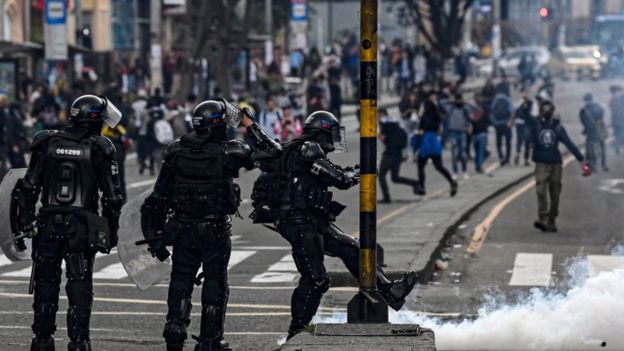 Image copyrightGETTY IMAGESImage captionPresident Duque said troops would carry out joint patrols with policeWhen protests resumed on Saturday, police used tear gas to disperse hundreds of people who had gathered near Bogotá's National Park, reports said.Demonstrators also gathered outside of congress in Bolivar Plaza, near the presidential palace.
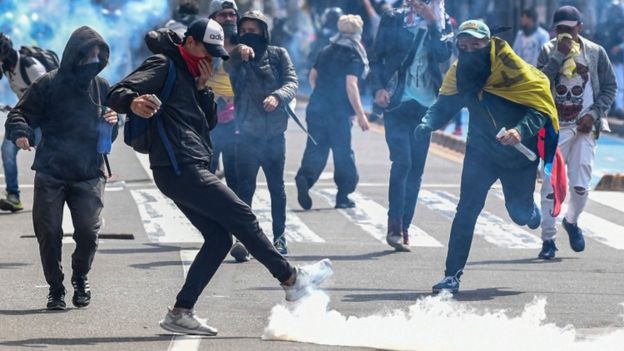 Image copyrightGETTY IMAGESImage captionProtests took to the streets of Bogotá despite a curfew imposed by the mayorSeparately, late on Friday, three police officers were killed in a bomb attack in the country's south-west.It is not clear if the incident is connected to the protests. The area is notorious for drug trafficking and gang violence.
 Media captionProtesters scattered as police fired tear gas in the capital BogotáPresident Duque said he had heard Colombians and vowed to deepen "social dialogue".Unrest in Colombia has coincided with a surge of anti-government demonstrations elsewhere in Latin America.Protesters have taken to the streets in several Latin American countries in recent months, including in Chile, where conservative President Sebastián Piñera is grappling with the country's biggest crisis since its return to democracy in 1990.In Bolivia, claims of election fraud led to the resignation of long-time leftist President Evo Morales amid nationwide protests. Demonstrations have also taken place in Ecuador and Nicaragua.
Image copyrightGETTY IMAGESImage captionPresident Duque said troops would carry out joint patrols with policeWhen protests resumed on Saturday, police used tear gas to disperse hundreds of people who had gathered near Bogotá's National Park, reports said.Demonstrators also gathered outside of congress in Bolivar Plaza, near the presidential palace.Image copyrightGETTY IMAGESImage captionProtests took to the streets of Bogotá despite a curfew imposed by the mayorSeparately, late on Friday, three police officers were killed in a bomb attack in the country's south-west.It is not clear if the incident is connected to the protests. The area is notorious for drug trafficking and gang violence.What are the protests about?
Colombians have taken to the streets over possible changes to the minimum wage, pension and tax reforms, and the privatisation of state companies. The government insists there are no planned pension or labour reforms and that any changes would take place in consultation with labour groups.Protesters are also angry about alleged corruption and what some see as the government's failure to honour a 2016 peace deal with left-wing Farc rebels amid a rise in violence.Thursday's general strike was called by unions and student groups, and more protests were held on Friday, with police using tear gas to disperse crowdsMedia captionProtesters scattered as police fired tear gas in the capital BogotáPresident Duque said he had heard Colombians and vowed to deepen "social dialogue".Unrest in Colombia has coincided with a surge of anti-government demonstrations elsewhere in Latin America.Protesters have taken to the streets in several Latin American countries in recent months, including in Chile, where conservative President Sebastián Piñera is grappling with the country's biggest crisis since its return to democracy in 1990.In Bolivia, claims of election fraud led to the resignation of long-time leftist President Evo Morales amid nationwide protests. Demonstrations have also taken place in Ecuador and Nicaragua.DISCLAIMER: The Views, Comments, Opinions, Contributions and Statements made by Readers and Contributors on this platform do not necessarily represent the views or policy of Multimedia Group Limited.
DISCLAIMER: The Views, Comments, Opinions, Contributions and Statements made by Readers and Contributors on this platform do not necessarily represent the views or policy of Multimedia Group Limited.
Latest Stories
-
Ghana’s public debt hit GH¢733.9 billion in July 2026
3 minutes -
“I don’t see any rational basis” – Inusah Fuseini rejects proposed five-year term
26 minutes -
Constitution shouldn’t be amended simply because years have passed – IEA
26 minutes -
Access Bank, Visa launch ‘Visa Accept’ in Ghana
49 minutes -
‘Our young people must inherit story of what Africa created, not lost’ – Mahama
51 minutes -
Afreximbank, GIIF and 24-Hour Economy Authority pact marks real progress toward 24-hour economy agenda
1 hour -
IMANI, Local Government Ministry discuss reforms on sanitation, local revenue and urban infrastructure
2 hours -
Ghana’s international reserves drop to US$11.04 billion in August as BoG pushes for significant build-ups in coming months
2 hours -
Four years enough for any government to deliver – IEA rejects five-year term
2 hours -
‘The most important players are here’ – Queiroz shrugs off Ghana’s injury crisis
2 hours -
Ayariga pledges stakeholder-led approach to Nzema, Kokomba Market redevelopment
2 hours -
Professional collaboration is key to Ghana’s land and property development – Western Regional Minister
2 hours -
‘When you play Ghana, it’s a derby’ – Kessié sets tone for AFCON qualifying showdown
2 hours -
Mahama urges global institutions to invest in Africa’s cultural infrastructure
2 hours -
Kuami Eugene joins UNICEF Ghana to promote universal birth registration
2 hours