

Audio By Carbonatix
The US has charged six Russian hackers over a series of global cyber attacks, including trying to undermine UK efforts to hold Moscow accountable for the Salisbury spy poisoning.
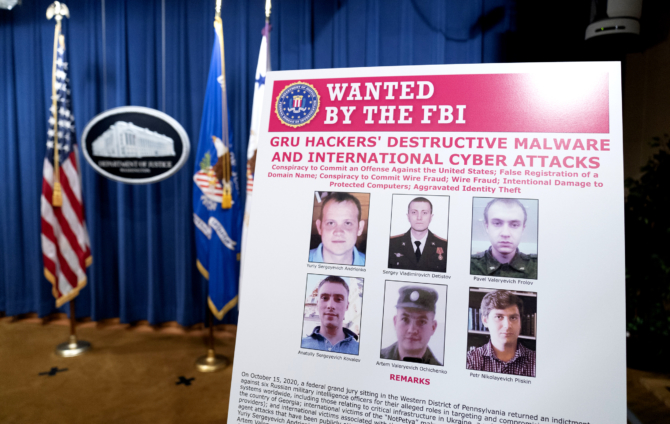
Mug shots of the men, aged between 27 and 35, were released on a poster with the words: "Wanted by the FBI".
The charging announcement came as Britain accused Russian cyber spies of attacking the 2020 Olympics and Paralympics before they were postponed, and of posing as Chinese and North Korean hackers to target the 2018 games.
Dominic Raab, the foreign secretary, described the actions of Russia's GRU military intelligence service as "cynical and reckless".
The UK named the specific group it said was behind the attacks as the GRU's Main Centre for Special Technologies, also known as Unit 74455.
This is the same group of hackers that allegedly targeted the 2016 US presidential election.
The US Justice Department said a federal grand jury in Pittsburgh returned an indictment charging six computer hackers, who are all allegedly members of Unit 74455.
It accused the hackers "and their co-conspirators" of cyber attacks, including against the UK's defence laboratory at Porton Down and the UN's chemical weapons watchdog in the Hague in April 2018, as both organisations investigated the poisoning of former Russian spy Sergei Skripal and his daughter Yulia in Salisbury.
The UK accused Russia of the nerve agent attack with a novichok toxin.
One of the six men; Anatoliy Sergeyevich Kovalev, 27 was specifically accused of having developed "spearphishing techniques and messages used to target... employees of the DSTL," referring to the UK's Defence Science and Technology Laboratory at Porton Down.
The US has charged six Russian hackers over a series of global cyber attacks, including trying to undermine UK efforts to hold Moscow accountable for the Salisbury spy poisoning https://t.co/0hDWIqdN51
— SkyNews (@SkyNews) October 19, 2020
The hackers were also charged with targeting the French presidential election in 2017. Then presidential candidate Emmanuel Macron's campaign was hit by a hack and leak attack just ahead of polling day.
In addition, on the list of charges was what is regarded as the world's most devastating cyber attack to-date - the NotPetya attack against Ukraine in June 2017.
The attack went viral, hitting companies globally, including in the United States and the UK, and inflicting some $10 billion in damage.
Other attacks linked to the group included against Georgia and the 2018 Pyeongchang Winter Olympic Games in South Korea.
Latest Stories
-
Elizabeth Ohene writes: Your lordship, justice must also be seen to be done
20 minutes -
Ghana Water to resume spillage at Weija Dam from Wednesday
30 minutes -
Agyarko ends 16-region tour, targets NPP parliamentary comeback in Greater Accra
37 minutes -
GIGS welcomes UN adoption of Equal Earth map as correction to ‘450 years of cartographic injustice’ against Africa
41 minutes -
‘October 3 is the only poll I believe in’ – Paul Afoko dismisses NPP chairmanship survey
2 hours -
Contractors who delay projects risk losing Big Push contracts – Agbodza
2 hours -
NPA uses Fetu Afahye to educate consumers on petroleum safety
2 hours -
Roads Minister orders contractors to keep working during official visits
2 hours -
New 4-year bond attracts GH¢4.46bn in bids
2 hours -
AIA VIP Lounge to be completed without taxpayer funds – Ablakwa
2 hours -
KEEA Assembly disburses GH¢267,518 to 94 PPCs in third quarter
2 hours -
GAF clears 175.6km corridor for Accra-Kumasi Expressway ahead of schedule
3 hours -
Dr Abu Sakara urges African youth to lead economic freedom
3 hours -
24-Hour Economy mobilises GH¢1bn for poultry value-chain transformation
3 hours -
From working in his room to building a business group – Michael Bartlett-Vanderpuye’s journey
3 hours