

Audio By Carbonatix
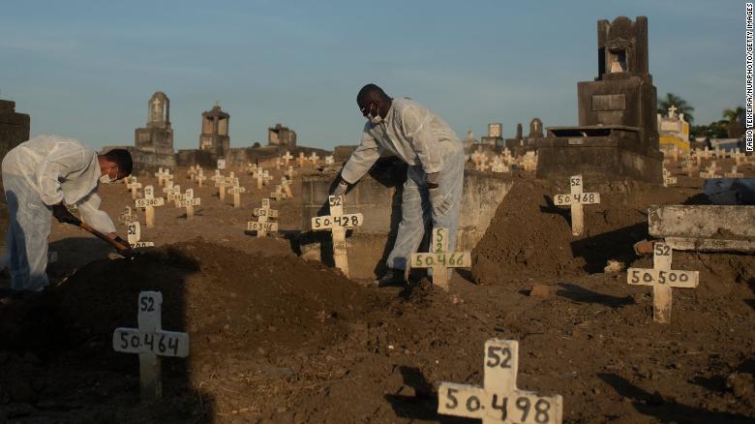
More than 4 million people around the world have died of Covid-19, according to data from Johns Hopkins University.
In total, three countries account for more than a third of all global deaths. The United States, which has the highest number of fatalities at 606,000, accounts for 15% of the global total, followed by Brazil and India.
The grim milestone, announced Wednesday, comes as new cases and deaths are dropping in the US and Europe, where significant numbers of residents have been vaccinated. But some developing countries, such as Indonesia, are still facing surging outbreaks, as authorities struggle to secure enough vaccines to protect citizens.
The Delta variant, a more transmissible and possibly more dangerous strain of coronavirus, is also contributing to an increase in cases in some countries and regions. In the US, the Delta variant now makes up more than half of all new infections, according to estimates from the US Centers for Disease Control and Prevention (CDC).
An average of 7,900 Covid-19 deaths were reported each day over the past week, according to JHU. That is 46% less than the global peak of more than 14,700 daily deaths in January, but 57% higher than the pace of about 5,000 daily deaths from this time last year.
The global death toll exceeded 1 million on September 18, 2020, 191 days after the World Health Organization declared the novel coronavirus outbreak a global pandemic. It took 115 days for the global death toll to hit 2 million, 88 days to surpass 3 million, and another 89 days to reach 4 million.
Given the difficulty in accurately tracking the spread of the virus especially in the developing world, many experts believe the global death toll is likely significantly higher than the officially reported number.
In a statement on Thursday, United Nations Secretary-General Antonio Guterres warned the pandemic is "far from over," warning of the emergence of more transmissible, more deadly variants that are more likely to undermine the effectiveness of current vaccines if the virus is allowed to continue to spread.
"Vaccines offer a ray of hope -- but most of the world is still in the shadows. The virus is outpacing vaccine distribution," he said, calling for a global plan to boost vaccine production, ensure equitable distribution and tackle vaccine hesitancy.
"To realize this plan, I am calling for an Emergency Task Force that brings together all the countries with vaccine production capacities, the World Health Organization, the global vaccine alliance GAVI and international financial institutions able to deal with the relevant pharmaceutical companies and manufacturers, and other key stakeholders," he said.
Latest Stories
-
PKO trio eye victories at Odwira Festival
12 minutes -
346 Ghana Navy recruits pass out after 26 weeks of intensive training
18 minutes -
Newsfile to discuss EOCO-MP arrest, drug trafficking, speech arrests and $235m water debt
46 minutes -
JoyNews gets results as listeners raise GH¢40,000 to help 17-year-old student with cerebral palsy attend SHS
1 hour -
Vice President calls for stronger local pharmaceutical production to reduce medicine imports
1 hour -
The brewing tension at KNUST; Beware the Ides of October….
2 hours -
Health Ministry moves to integrate traditional medicine into mainstream healthcare
2 hours -
550 pupils in Kintampo South get educational lifeline as ‘Seeds of Hope’ reaches farming communities
3 hours -
Opoku Mensah urges Christian Council, House of Chiefs to speak up on democratic freedoms
3 hours -
Teacher unions’ strike: Minority demands immediate payment of teacher arrears, 20% deprived area allowance
3 hours -
The Accra-Kumasi Expressway: Building it right
3 hours -
Beyond gold exports: Building value and economic resilience from Ghana’s gold
3 hours -
2027 AFCONQ: Ghana under pressure as Gambia beat Somalia 2-1
3 hours -
Eastern NPP Women’s Organiser calls on AG, Police to secure bail for Salomey Baffoe
4 hours -
Poverty, illiteracy driving acceptance of vote-buying among women – Damongo Queen Mother
4 hours