

Audio By Carbonatix
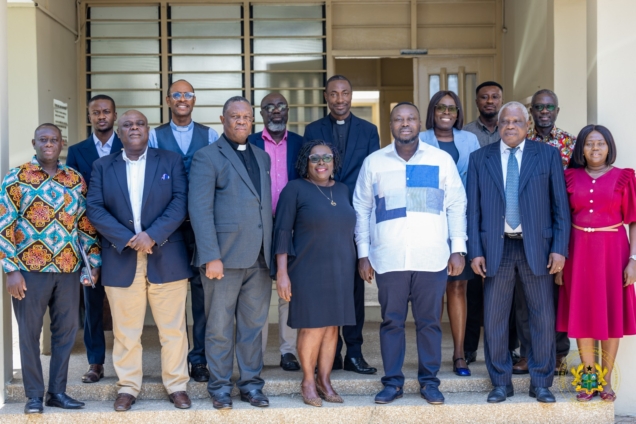
Minister of Youth Development and Empowerment, George Opare-Addo, has called on the Christian Council of Ghana (CCG) to collaborate with the Ministry to address the complex challenges confronting the nation’s youth.
He said the youth continued to grapple with mental health concerns, substance abuse, unemployment-related stress, sexual and reproductive health risks, digital addiction and growing social pressures.
Mr Opare-Addo noted that the CCG remained a major stakeholder in the development and empowerment of young people and emphasised that collaboration was essential in responding to emerging youth needs.
“Government cannot do it all. Beyond formal education, we must partner with you to train many more young people and equip them with the skills they require,” he said.
The Minister made the call during a working visit to the Council’s office at Osu in Accra.
He said the future of the country rested in the present generation of young people, and that investing in their health, character, leadership and community service would contribute to building a prosperous and morally grounded nation.
He described the church as one of the most trusted institutions in Ghana, capable of mobilising the youth towards peaceful civic engagement, tolerance, unity and responsible citizenship.
He urged the Council to partner with the Ministry in career mentorship in churches, digital literacy training, scholarship facilitation and apprenticeship support.
Mr Opare-Addo observed that many young people lacked employable skills and that the church could serve as a strong platform for training.
He mentioned the ongoing national apprenticeship programme and said the Ministry hoped to work with churches, including the Presbyterian Church, to convert existing centres into training hubs.
He said technology, artificial intelligence and digital skills had become central to global development, and Ghana must prepare its youth appropriately.
With the world expected to look to Africa for labour within the next decade, he said Ghana must position itself to take advantage of emerging opportunities.
He added that Ghana’s youth bulge could become a national asset if investments were made in their education, skills and leadership development.
“It has been the greatest honour of my life to serve the youth of this country, and I commit to ensuring that young Ghanaians achieve their aspirations,” he said.
General Secretary of the CCG, Rev Dr Cyril G.K. Fayose, said the Council had been organising skills training, sensitisation programmes on substance abuse, and anti-corruption education for young people across its member churches.
He said the Council would issue a circular to its member churches to mainstream the issues raised by the Ministry into their worship activities and youth programmes.
Latest Stories
-
GPRTU wants full TRAFFITECH-GH implementation to start in 2027
2 minutes -
Mahama announces plans to import electric wheelchairs for PWDs
6 minutes -
KGL U17 Colts 2026: Western beat Prempeh Elite Academy to set up final final with Greater Accra Region
24 minutes -
Late Solanke strike salvages 10-man Spurs draw at Man United
34 minutes -
Gender Ministry to monitor welfare of Nana Akua Addo’s children amid domestic violence case
41 minutes -
Benedict Okyere Yeboah: Ghana’s football problem goes beyond sacking a coach
50 minutes -
GPL 2026/27: Darkwah Wiafe’s winner sees All Blacks beat Kotoko
56 minutes -
ITF World Tour : Patel Wins Boys’ Singles Final at J100 Accra
1 hour -
Ghana must pursue BRICS partnership if it brings economic benefits – Kpebu
1 hour -
Success and Wright Claims J100 Accra Girls’ Doubles Championship
1 hour -
ITF J100: America’s Wright wins J100 Accra Girls’ Singles Title
1 hour -
Expedition hopes to find aviator Amelia Earhart’s plane on remote island
1 hour -
US seeks changes to rejected $109m health compact with Ghana – Mahama
2 hours -
Nine dead in mass shooting at Pennsylvania home
2 hours -
‘Time for Ukraine to get new president,’ says Trump after Zelensky condemns diesel deal
2 hours