

Audio By Carbonatix
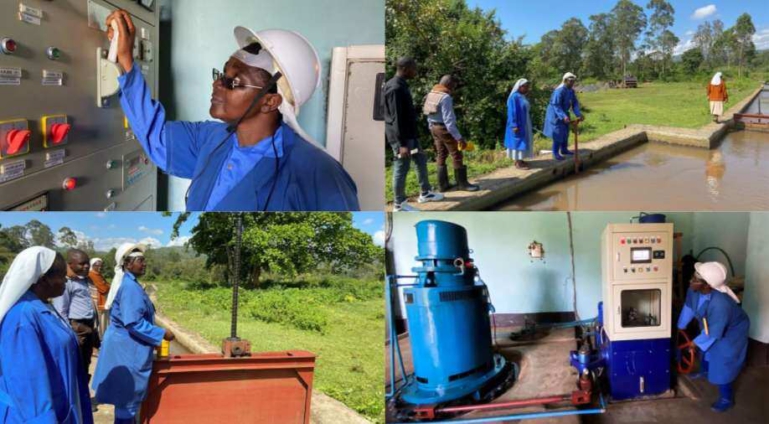
Sister Alphonsine Ciza spends most of her day in gumboots, white veil tucked under a builder's hat, manning the micro hydroelectric plant she built to overcome daily electricity cuts in her town of Miti in eastern Democratic Republic of Congo.
She works around the clock with a team of nuns and engineers, greasing machinery and checking the dials of a generator that is fed from a nearby reservoir.
The mini plant lights up a convent, church, two schools and a clinic free of charge.
Without the plant, residents would only have electricity two or three days a week for a few hours.
"This is the alternator that produces the current and here we have the cabinet that sends the current to the population. It's here that we make adjustments, it's called the electrical cabinet," said Ciza, 55, a portable voltage meter slung around her neck in the town of 300,000 inhabitants near the border with Rwanda.
Blackouts are a daily disruption in the Congo, a vast central African country of around 90 million people that sources most of its electricity from a run-down and mismanaged hydropower system.
The government has worked with foreign partners in an effort to increase the capacity of the mineral-rich nation's ailing grid. Critics say the new projects focus too much on powering mines and exporting electricity to neighbouring countries.
Despite millions of dollars in donor funding, only around 20 per cent of the population has access to electricity, according to the World Bank.
Fed up with relying on candlelight and costly fuel-powered generators, Ciza started raising money in 2015 to build the hydropower plant.
She picked up skills as a young nun, repairing electrical faults around the convent, which convinced superiors to send her to study mechanical engineering.
It took Ciza's convent three years to gather the required $297,000 (€284,897) and build the plant, which generates between 0.05 and 0.1 MW.
Thanks to Ciza's efforts, students at Miti's Maendeleo secondary school can now learn computer skills from screens rather than from books.
"It was rare to find power during the day. We had to use fuel for the generator, but buying fuel was very expensive. It was no longer possible at some point, so we were forced to stop and only teach theory for the computer science course," said headmistress Mweze Nsimire Gilberte.
Latest Stories
-
Catholic Bishops pressure gov’t to sign long-delayed mission schools agreement
1 hour -
Cedi under fresh pressure as Christmas import demand drives dollar surge
1 hour -
Ato Forson eyes first-week November for 2027 Budget, promises jobs and major infrastructure push
1 hour -
Catholic Bishops demand probe into ‘protocol admissions’ amid SHS placement challenges
2 hours -
SHS placement: Catholic Bishops demand probe into alleged payments for school places
2 hours -
Facts about Nigeria’s Dangote oil refinery Initial Public Offering
2 hours -
Trump says AI safety fears a ‘hoax’ as he rejects calls for greater safeguards
2 hours -
Oil climbs as Saudi pipeline outage, fresh attacks heighten supply concerns
3 hours -
Donald Trump Jr and Bettina Trump say Putin ally paid for some wedding festivities as a ‘gift’
3 hours -
Farouk Aliu Mahama supports medical student with GH¢10,000 donation
3 hours -
EU is set to propose ban on social media and AI chatbots for under-15s
3 hours -
No SHS space shortage – GES says 800,000 places available for just over 600,000 students
3 hours -
Emmys 2026: The winners and nominees in full
3 hours -
African banks’ foreign subsidiary contributions increasing; Access Bank records fastest cross-border growth
3 hours -
Food prices in Ghana remain largely stable – AGRA report
3 hours