


Audio By Carbonatix
Of the 28 African countries and territories tracked in the IQAir 2025 World Air Quality Report, only one, the French island territory of Réunion, recorded air quality clean enough to meet the World Health Organisation's annual guideline for fine particle pollution.
That guideline stands at 5 micrograms per cubic metre (µg/m³) for PM2.5, the tiny airborne particles, invisible to the naked eye, that penetrate deep into the lungs and bloodstream and are linked to heart disease, stroke, cancer and premature death. Réunion recorded 4.3 µg/m³. Every other country on the African continent recorded concentrations above that threshold, and most recorded levels many times higher.
At the other end of the scale, Chad recorded the continent's worst air quality at 53.6 µg/m³, more than ten times the WHO limit, followed by the Democratic Republic of Congo at 50.2 µg/m³. Uganda ranked third at 43.0 µg/m³, with Egypt fourth at 40.6 µg/m³ and Rwanda fifth at 34.5 µg/m³.
Chad has ranked as Africa's most polluted country in every year it has appeared in the IQAir report. Its peak was recorded in 2024 at 91.8 µg/m³, nearly 18 times the WHO guideline. The 2025 figure of 53.6 µg/m³ represents a sharp drop on paper, but IQAir urges caution in interpreting it. The decline coincides with the loss of monitoring data from US Embassy and Consulate locations, which ceased public reporting in March 2025 and served as a primary data source for many cities across the continent. In Chad's case, the apparent improvement likely reflects missing data rather than cleaner air.
DR Congo's 50.2 µg/m³ tells a similar story of entrenched pollution in one of the continent's most densely populated urban centres. Kinshasa, the country's sprawling capital, did record a notable improvement, PM2.5 levels fell nearly 14%, but the city's annual average of 50.2 µg/m³ still places it among the most polluted urban environments on earth.
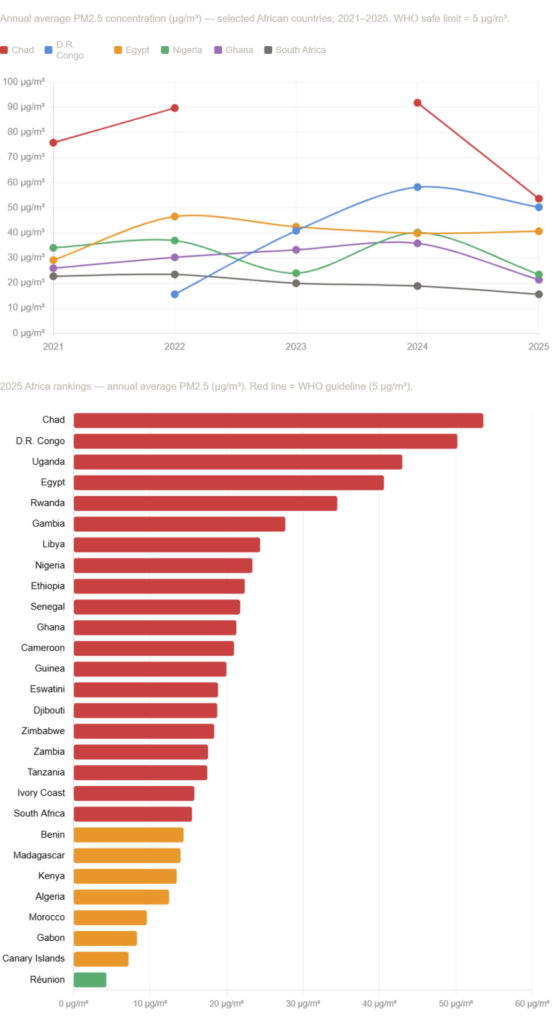
West Africa features prominently across the report's rankings. The Gambia ranked sixth at 27.7 µg/m³, Nigeria eighth at 23.4 µg/m³, Senegal tenth at 21.8 µg/m³ and Ghana 11th at 21.3 µg/m³.
For Ghana, the 2025 figure marks its best performance and lowest reading in five years of IQAir data. The country recorded 25.9 µg/m³ in 2021, 30.2 in 2022, 33.2 in 2023 and 35.8 in 2024, a worsening trend that has now reversed. The improvement drops Ghana from 8th to 11th on the continent. Its 21.3 µg/m³ average, however, remains more than four times the WHO safe limit, meaning the air most Ghanaians breathe every day still poses a measurable risk to their health.
Nigeria's improvement is also notable, it ranked 6th in Africa in 2024 with a reading of 40.1 µg/m³, a level that placed it in the same bracket as the continent's worst polluters. Its 2025 reading of 23.4 µg/m³ represents a significant drop, though its position as one of the continent's most populous countries means the health stakes remain enormous.
The three territories with the cleanest air in Africa are all islands or island groups sitting far from the continent's industrial heartland. Réunion, a French overseas territory in the Indian Ocean, recorded 4.3 µg/m³, the only African territory to meet the WHO guideline. The Canary Islands, a Spanish archipelago off the northwest African coast, recorded 7.2 µg/m³, and Gabon on the central African coast came in at 8.3 µg/m³. Morocco (9.6 µg/m³) and Algeria (12.5 µg/m³) round out the five cleanest-air nations.
One of the most important findings in the Africa section of the report is about the ability to measure the pollution. Africa's 463 air quality monitoring stations account for roughly 1% of all stations contributing to the global report. Without adequate monitoring, governments cannot know the true scale of the problem, let alone act on it.
There are early signs of progress. The Gambia nearly doubled its monitoring capacity this year with the addition of 11 new stations. Ghana's new Air Quality Management Regulation, enacted in 2025, was highlighted by IQAir as a legal model for the region, introducing mandatory reporting requirements and a centralised data system. Nairobi leads the continent in the number of monitors providing publicly accessible data, and concentrated urban networks in Addis Ababa and Kigali are expanding.
Despite these gains, 12 African countries still rely exclusively on low-cost sensors, and in South Africa, technical and maintenance failures left only one-third of the national monitoring network operational in July 2025.
A five-year view of the data reveals several important patterns. Chad's trajectory is one of persistent, extreme pollution; its readings in 2022 (89.7 µg/m³) and 2024 (91.8 µg/m³) are among the highest ever recorded for any African country in the IQAir series. Ghana's numbers moved steadily in the wrong direction between 2021 and 2024, making the 2025 reversal more significant, though the causes of that improvement, whether policy, weather, monitoring changes, or a combination, require further investigation. Egypt has remained stubbornly in the top five for the entire period, driven by vehicle emissions, desert dust and industrial activity in the Nile Delta.
Across the continent, the overarching message is the same year after year: the air that hundreds of millions of Africans breathe every day exceeds levels the world's leading health authority, WHO considers safe.
This story was a collaboration with New Narratives. Funding was provided by the Clean Air Fund which had no say in the story’s content.
Latest Stories
-
Ho set to host Republic Bank–JoyNews Habitat Fair as multiple firms prepare to showcase housing solutions
7 minutes -
NPP demands public inquiry into alleged $600,000 World Cup visa fraud, wants Sports Minister, GTA CEO summoned
14 minutes -
I want my brand to be bigger than just music – Yaw Wazinga
17 minutes -
Houthi missile attack on Yemeni presidential palace kills two, minister says
18 minutes -
I hoped to win an award; I worked hard – 2026 Best Graduating Law Student
27 minutes -
Fraudsters increasingly target bank customers instead of banking systems – Fraud detection expert
28 minutes -
44 teacher sexual abuse cases tracked since 2015; school heads feature in 40% of recent cases — JoyNews Research
31 minutes -
Unchecked imports and the Middle East crisis threaten Ghana’s fragile food inflation anchor
50 minutes -
Ecobank Junior Saver Big Pitch to reward 10 winners with GH¢2,000 each
54 minutes -
AMA demolishes unauthorised pigsty obstructing Agbogbloshie waste evacuation exercise
54 minutes -
I was filled with disbelief – Akosua Achia Sarpong Esq. shares her first reaction
55 minutes -
Snake Village: A look at Volta Region’s hidden snake village and its tourism potential (Video)
1 hour -
Election Watch Ghana calls for constitutional reforms to strengthen Electoral Commission independence
1 hour -
NACOC, Postal and Courier Services Regulatory Commission intensify efforts to curb drug trafficking
1 hour -
Ga Mantse chairs committee to drive Accra Green and Clean City Initiative
1 hour