

Audio By Carbonatix
They called it African innocence. It was a protest Fifty-two years later, the Leopards are back.
In 1974, Zaire went to the World Cup and became a global joke. The world saw chaos and naivety.
The truth was darker.
In 2026, DR Congo, previously known as Zaire, will return as the tenth African nation at a single World Cup, the most ever.
On June 18, 1974, at the Parkstadion in Gelsenkirchen, Brazil were awarded a free kick from 25 yards out. Roberto Rivellino, one of the greatest dead-ball specialists in football history, was prepared to take it. Before he could, a Zaire defender named Mwepu Ilunga sprinted out of the defensive wall and kicked the ball as hard as he could upfield.
The world laughed. BBC commentator John Motson called it a bizarre moment of African innocence. For decades, it became shorthand for African football’s supposed incompetence proof, to those who wanted proof that Sub-Saharan Africa did not belong on the world stage.
Ilunga knew the rules perfectly. He was trying to get sent off. He explained this in a 2002 interview, 28 years after the fact. He was not naïve. He was protesting the only way available to a footballer on a pitch with a referee watching.
The players had arrived in West Germany to discover that Mobutu’s government entourage had drained their entire wage-and-bonus fund before the tournament began. They were playing for a dictator who had promised them cars and houses and then threatened them with punishment when they lost.
The free kick incident was not innocence. It was the only act of defiance a man in that situation could make.
The world remembered the wrong story for fifty-two years.
The world remembered humiliation. The scoreline, the disarray, the caricatured naivety of that team became the global byword for DRC football. Ghosts can follow sports teams.
What actually happened in 1974
Zaire (now DR Congo) arrived at the 1974 World Cup as the reigning African champions, having won the AFCON just three months earlier, in March 1974. Mobutu Sese Seko had invested heavily in the national team as a vehicle for national prestige. Each player had been promised a house, a car, and free holidays.
Mobutu also sent a government entourage to West Germany, which drained the players’ entire wage-and-bonus fund before the tournament began. The players discovered mid-tournament that they would not be paid. Mobutu then threatened punishment if they lost.
They lost 9-0 to Yugoslavia (now divided into Bosnia and Herzegovina, Croatia, Montenegro, North Macedonia, Serbia, and Slovenia), 2-0 to Scotland, and 3-0 to Brazil.
Pierre Ndaye Mulamba, the man who had scored nine goals to win the AFCON Golden Boot three months earlier, returned to poverty without institutional support. The team came home not on the presidential plane that had flown them to Germany but on an empty army truck.
That is the history DR Congo carries into 2026.
Fifty-two years
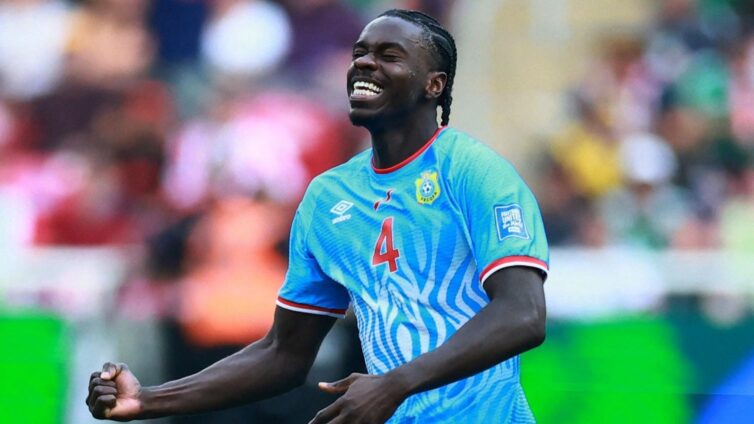
The country became Zaire under Mobutu. Then, in 1997, after Mobutu fell, it became known as the Democratic Republic of the Congo. The football team was rebranded. The strip changed from green to blue. But the ghost of 1974 did not change with the name or the colours.
Every failed qualification, every thwarted AFCON campaign, every near miss added weight to a first impression that had been made in the worst possible circumstances and never corrected.
The wait lasted fifty-two years. In March 2026, at the Estadio Akron in Guadalajara, Mexico, Axel Tuanzebe tapped home in extra time to beat Jamaica 1-0 in the intercontinental playoff.
DR Congo was going to the World Cup. The country declared a public holiday. In Kinshasa, in streets named after the independence struggle, people who had never seen their national team at a World Cup celebrated something their parents had only seen end in humiliation.
Tuanzebe was born in Bunia, DR Congo, and moved to England at the age of four when his family fled the civil war. He grew up in Rochdale, went through Manchester United’s academy, represented England at under-19, under-20, and under-21 levels, and then chose to play for DR Congo.
The country he had left as a child. That choice is one of the defining features of this squad. Coach Sébastien Desabre, a Frenchman who has coached in eight African countries and been in African football for over two decades, has built a team from the diaspora in Belgium, France, and Switzerland alongside players who have never left Kinshasa.
Some speak Lingala fluently.
Some have never set foot in the country. What connects them is the choice to represent it.
Africa’s tenth nation and what it means
DR Congo is the tenth African nation to qualify for the 2026 World Cup. Ten. The tournament’s expansion to 48 teams gave Africa nine guaranteed spots plus the intercontinental playoff berth that DRC won. Africa's first 10-team World Cup contingent.
The significance of that number goes beyond football. For decades, the argument against African football was institutional. The governing bodies were corrupt, the infrastructure was poor, the players were talented, but the systems around them were not. Morocco’s 2022 semi-final run began to answer that argument.
Nine African nations qualifying directly for 2026 confirms it. The continent is not sending a token representation to a tournament hosted by others. It is sending 10 competitive nations, several of whom, including Morocco, Senegal, Algeria, Egypt, and Ghana, have genuine knockout-stage ambitions.
DRC’s path to qualification tells its own story. They beat Cameroon and Nigeria in the second round of African qualifying, two of the continent’s most historically significant football nations.
Then they beat Jamaica in the intercontinental playoff. They qualified the hard way, through a gauntlet that eliminated sides with far longer World Cup pedigrees.
DR Congo 2026 World Cup
Second World Cup appearance. First, since 1974, 52 years. Beat Cameroon, Nigeria, and Jamaica to qualify.
Group K: Portugal, Colombia, Uzbekistan, DR Congo. Africa’s 10th nation at 2026, the most African nations ever at a single World Cup. Coach: Sébastien Desabre.
Group K: Portugal, Colombia, Uzbekistan
DR Congo is in Group K alongside Portugal, Colombia, and Uzbekistan. Portugal's Cristiano Ronaldo, the group’s dominant force, is in this final World Cup. Colombia, with James Rodríguez orchestrating and a generation of technically gifted players, is the second seed. Uzbekistan is making its World Cup debut.
Desabre’s approach is tactical adaptability over fixed identity. He prioritizes organization, compactness, and the ability to hurt teams on the transition. The spine of his side is built around Chancel Mbemba, the Lille center-back and captain, whose physicality and leadership anchor the defense.
In attack, Cédric Bakambu, 67 caps, 21 goals for Congo, born in France, who chose Congo in 2015, is the focal point. Behind them, Yoane Wissa of Newcastle provides explosive pace and directness from wide areas.
Portugal will present their biggest test. Ronaldo at 41, Bruno Fernandes controlling the midfield, Rúben Dias in defense, a team with enormous individual quality but an aging core that has not won a tournament in a decade. Colombia is technically more dangerous but more beatable. Uzbekistan, in their debut, are DRC’s most achievable three points.
The path to the knockout rounds is narrow, but it exists. Win against Uzbekistan. Take something from Colombia. That is how African outsiders survive group stages. That is also what DRC did against Nigeria and Cameroon in qualifying; they won the matches they needed to win and scrapped for everything else.
Mwepu Ilunga kicked that ball in 1974 as an act of protest against conditions no footballer should have faced. The world called it innocence for twenty-eight years until he explained otherwise.
DR Congo go to the 2026 World Cup as the tenth African nation at a single tournament, more than have ever gone before, with a squad built on choice, a coach built on commitment, and a country that declared a public holiday when Tuanzebe’s shot crossed the line in Guadalajara. The ghost from 1974 wore green. This team wears blue.
Latest Stories
-
Unchecked imports and the Middle East crisis threaten Ghana’s fragile food inflation anchor
15 minutes -
Ecobank Junior Saver Big Pitch to reward 10 winners with GH¢2,000 each
19 minutes -
AMA demolishes unauthorised pigsty obstructing Agbogbloshie waste evacuation exercise
19 minutes -
I was filled with disbelief – Akosua Achia Sarpong Esq. shares her first reaction
20 minutes -
Snake Village: A look at Volta Region’s hidden snake village and its tourism potential (Video)
27 minutes -
Election Watch Ghana calls for constitutional reforms to strengthen Electoral Commission independence
30 minutes -
NACOC, Postal and Courier Services Regulatory Commission intensify efforts to curb drug trafficking
31 minutes -
Ga Mantse chairs committee to drive Accra Green and Clean City Initiative
33 minutes -
Drivers threaten to remove traders from lorry stations over TrafficTech concerns
36 minutes -
AI could create 10 to 20 times more jobs despite current recruitment slowdown – Hubtel CEO
38 minutes -
Sexual abuse in schools persists because perpetrators are not held accountable – Dr Nyarkoa
46 minutes -
Chief Justice has designated Achimota Court to handle petroleum diversion cases – NPA CEO
49 minutes -
Philip Nai and friends gear up for bigger seventh Christmas outreach
50 minutes -
GSA strengthens electricity meter testing to protect consumers and improve energy reliability
51 minutes -
‘Dismissed or suspended? Ghanaians deserve clarity’ – NPP demands clarity on Ampofo Ankrah’s fate
55 minutes