

Audio By Carbonatix
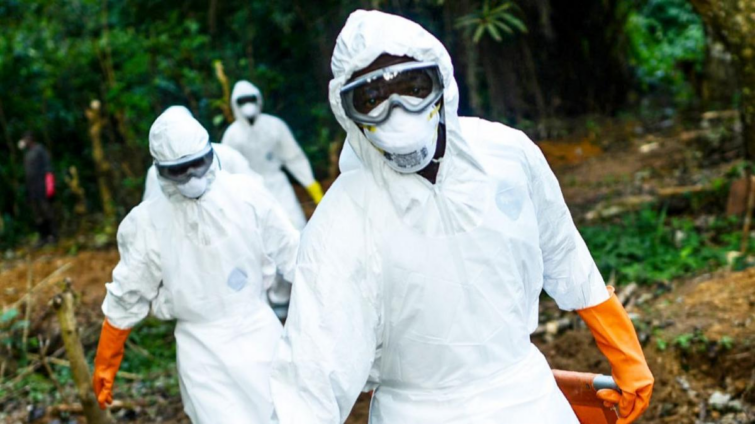
Global health organisation CEPI will give roughly $60 million to Moderna and two other groups to accelerate the development of shots against Ebola Bundibugyo, the deadly virus that has swept through eastern Democratic Republic of Congo.
The Coalition for Epidemic Preparedness Innovations was one of the early investors that helped to develop a vaccine at the height of the COVID-19 pandemic.
Richard Hatchett, head of CEPI, told Reuters on Monday it was possible to get Ebola Bundibugyo (BDBV) vaccines ready for trials within a couple of months.
There are currently no approved BDBV vaccines or treatments.
Hatchett said the promise of vaccines on "a not infinitely distant horizon" should help start conversations about who would buy them and fund any rollout.
But he cautioned that vaccine development can be unpredictable, and the challenging security situation in eastern Congo would complicate trials.
There have been 282 confirmed cases in Congo, including 42 deaths, and around 1,100 suspected cases, according to the Africa Centres for Disease Control and Prevention and the World Health Organisation.
Another nine cases have been confirmed in Uganda, including one death.
Global health agencies have declared the outbreak a public health emergency.
EARLY CLINICAL TESTING OF MODERNA VACCINE CANDIDATE
CEPI has committed up to $50 million to support preclinical and early clinical development of Moderna's investigational BDBV vaccine candidate.
The funding would also support manufacturing and progression to later-stage trials if early data are positive, Moderna said.
"We have worked on Ebola in preclinical models showing great results," Moderna Chief Executive Stephane Bancel said in a telephone interview.
Given the lethality of Ebola, the aim would be to create a vaccine that prevents disease while attempting to simplify the dosing strategy, he said.
At this point, it's not clear whether the vaccine could be given in one or two doses. That would be ironed out in the phase 1 trial before moving into larger trials, which he said would need to be done in Africa.
"Our goal is to move as fast as we can without compromising safety, and to be as helpful as we can," he said.
CEPI said it would also invest up to $8.6 million for a shot developed by the University of Oxford and manufactured by the Serum Institute of India, and an initial $3.2 million for a vaccine developed by the International AIDS Vaccine Initiative.
IAVI's single-dose Bundibugyo vaccine candidate uses the same technology as Merck's approved vaccine, Ervebo, for the Zaire strain, the first strain of Ebola to be discovered in what was then Zaire and is now the Democratic Republic of Congo.
It has shown survival benefit in animal studies.
IAVI CEO Mark Feinberg said in a press briefing it remains unclear which partners would be responsible for organising or conducting clinical trials for the vaccine candidate.
He noted that multiple studies were carried out during the 2014-2016 West African Ebola outbreak, backed by U.S. agencies and the World Health Organisation.
"We understand from the WHO more recently that they won't be assuming that role in the future," Feinberg said, adding it would require "tens of millions of dollars until we're in a position to enter the clinic".
The WHO did not immediately clarify its stance on sponsoring or conducting trials.
Oxford's candidate, ChAdOx1 Bundibugyo, uses the same technology as the Oxford/AstraZeneca COVID-19 vaccine.
Hatchett said Oxford and Serum had demonstrated in a different outbreak last year - Rift Valley Fever in Mauritania and Senegal - that they could make doses ready for trial in around six weeks, far quicker than typical timescales that have in the past run to years.
Once a vaccine is developed, Hatchett said the next challenge was ensuring access to the shots where they are needed.
He said 300,000 doses of Ervebo were needed to bring the 2018-2020 Ebola Zaire outbreak under control in a similar region of Congo.
Separately, global vaccine alliance Gavi on Friday committed up to $50 million to the Ebola response, and the World Bank's Pandemic Fund announced up to $220.6 million in grants.
Latest Stories
-
Conflicts among care providers linked to maternal, neonatal deaths – Expert
34 minutes -
GIS marks 10th TIME conference, champions improved teaching practices
42 minutes -
BRICS Or Balance? What Ghana’s bid really means
1 hour -
GPRTU wants full TRAFFITECH-GH implementation to start in 2027
1 hour -
Mahama announces plans to import electric wheelchairs for PWDs
2 hours -
KGL U17 Colts 2026: Western beat Prempeh Elite Academy to set up final final with Greater Accra Region
2 hours -
Late Solanke strike salvages 10-man Spurs draw at Man United
2 hours -
Gender Ministry to monitor welfare of Nana Akua Addo’s children amid domestic violence case
2 hours -
Benedict Okyere Yeboah: Ghana’s football problem goes beyond sacking a coach
2 hours -
GPL 2026/27: Darkwah Wiafe’s winner sees All Blacks beat Kotoko
2 hours -
ITF World Tour : Patel Wins Boys’ Singles Final at J100 Accra
3 hours -
Ghana must pursue BRICS partnership if it brings economic benefits – Kpebu
3 hours -
Success and Wright Claims J100 Accra Girls’ Doubles Championship
3 hours -
ITF J100: America’s Wright wins J100 Accra Girls’ Singles Title
3 hours -
Expedition hopes to find aviator Amelia Earhart’s plane on remote island
3 hours