

Audio By Carbonatix
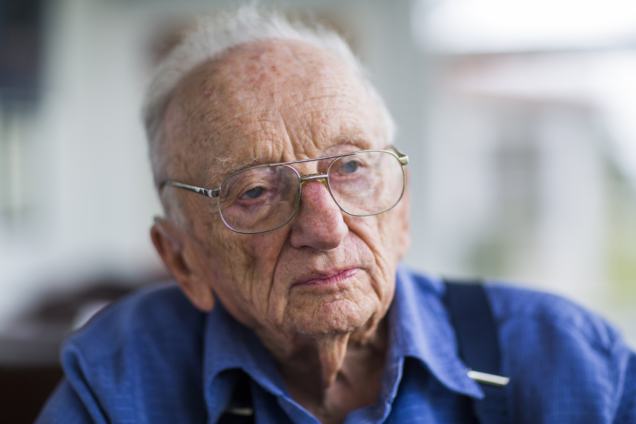
The last surviving prosecutor from the post-World War Two Nuremberg trials has died aged 103.
Ben Ferencz was just 27 when he secured the convictions of 22 Nazi officers for war crimes and crimes against humanity.
He later advocated for the establishment of an international court to prosecute war crimes, a goal realised in 2002.
Ferencz died peacefully in his sleep on Friday evening at an assisted living facility in Boynton Beach, Florida.
Confirming his death, the US Holocaust Museum said the world had lost "a leader in the quest for justice for victims of genocide".
Ferencz was born in Transylvania - part of Romania - in 1920, but his family emigrated to the US when he was young to escape antisemitism, later settling in New York.
After graduating from Harvard Law School in 1943, he enlisted in the US Army and took part in the Allied landings at Normandy and the Battle of the Bulge. He rose to the rank of Sergeant and ultimately joined a team tasked with investigating and gathering evidence of Nazi war crimes.
The team was based with the army in Germany and would enter concentration camps as they were liberated, taking notes on conditions in each and interviewing survivors.
In a later account of his life, Ferencz spoke of finding bodies "piled up like cordwood" and "helpless skeletons with diarrhoea, dysentery, typhus, TB, pneumonia, and other ailments, retching in their louse-ridden bunks or on the ground with only their pathetic eyes pleading for help".
He described Buchenwald - one of the largest camps inside Germany - as a "charnel house of indescribable horrors".
"There is no doubt that I was indelibly traumatised by my experiences as a war crimes investigator of Nazi extermination centres," he wrote. "I still try not to talk or think about the details."
After the war, he returned to New York to practice law, but shortly afterwards was recruited to help prosecute Nazis at the Nuremberg trials, despite having no prior trial experience.
He was made chief prosecutor at the trial of members of the Einsatzgruppen, mobile SS death squads that operated within Nazi-occupied Eastern Europe and are estimated to have murdered more than a million people.
Of the 22 men on trial, all were convicted, with 13 of them receiving death sentences and four ultimately being executed.
After the trials ended, Ferencz - who was fluent in six languages, including German - remained in West Germany and helped Jewish groups obtain a reparations settlement from the new government.
In his later years, he became a professor of international law and campaigned for an international court that could prosecute the leaders of governments found to have committed war crimes, writing several books on the subject.
In 2002, the International Criminal Court was set up in The Hague, Netherlands, although its effectiveness has been limited by the refusal of several major countries, including the US, to take part.
Ferencz is survived by a son and three daughters. His wife - childhood sweetheart Gertrude Fried - died in 2019.
Latest Stories
-
Credit Unions encouraged to use technology to improve service
1 minute -
GBA President calls for reasonable, proportionate bail conditions
6 minutes -
NAGRAT calls for end to political influence on WAEC results
9 minutes -
GBA to announce position on Tribunals Law soon – GBA President
9 minutes -
WAFU B U-17 Girls Cup: Joe Nana Adarkwa eyes title defence with Black Maidens
11 minutes -
GFA opens disciplinary case against GoldStars CEO Kwasi Adu
11 minutes -
Education Ministry welcomes Catholic Bishops’ call for CSSPS review
14 minutes -
2026 Women’s Super Cup set for September 23 to September 29 in Prampram
23 minutes -
Rennes register Ghana defender Alidu Seidu for Europa League amid Nice interest
28 minutes -
Deliberate VAT evasion will attract penalties — GRA
30 minutes -
If the Ghana Premier League is financially weak and structurally fragile, Africa will expose its weaknesses
42 minutes -
Accra-Kumasi Expressway: 48 Engineer Regiment can deliver if well resourced – Political Lecturer
56 minutes -
Businesses above GH¢750,000 turnover must register for VAT – GRA
60 minutes -
Kenya confirmed hosts of World Athletics Championships 2029
1 hour -
No more pothole ambulance rides: Mahama’s roads will change lives – Agbodza tells Upper West farmers
2 hours