


Audio By Carbonatix
The Lead Consultant for Konfidant, a globally oriented, Africa-region-focused advisory firm, Micheal Kottoh says party manifestos should be banned if Ghana wants to develop to the level of first-world countries.
According to him, the current political system that allows presidential aspirants to compete on their own ideas, for the best idea to emerge as victorious, is not pushing the country into development.
He said a common manifesto would propel the country into economic stability and infrastructural development.
“The only way we can have a common manifesto for a common future is to ban party manifesto. Let's ban them [party manifestos]. I hear time and again that a lot of Ghanaians are frustrated about why we cannot have a national development plan and stick to it.
“We keep referring to Malaysia, Singapore, and the Chinese and we know that this has been a very fundamental part of their transformation. There is no way we can have a common national development plan and stick to it if we keep having party manifestos. It is not possible. There is a contradiction there. So if we want a common manifesto that will translate into a common development plan, I say ban the party manifestos,” he said.
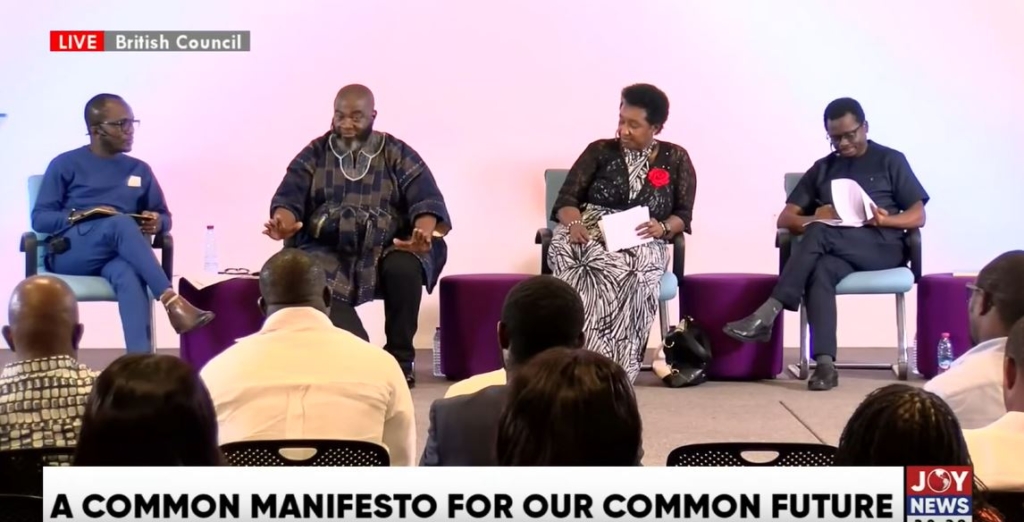
He made these comments while contributing to a public lecture dubbed, 'A Common Manifesto for our Common Future' on Tuesday, November 28.
Mr Kottoh explained that when the era of manifestos ends, the country can then assess the presidential candidates on who is the best person to achieve the national ‘Key Performance Indicators (KPI).’
He said the current political system creates the picture where employees [politicians] are assessed on their own marking scheme [manifestos]. He said KPIs would help the populace determine whether to retain or sack them.
To achieve the necessary impact, Mr Kottoh suggested that with these KPIs, the citizenry agrees on some non-negotiable terms in the common manifesto.
He stressed that when this happens, the country will move towards the desired development.
But David Ofosu-Dorte, Executive Chairman of AB and David Africa who was the guest speaker at the lecture, said instead of banning manifestos, the citizenry must rather drive what goes into the manifestos of the parties to bring about the desired development.

He, however, said his analysis of manifestos churned out by Ghana’s two main political parties since 1992, shows that the real issues of importance to national development are often not captured.
According to him, his analysis also established that the two main parties usually say the same things in their manifestos except for the wording of the pointers that differ.
But David Ofosu-Dorte, Executive Chairman of AB and David Africa who was the guest speaker at the lecture, said instead of banning manifestos, the citizenry must rather drive what goes into the manifestos of the parties to bring about the desired development.
He, however, said his analysis of manifestos churned out by Ghana’s two main political parties since 1992, shows that the real issues of importance to national development are often not captured.
According to him, his analysis also established that the two main parties usually say the same things in their manifestos except for the wording of the pointers that differ.
The interesting thing is that none of these manifestos seems to focus on the soft points without which the manifestos cannot thrive. For example, the manifestos make copious provisions for security. But what is security in an undisciplined society? If the society is undisciplined there cannot be security; it doesn’t matter how many plans you make” he argued.
After pointing out several other examples of the similarities in manifesto promises for various sectors of the economy, David Ofosu-Dorte concluded that “The real problem, therefore, is not what the manifestos say, it is rather what the manifestos don’t say. Because the manifestos in my view, are silent on very important issues which form the real foundation. It’s either they’re completely silent on them or do not address them adequately.
Watch below the full lecture:
Latest Stories
-
Pop star Madison Beer and NFL player Justin Herbert announce engagement
35 minutes -
‘Don’t wait until you want revenge’ – why prenups are on the rise
38 minutes -
Burnham has no scope to increase borrowing, think tank warns
49 minutes -
eBay agrees $56m settlement with bloggers over harassment case
1 hour -
Rodri out for ‘short period’ after back surgery
1 hour -
Villa offer glimpse into future despite friendly loss
1 hour -
Savinho open to leaving Man City amid Spurs interest
1 hour -
Okomfo Anokye SHS ends two-year NSMQ exile with dramatic final-riddle victory
2 hours -
Uefa and PM criticise Infantino World Cup plan
2 hours -
Nsutaman Catholic SHS stuns KNUST SHS on home turf to book 2026 NSMQ spot
2 hours -
Only use VAR when error blatant – Referee chiefs
2 hours -
Gideon Boako labels cross-border VAT a ‘social media tax’, warns of double taxation on online purchases
2 hours -
Ghana’s power sector reforms target financial stability; government moves to clear IPP payment gaps
2 hours -
E-filing, electronic service to become new norm in Ghana’s courts from October – Chief Justice
2 hours -
Wontumi challenges conviction, files appeal against High Court judgment
2 hours