

Audio By Carbonatix
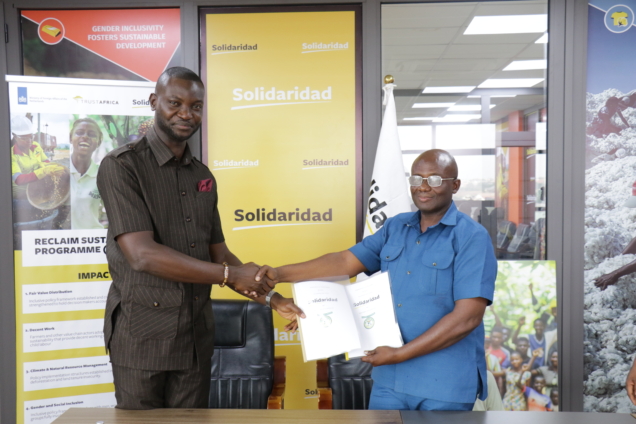
Solidaridad has partnered with the Department of Co-operatives in Ghana to facilitate the establishment of a robust regional and national cooperative association to increase the participation of cocoa farmers in decision-making.
The partnership was formalised with the signing of a Memorandum of Understanding at a brief ceremony on January 24, 2024, at Solidaridad's office in Accra.
Cocoa farmers’ cooperatives in Ghana face significant challenges due to the absence of a legally recognised, national unified front. This lack of representation often leads to formulating policies that don't align with farmers' needs, hindering sustainable cocoa production efforts.
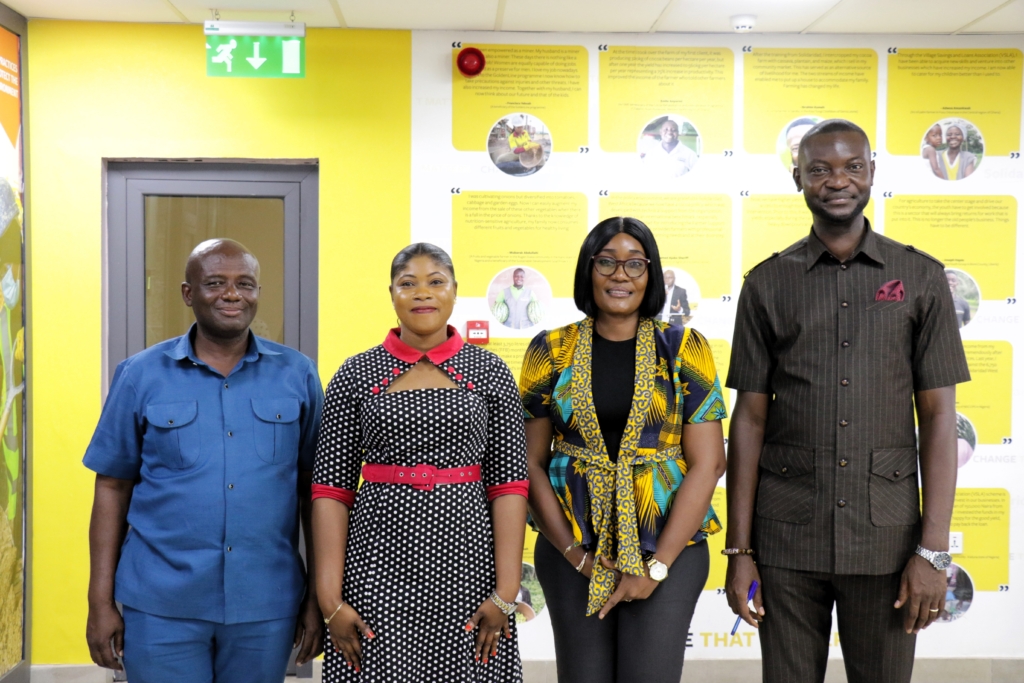
Key roles of both parties under the new partnership
Under the partnership, Solidaridad will enhance the capacity of cooperatives and associations on cocoa sector policies, as well as support the implementation of advocacy actions and the development of advocacy campaigns.
Bossman Owusu, Country Representative for Solidaridad in Ghana, said "We are dedicated to supporting the capacity agenda, to enable farmers to participate in decision-making processes actively."
He emphasised the organization's commitment to empowering farmers.
The Department of Co-operatives, on the other hand, will ensure the registration and regulation of the cocoa cooperative association, provide training in policies and governance, and maintain a database for registered cooperative unions.
Kwabena Apraku Yeboah, Acting Registrar for the Department of Co-operatives, expressed gratitude for Solidaridad's support and affirmed the department’s dedication to strengthening cocoa cooperatives in Ghana through effective collaboration.
Mobilising for change
The partnership is under Solidaridad’s RECLAIM Sustainability! programme and forms part of efforts to strengthen civil society organizations, workers and cooperatives to dialogue with public and private decision-makers and monitor implementations of mechanisms that ensure gender and social inclusion in the value chain.
Over the past two years, the programme has been actively working to enhance the capacity of cocoa cooperative unions on sector regulations. So far, 83 cocoa cooperative unions have been mobilized and strengthened, for the formation of a national cooperative association. The co-operatives have also been enabled to actively engage in advocating for their interests.
Humphrey Ayisi, former president of the Fanteakwa Co-operative Union, shared how Solidaridad’s support has been instrumental in developing cooperatives.
“Our engagements with Solidaridad have brought about a significant improvement in our operations as a cooperative. Last year with support from Solidaridad, the Fanteakwa Co-operative union, together with other cocoa farmers' cooperative unions in the Eastern Region of Ghana, successfully submitted a petition to the Commission on Human Rights and Administrative Justice (CHRAJ) and relevant government institutions to put an end to surface mining in the region,” he said.
Also present at the ceremony were representatives from Suhum KCC Cocoa Farmers Cooperative Union, Sefwi Bekwai Cocoa Farmers Cooperative Union, Baakoye Cocoa Farmers Cooperative Union, Fanteakwa Cocoa Farmers Cooperative Union and World Cocoa Farmers Organization (WCFO).
About the RECLAIM Sustainability! Programme
The RECLAIM Sustainability! (RS!) programme is implemented by six Solidaridad Regional Expertise Centres (REC) and three external consortium partners with funding from the Dutch Ministry of Foreign Affairs. In West Africa, the five (5) year programme is implemented in Ghana, Cote d’Ivoire and Sierra Leone. The programme seeks to promote an inclusive, sustainable trade and value chain in which the interests, voices and rights of farmers, workers and citizens are represented and heard in decision-making.
This will be achieved by supporting cocoa, oil palm farmers and mining companies/organizations to adopt and implement frameworks, models and norms that ensure sustainable sourcing, trade and investment.
Also, the strengthening of civil society organisations, workers and cooperatives to dialogue with public and private decision-makers and monitor implementations of mechanisms that ensure gender and social inclusion in the value chain.
Finally, supporting public institutions to collaborate with the private sector to develop and implement frameworks and systems that ensure sustainable production, trade and consumption
Latest Stories
-
NSMQ 2026: Kpando SHS brush aside Abor, Jukwa to storm One-Eighth stage with 32 point gap
1 hour -
Duncan Amoah: Gov’t should create conditions for 24-hour economy, not build markets
1 hour -
JoyNews-Republic Bank Habitat Fair finale turns homeownership dreams into real possibilities
2 hours -
Bamiri chief commissions KG block, guest house to boost education and revenue
2 hours -
NSMQ 2026: Yaa Asantewaa Girls’ going ‘beck’ to Tanoso after Bishop Herman deals them early exit
3 hours -
Data Protection Commission acquires two vehicles to strengthen data protection enforcement
3 hours -
NSMQ 2026: Holy Child School storms back from two-year NSMQ absence to book One-Eighth ticket
4 hours -
GNFS dismisses reports of unpaid 2025 rent allowance
5 hours -
Gordon Asare-Bediako steps down from NPP Communications Director race, backs Dennis Aboagye
5 hours -
GES dismisses requirement for newly promoted teachers to submit documents for salary adjustments
6 hours -
Meko Bono 2026: Vice President pledges agricultural revival as Atebubu hosts grand homecoming
7 hours -
Russian skydiver Sergey Boytcov sets world record with 11,551-metre stratosphere jump
7 hours -
Ablakwa-led committee submits five reports to Mahama ahead of 2027 AU chairmanship
7 hours -
Africa not seeking Western cash in reparations campaign – Ablakwa
7 hours -
Production decline, reserve depletion threaten Ghana’s upstream sector – Jinapor
7 hours