

Audio By Carbonatix
Researchers are calling for a major shift in Ghana’s cocoa policy, warning that climate change is increasingly affecting the health, well-being, and productivity of cocoa farmers, not just the trees they cultivate.
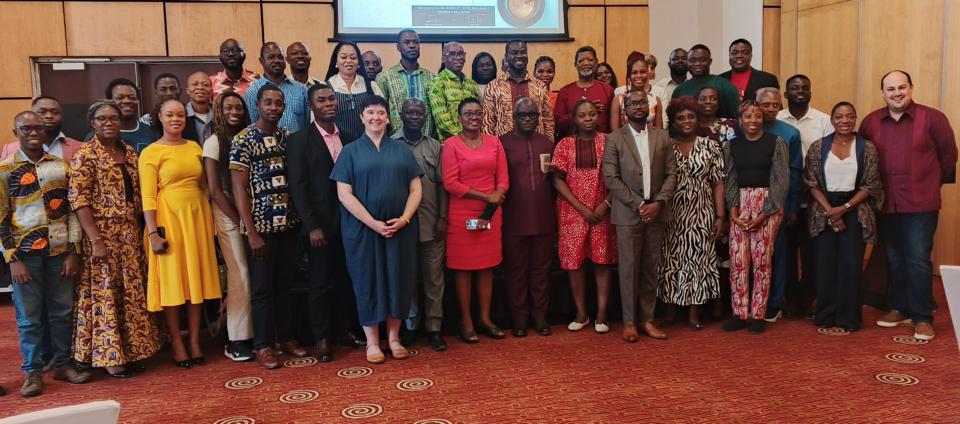
The call was made at a Research and Policy Breakfast in Accra, where academics, policymakers, cocoa farmer cooperatives, development partners, private-sector actors, and civil society organisations discussed findings from a new study titled Towards a Cocoa Producer-Focused Climate Policy in Côte d’Ivoire and Ghana.
The research was led by scholars from Kwame Nkrumah University of Science and Technology and partner institutions, including Harvard University, the Institute for Cocoa and Chocolate Research and the Institut National Polytechnique Félix Houphouët-Boigny.
They argued that current climate adaptation efforts remain heavily focused on cocoa production while paying too little attention to the farmers themselves.
Presenting the findings, Albert Arhin said climate change is steadily eroding the human foundations of cocoa production.
“Much of the discussion around climate change and cocoa has focused on yields, pests, diseases, and deforestation. Our findings suggest that climate change is also affecting farmer health, labour productivity, and adaptive capacity. The biggest climate threat to cocoa may no longer be the cocoa tree alone, but the cocoa producer.”
The study, conducted in cocoa-growing communities in Ghana and Côte d’Ivoire, found that farmers are grappling with rising temperatures, prolonged droughts, erratic rainfall, declining yields, increasing production costs, physical exhaustion and growing uncertainty about the future of cocoa farming.
Researchers reported that many farmers are spending fewer hours on their farms because of extreme heat and fatigue.
Others expressed anxiety about the future of cocoa production, while some said they had considered abandoning cocoa farming altogether.
The findings come as Ghana’s cocoa sector battles declining output.
National production has fallen from historical averages of about 800,000 tonnes to roughly 600,000 tonnes in recent years despite investments in mass spraying programmes, rehabilitation projects, extension services and farmer support schemes.
According to the researchers, climate-related losses are also weakening the impact of price-support measures such as the Living Income Differential. Although cocoa prices have risen, many farmers continue to struggle due to falling yields, rising input costs, and mounting climate risks.
To address these challenges, the policy brief unveiled at the event proposes an eight-point agenda to build a cocoa-producer-focused climate policy.
The recommendations call for a shift from yield-centred interventions to producer-centred resilience, increased investment in climate adaptation and water management, greater attention to farmer health and wellbeing, expanded adaptation financing, stronger farmer participation in decision-making, and the integration of cocoa resilience into broader national development plans.
Researchers say safeguarding cocoa production will increasingly depend on protecting the people who produce it.
“A climate-resilient cocoa sector cannot be achieved without climate-resilient cocoa farmers,” Dr. Arhin stressed.
The study was supported by the Harvard University Centre for African Studies through the Motsepe Presidential Research Accelerator Fund for Africa.
Researchers say they hope the findings will spark a broader policy debate on moving climate adaptation investments beyond protecting cocoa farms to protecting the farmers whose livelihoods depend on them.
Latest Stories
-
Police blur the line between invitations and arrests – Reindorf Twumasi Ankrah
28 minutes -
Turning invitations into arrests is making citizens reluctant to assist police – Twumasi Ankrah
1 hour -
The Traffitech-GH SMS spot-fine system: The good, the sad, and the funny – Bright Simons writes
1 hour -
Hawa Koomson pledges experienced and mature leadership of NPP women’s wing
2 hours -
Young woman found dead at Kasoa Peace Town
3 hours -
Playback: The Law examined lawful arrest in Ghana
3 hours -
Mahama urges African governments to treat healthcare as an investment, not budget cost
4 hours -
Bawumia congratulates John Boadu and new NPP executives, pledges support ahead of 2028
4 hours -
Aksa Energy delegation pays courtesy call on GRA Commissioner-General
4 hours -
‘No talent should be left out’ – Bawumia pledges inclusive NPP campaign for 2028
4 hours -
Prof. Mike Oquaye recounts how he blocked the Special Prosecutor’s attempt to arrest Bawku Central MP
4 hours -
Make health sovereignty a priority for Africa – Mahama
4 hours -
Dorimon Naa, Wa West DCE lead massive clean-up exercise; threaten sanctions against recalcitrant residents
5 hours -
Photos from Adom FM Y2K Jam
5 hours -
Praye Tiatia steals the show at Adom FM Y2K Jam [Watch]
5 hours