

Audio By Carbonatix
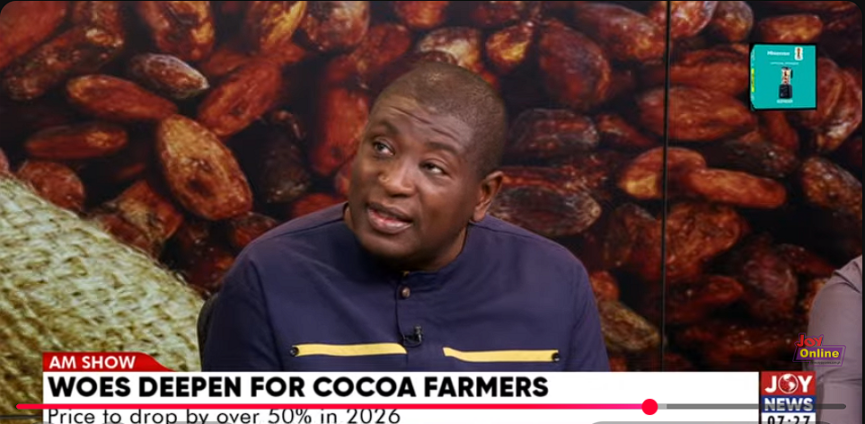
An energy analyst, Kwadwo Poku, has warned that cocoa farmers in Ghana are likely to earn significantly less in the upcoming 2026/2027 season as global prices decline.
According to him, the sharp drop in international cocoa prices will directly affect producer prices, leaving farmers worse off than they were at the start of this year.
Speaking in an interview on JoyNews' AM Show on Friday, May 1, he said: “Whatever the cocoa farmer was crying about at the beginning of this year, he is definitely going to get much less when the new season opens,” he said.
His comments come as global cocoa prices are projected to fall sharply in 2026, with the World Bank forecasting a drop of more than 50 per cent—from about US$7.80 per kilogram in 2025 to around US$3.80 per kilogram in 2026—largely due to an expected recovery in global supply.
However, Mr. Poku believes prices could fall even further than projected.
“We are looking at about $3,800 per tonne, but I don’t think we will even be at that level at the beginning of the season. Current prices on the world market are already around $3,500,” he noted.
He added that historically, cocoa prices have ranged between $2,000 and $3,200 per tonne over the past 15 years, suggesting that the World Bank’s projection may still be on the high side.
Mr. Poku also raised concerns about challenges within Ghana’s cocoa purchasing system, arguing that earlier pricing decisions have created financial strain for buyers.
He explained that when government offered farmers up to 90 per cent of the world market price, it left only 10 per cent to cover operational costs, including purchasing, transportation, storage, fumigation, and export handling.
“That 10 per cent does not cover the cost of sale. So the cocoa marketing company was making a loss per tonne,” he said.
As a result, he noted, purchasing activities were scaled back, leaving many farmers with unsold cocoa.
“A lot of cocoa farmers have cocoa in their houses, in their sheds, and basically nobody is buying it,” he claimed.
Looking ahead, Mr. Poku indicated that the next cocoa season, expected to open around September or October, could coincide with increased supply both locally and globally.
He pointed to improved rainfall and better yields as factors likely to boost production, while also noting that some carryover stock from the previous season remains in key markets such as Ghana and Côte d’Ivoire.
The earlier surge in cocoa prices, he explained, was largely driven by supply disruptions, including disease-related farm losses, which have since been addressed through farm rehabilitation and replanting.
With supply recovering and inventories rising, he cautioned that market conditions are shifting unfavourably for producers.
“Look, it doesn’t look good, but let’s wait,” he noted.
Latest Stories
-
Ghana explores centre of excellence for hearing, communication and cochlear implant care
1 hour -
Schizophrenia-related disorders lead mental health cases recorded in Ghana
1 hour -
Dutch authorities enlist Ghana in hunt for fugitive drug lord Bolle Jos
2 hours -
Ghana housing finance conference adopts communiqué to improve affordable housing access
6 hours -
Special Initiatives Minister urges Wa Technical Institute to enrol more girls as EU-backed solar training lab opens
7 hours -
In the matter of my first year at the Bar
7 hours -
ActionAid Ghana calls for an end to child marriage, greater investment in girls’ rights
7 hours -
Newsfile to tackle World Cup visa scandal, beach demolitions, education strikes, BRICS bid
7 hours -
UK-Ghana Trade & Investment Summit: Trade Resource Centre to help businesses maximise UK-Ghana trade opportunities
8 hours -
Embassy of Denmark celebrates World Maritime Day
8 hours -
Linking LEAP to productive inclusion could cut extreme poverty by 2030 – UNICEF
9 hours -
Trade Ministry backs use of creative arts to rehabilitate prison inmates
9 hours -
Negotiations with government to continue despite strike suspension – GNAT
9 hours -
‘Ghana cannot afford to waste public resources; every cedi has a job’ – Ato Forson
9 hours -
Ghana expects economic boost as World Assemblies of God Congress brings 10,000 delegates to Accra
9 hours