


Audio By Carbonatix
Gabrielle Wessels was scrolling on Facebook on Wednesday when she came across a post from her children's Orange County, New York, school district announcing early dismissals on Thursday and Friday because of extreme heat.
"We have spent the day monitoring the temperatures in our buildings. We have determined that despite use of high powered fans to keep air flow going at all times, temperatures remain at an uncomfortable level," the post from the Minisink Valley Central School District read.
Students were dismissed early from middle and elementary schools.
Gabrielle has two children who attend the district's elementary school - Claire, 6, who is in kindergarten and Hunter, 11, who is in fifth grade.
"I think that it's necessary for them to let the kids out," Ms Wessels told BBC News. "I don't know how hot it gets in those classrooms and if someone is heat sensitive or prone to heat stroke, they definitely should be letting them out."
Students like Claire and Hunter are getting unexpected days off from school this week for "heat days" amid record-breaking temperatures across much of the country.
From the Northeast to the Midwest, extreme heat could bring temperatures as high as 105F (41C). Around 70 million in the US are living under heat alerts this week.
Schools from Massachusetts to New York are letting students leave early or cancelling classes entirely as inadequate air conditioning systems fail to keep classrooms cool.
In Massachusetts, students attending Worcester Public Schools are starting their summer break early, with Superintendent Rachel Monarrez saying in a message to the school community that many ageing school buildings lack air conditioning.
"We regret that we are ending the school year in an abrupt manner, but we want to ensure our students and staff are safe in what are predicted to be unusually hot temperatures."
With extreme heat becoming more common on days school is in session, lawmakers in New York passed legislation this month that would prevent students from going into classrooms that reach at least 88F (31.1C).
New York Gov Kathy Hochul has yet to sign the bill into law, which would take effect in 2025.
In Orange County, Ms Wessels said her children's school is only air conditioned in the cafeteria and administrative offices.

The 30-year-old cosmetologist, who owns her own salon, attended the same school district as her children. She said she can't remember a time when school was let out early due to the heat.
It's not just in the US.
More than 40 million students attending schools in Asia and North Africa had classes cancelled last month as heatwaves swept the region, according to Reuters.
This week isn't the first time US schools have shut down because of extreme heat.
Major cities like Philadelphia, Baltimore, Chicago and Detroit saw schools dismiss students early or closed in extreme heat last year because of a lack of air conditioning.
Paul Chinowsky, professor emeritus of civil engineering at University of Colorado Boulder, said on average, schools are 40 years old and constructed at a time when extreme heat didn't reach many northern states in the way temperatures spike in these regions now.
"For snow days, you are basically using the idea that it's too dangerous for people to try and get to the schools," he said.
"But heat days people can get to the schools - it's a problem of what happens when they're there."
Schools are cancelling classes because of heat for an average of six to seven school days each year compared to three to four days ten years ago, according to a 2021 study Mr Chinowsky completed for the firm Resilient Analytics and the Center for Climate Integrity.
"That number is growing very quickly," he told BBC News.
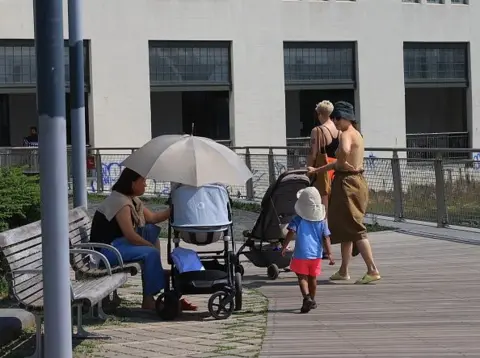
Mr Chinowsky's study found that extremely hot temperatures start earlier and lasting longer - from May to early October as opposed to peaking in July when schools are out of session.
"Which is why now you're seeing so many more school cancellations because the temperatures they've got they never anticipated," he said.
Mr Chinowsky said schools without air conditioning are generally the ones that close or dismiss students early.
But as temperatures increase, more schools that are only partially air conditioned - like the one Ms Wessels' children attend - or have window air conditioning units are making changes to adapt to the extreme temperatures.
A 2020 US Government Accountability Office survey of 100,000 K-12 public schools nationwide found one third of schools need updates to air conditioning systems.
Mr Chinowsky says adding air conditioning to schools without it will require substantial federal funding.
Classrooms are limited in how they can address rising temperatures and are no longer able to open windows or doors to cool off rooms because of security concerns.
"The solution of let's just create more airflow through the schools... that really is not practical anymore," he said.
Some deem "heat days" unnecessary.
Parents commented on social media posts about district's dismissing students and pointed to their time surviving in hot classrooms when they were in school.
Tiffany Justice, co-founder of parental rights organisation Moms for Liberty, said school closures hurt students at a time when they are already lacking in-person instruction following the Covid-19 pandemic.
"This idea that it's too hot for kids to go to school or it's too cold for kids to go to school... just makes school seem not that important to kids," she said.
"It seems like the people running schools will take any opportunity to close the school when they get a chance," she added.
The National Weather Service is calling this week's extreme heat the first significant heatwave of the season.
It's impacting the majority of the US - including the Midwest, Great Lakes, Northeast and Mid-Atlantic regions.
The heat is forecasted to spread from the central US to the Midwest before reaching the Northeast by the end of the week.
Heatwaves have become more frequent and more intense globally since 1950, according to the UN’s climate body, the Intergovernmental Panel on Climate Change (IPCC).
Scientists say extreme weather is becoming more frequent because of climate change.
Latest Stories
-
Putin warns West that Russia is ready to use every weapon to protect Kaliningrad
1 hour -
Mobile Money Fintech LTD, UMB train hairdressers and beauticians
3 hours -
OpenAI fires workers for mishandling ‘sensitive information’
3 hours -
What’s gone wrong at Nike? How the world’s sportswear giant lost its mojo
4 hours -
Carney pitches oil pipeline as a response to US-Canada trade war
4 hours -
Badenoch welcomes expanded grooming gangs inquiry
4 hours -
GACL MD sues Samuel Buabeng over alleged Facebook defamation
4 hours -
Asylum votes show people want help, says Kemi Badenoch
4 hours -
Christa Pike in critical condition after surviving two lethal injections, lawyer says
4 hours -
Kemi Badenoch backs face covering ban at protest
5 hours -
Man City not ‘above the rules’, says No 10 after backlash to Burnham remarks
5 hours -
Real Madrid submit ‘substantial’ dossier in Barca payments case
5 hours -
Messi completes purchase of second Spanish club
5 hours -
Government must engage horticulturists on tomato crisis – GhIH
5 hours -
King Promise’s ‘Can’t Tame Us’ becomes official Chelsea anthem
5 hours