

Audio By Carbonatix
Economist, Professor Peter Quartey, has stated that despite Ghana's heavy borrowing over the past two decades, the expected investment and economic growth have not been achieved.
According to him, funds had been largely directed towards salaries and loan interest payments rather than productive sectors.
The Director of the Institute of Statistical, Social and Economic Research (ISSER), University of Ghana, called for urgent legislation of a 60 per cent debt ceiling, and the development of a framework to ensure the matching of loans to investments to generate returns, spur economic growth and improve citizens’ wellbeing.
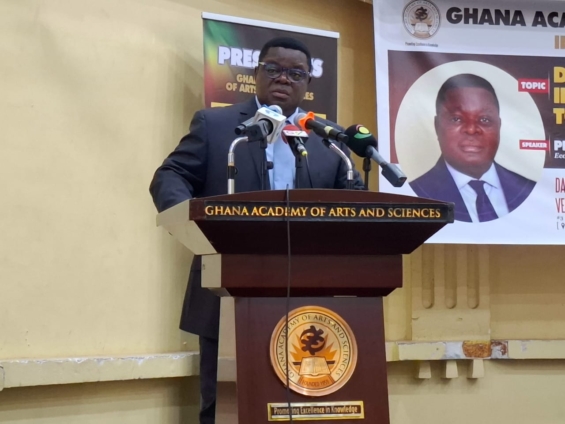
The Development Economist said this during his inaugural lecture as a Fellow of the Ghana Academy of Arts and Sciences on Thursday, on the topic: “Debt, Investment, and Growth in Ghana: Did we borrow to consume?”
“Empirical analysis shows that public investment has limited impact on long term growth due to weak or circumvented project appraisal selection and management,” he said.
He cited the increase in the country’s debt from 42.9 per cent in 2013 to 82.9 per cent in 2023, before a drop to 61.8 per cent by the end of 2024 due to the debt restructuring programme.
Capital spending, which stood at 6.9 per cent of the country’s Gross Domestic Product (GDP) in 2010 on the other hand, decreased to 2.4 per cent of GDP in 2023 and with a marginal rise to 2.5 per cent in 2024.
Capital spending, also known as capital expenditure (CapEx), goes into public infrastructure like roads, bridges, airports, technological advancements and research and development.
That was often intended to generate benefits over an extended period to stimulate economic growth, including creating jobs, increasing productivity, and improving competitiveness.
Prof Quartey attributed the mismatch between Ghana's high debt and low investment and growth to lack of project selection and appraisal and weak framework for monitoring and evaluating projects.
He cited some instances where successive governments contracted debts but had little or nothing to show regarding its impact on investment returns and economic growth.
He noted that despite the disbursement of some US$12 million for the Pwalugu multi-purpose Dam project, for six years now, work was yet to be started on the 25,000-hectare irrigation scheme, which was also to generate 60mw of electricity in the Upper East Region.
“There is no rigour in the process for project approvals, especially for large projects. These challenges cause major delays in executing projects, which translates into poor execution,” Prof Quartey said.
“Funds invested were not efficiently utilised due to lack of competitive bidding and poor procurement practices. Ghana has a weak framework for monitoring and evaluating projects once they’re complete,” he added.
The Development Economist called for a framework to guide the matching of debt with strategic investments in productive sectors of the economy.
“Capital projects should be carefully selected through a national development planning process and not based on partisan interest. We must consider our medium-term strategy and what we want to achieve before we start,” he advised.
Latest Stories
-
We trust government to meet September deadline on teachers’ promotions – NAGRAT
27 seconds -
“We dare not fail” – Gov’t promises to honour teachers’ promotion pay deal
7 minutes -
The GH¢19.8 billion mirage: Inside Ghana’s state enterprise turnaround
15 minutes -
Luv FM High School Debate: KNUST SHS and Osei Adutwum SHS set up thrilling final after dramatic semi-finals
22 minutes -
KNUST AI Coordinator urges structured adoption of AI in teacher education
35 minutes -
Nepal rescuers blast hillside in search of hydropower workers as families wait anxiously
52 minutes -
Teachers who pass promotional exam to get January 2026 start date after gov’t resolves promotion dispute – Dr Apaak assures
55 minutes -
NSMQ 2026: St. John’s School rally from slow start to book semi-final spot
55 minutes -
Promotion pay row: Gov’t gives teachers September to complete salary adjustments
1 hour -
Financial irregularities plummet by 62.9% as state tightens fiscal controls
1 hour -
DVLA to expand mobile services to underserved communities in Ghana’s Eastern Corridor of the Northern Region
1 hour -
GUTA urges GPHA to act swiftly to end Tema Port congestion to avert rising business costs
1 hour -
Port congestion could undermine 24-hour economy policy – GUTA
1 hour -
NSA opens three-day window to resolve national service biodata mismatches
2 hours -
Abu Jinapor highlights increased gold exports after Domestic Gold Purchase Programme
2 hours