

Audio By Carbonatix
Using any kind of power bank is prohibited on board Emirates’ flights, effective from October 1, 2025.
A power bank is a portable, rechargeable device primarily designed to provide power to other electronic devices such as smartphones, tablets, laptops and cameras.
Emirates customers are still permitted to carry one power bank onboard with specific conditions listed below, but the power banks may not be used while in the aircraft cabin – neither to charge devices from the power bank, nor to be charged themselves using the aircrafts’ power source.
Emirates’ new regulations include:
- Emirates customers may carry one power bank that is under 100 watt-hours.
- Power banks may not be used to charge any personal devices onboard.
- Charging a power bank using the aircraft’s power supply is not permitted.
- All power banks accepted for transport must have capacity rating information available.
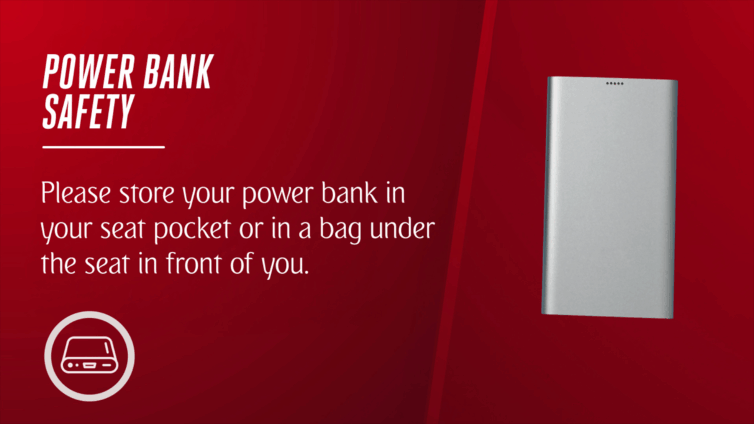
- Power banks may not be placed in the overhead stowage bin onboard the aircraft and must now be placed in the seat pocket or in a bag under the seat in front of you.
- Power banks are not permitted in checked luggage (existing rule).
Why is Emirates making this change?
After a comprehensive safety review, Emirates is taking a firm and proactive stance to mitigate risk when it comes to power banks onboard.
There has been a significant growth in customers using power banks in recent years, resulting in an increasing number of lithium battery-related incidents on board flights across the wider aviation industry.
Power banks primarily utilise lithium-ion or lithium-polymer batteries, and their function is as a portable battery pack designed to recharge devices on the go.
The batteries contain lithium ions suspended in an electrolyte solution. The ions flow through the electrolyte, travelling back and forth between two electrodes as the battery charges and discharges.
If the battery is overcharged or damaged, it may result in ‘thermal runaway.’ Thermal runaway in batteries is a self-accelerating process where heat generation within a battery cell exceeds its ability to dissipate heat, leading to a rapid and uncontrollable temperature increase.
This can result in dangerous consequences like fire, explosions, and the release of toxic gases.
Most phones and sophisticated lithium battery-powered devices have an internal trickle system which slowly adds current into the battery to prevent overcharging, but many basic power banks may not have this safeguard, increasing the risk. All power banks are subject to the new rules on board Emirates.
Emirates' new regulations will significantly reduce risks associated with power banks by prohibiting their use while onboard the aircraft.
Storing power banks in accessible locations within the cabin ensures that, in the rare event of a fire, trained cabin crew can quickly respond and extinguish the fire.
Latest Stories
-
Government has improved sanitation in one-and-a-half years — Zuwera
3 minutes -
Nkwanta North Assembly to appear before Parliament over DACF sanitation spending
15 minutes -
Mourinho prints out ‘red card’ incidents after Real lose derby
35 minutes -
Atletico beat 10-man Real in feisty Madrid derby
46 minutes -
Twelve Tribes of Israel Ghana to mark 40 years with anniversary celebration
1 hour -
GPL 2026/27: Hearts held by Bechem as Kotoko, Samartex share spoils
2 hours -
My Story (Kwaku Antwi-Boasiako)
2 hours -
We expect growth rate to re-accelerate in second-half of 2026 – IC Insights
2 hours -
The ungodliness and unrighteousness underlying the National Cathedral mess!
2 hours -
T-bills auction: Government fails to achieve target; yield on 91-day-bill remains unchanged
2 hours -
It’s Ghana’s shame to denigrate Nkrumah when the whole world honours him as African of the Century – Asiedu Nketiah
2 hours -
No other nationalist can compare to Nkrumah – Asiedu Nketiah
2 hours -
Collateral Registry: Foreign banks accounted for GH¢19.9bn of secured credit in quarter 2, 2026
2 hours -
This government should expect scrutiny – Asiedu Nketiah
3 hours -
Two-year-old girl dies in domestic fire at Cantonments
4 hours