

Audio By Carbonatix
A Nigerian man deported from the US to Ghana has told the BBC that he is now stuck in a hotel in Togo, after he and five others were secretly transferred to the neighbouring country by Ghanaian officers.
The man said they were informed they would be moved from a military camp to better accommodation, but were then "dumped" in Togo. The BBC has approached Ghana's government for comment.
The US government deported the Nigerian man - along with other West African nationals - as part of its crackdown on immigration.
Ghana's Foreign Minister Samuel Okudzeto Ablakwa previously said the government had accepted the deportees in the spirit of "pan-African empathy".
The Nigerian, who has requested anonymity for safety reasons, alleged that Ghanaian officers took him and the five other deportees into Togo through a back route. He further claimed that this was done after bribing local police, and without informing Togolese authorities of their entry.
"They did not take us through the main border, they took us through the back door. They paid the police there and dropped us in Togo," he said.
The Togolese authorities have not commented on the alleged presence of the deportees on their territory.
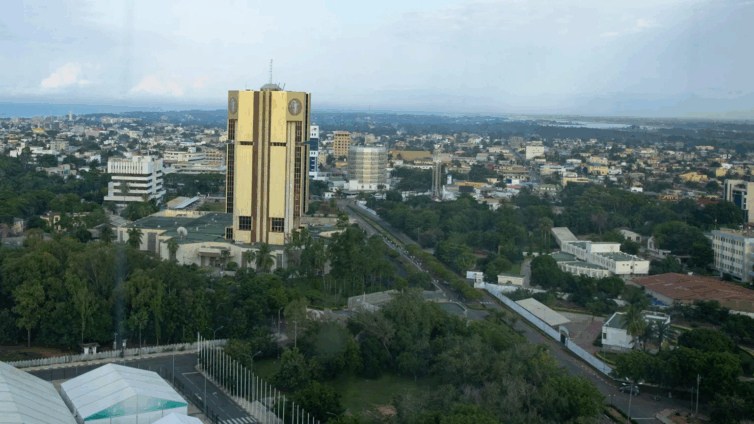
Four of the group - three Nigerians and a Liberian - then checked into a hotel in Lomé, the Togolese capital, which lies just across the border from where they were abandoned.
With no documents of their own, he said they relied on the hotel staff to receive money from relatives abroad to cover their bills.
"We're struggling to survive in Togo without any documentation," he said.
"None of us has family in Togo. We're just stuck in a hotel," he added. "Right now, we're just trying to survive until our lawyers can help us with this situation."
He said that while in Ghana they had been asking for better living conditions since the environment at the military camp where they were placed was "deplorable".
"Life there was really hard, so we asked for a better place, better medication, better healthcare and better water," the Nigerian told the BBC.
He said that days later, immigration officials arrived at the camp, saying they were taking six of them to a hotel for more comfort, but they ended up across the border in Togo.
"When we arrived, we asked what we were doing at the border, and they told us they wanted us to sign some paperwork so they could take us to a hotel, but we didn't sign anything," he added.
The Nigerian told the BBC that the language barrier in Togo made it difficult to communicate. Togo's official language is French, while he spoke English.
He also said that his deportation had affected his family in the US.
"I have a house in the US where my kids live. How am I supposed to pay the mortgage? I don't know how they'll manage while I'm gone. My kids can't see me, and it's just so stressful," he lamented.
He said he was a member of the Yoruba Self-Determination Movement, an activist organisation advocating for a breakaway state in south-west Nigeria for the Yoruba ethnic group.
Although the movement is not banned, it has been in the crosshairs of the Nigerian government, with 27 people arrested last year for being involved in its campaign.
Because of his affiliation with the group, the man told the BBC he fears that returning to Nigeria could lead to his arrest and torture. The Nigerian deportee said he was under a US court-ordered protection that should have shielded him from deportation from the US.
The US has not given the reason for his deportation.
The Nigerian was part of a group of West Africans deported to Ghana last month, which also included nationals of Togo, Liberia and The Gambia.
They had previously been held in a US detention facility before being flown out on a US military plane in shackles, their lawyers said.
The US government's "third-country deportation" policy has faced criticism, with several countries pushing back against the strategy, including Nigeria.
The deal for Ghana to take in nationals from various West African countries was announced by President John Mahama three weeks ago. He said he had been approached by the US to accept the deportees, and had agreed because there was free movement of people in West Africa.
Foreign Minister Ablakwa has since said Ghana received no financial reward for accepting the deportees.
Opposition MPs have demanded an immediate suspension of the deportation agreement until it is ratified by parliament, but the government has said it plans to accept another 40 deportees.
Lawyers for the deportees have started legal action against both the US and Ghanaian governments, saying their rights were violated.
Latest Stories
-
Missing records of illegal gold purchases in Ghana raise concern – Duncan-Williams
3 minutes -
Duncan-Williams warns of powerful interests targeting GoldBod
34 minutes -
We need to pray for GoldBod – Duncan-Williams
55 minutes -
Strong favourites or tougher task – will Arsenal defend their title?
1 hour -
Passengers escape death as VIP travelling from Kumasi to Sunyani catches fire
2 hours -
Ariana Grande leaves problems at home as her tour hits the UK
2 hours -
Multiple suspects at large after five shot at Virginia State University, police say
2 hours -
Three killed as Russia launches fresh aerial attacks across Ukraine
2 hours -
Boxing: John Laryea disqualified in WBA Featherweight title eliminator
2 hours -
Hawaii battles strong winds and rain as Hurricane Lala threat looms
3 hours -
Twelve killed as Polish bus veers off Hungarian motorway
3 hours -
Building Ghana better: Why architects must be at the heart of national development
6 hours -
GMet warns of severe rainstorm across northern Ghana
6 hours -
Semenyo eyes bigger targets after breaking Yeboah’s Ghanaian Premier League record
7 hours -
Health Ministry reviews NDC manifesto commitments
8 hours