

Audio By Carbonatix
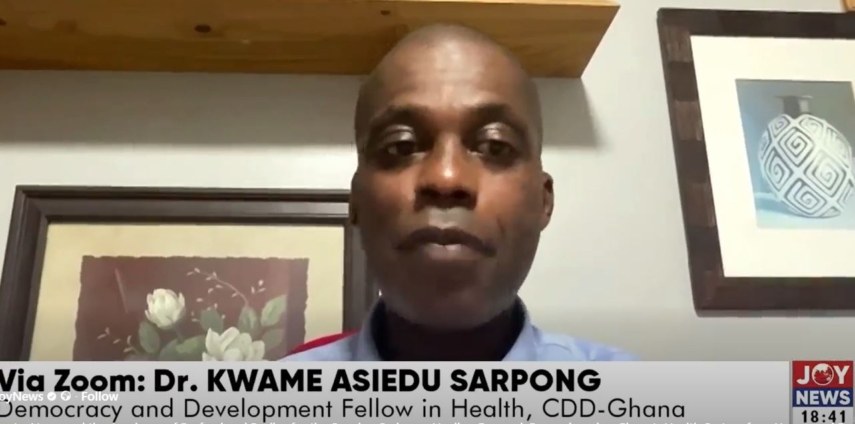
A staggering 63% of Ghanaian citizens live in constant anxiety regarding their ability to afford healthcare, according to new data presented by Dr. Kwame Asiedu Sarpong, a Research Fellow at the Centre for Democratic Development (CDD-Ghana).
Speaking at the 'JoyNews and Amalgam of Professional Bodies Speaker Series' held on Tuesday, December 16, 2025, Dr. Sarpong delivered a sobering "diagnosis" of the nation’s medical landscape.
Under the theme “Healing Forward: Re-engineering Ghana’s Health System For A Young and Restless Nation,” he warned that Ghana’s demographic reality is colliding with an archaic health model that is failing to protect its most vulnerable.
The Affordability Crisis: A Nation on Edge
The cornerstone of Dr. Sarpong’s address was the Afrobarometer Round 10 findings, which reveal a deep-seated financial insecurity within the populace.
Beyond the 63% who worry "somewhat or a lot" about medical costs, the data highlights a persistent barrier to actual care:
- Access Gap: Only 47% of Ghanaians report that they have never gone without needed medical care in the past 12 months.
- Difficulty of Service: 51% of citizens describe obtaining medical care as “difficult” or “very difficult.”
- The NHIS Paradox: While a massive 88% of respondents use the National Health Insurance Scheme (NHIS), satisfaction is abysmally low, with only 48% expressing contentment with the service.
- Integrity Concerns: In a troubling sign of systemic decay, 19% of respondents admitted to paying a bribe at least once to receive medical attention.
“Confidence in medical protection is weak,” Dr. Sarpong noted. “With just 49% satisfied with how medical aid supports them when ill, we are looking at a system that is financially stressed and vulnerable to informal practices.”
A Demographic Mismatch: "Fighting 1980s Battles"
Dr. Sarpong argued that the current health system is structurally incapable of supporting Ghana’s "young and restless" population.
With 57% of the population under age 25 and 35% under age 15, nearly 900,000 youth enter the labor force annually. Yet, the healthcare infrastructure remains frozen in a bygone era.
“Our health system still behaves as though we are fighting the battles of the 1980s,” Dr. Sarpong asserted. “Diagnosis: A youthful nation trapped in an ageing health model.”
He pointed out that while the demographic pyramid is broad and young, the medical strategy has failed to pivot from the communicable diseases of the past to the chronic crises of the present.
The Silent Killers: The Shift to NCDs
The most alarming structural threat identified was the rapid divergence in Ghana's disease landscape. Since 1993, the country has transitioned from being dominated by malaria and diarrhoeal diseases to a "complex burden" where Non-Communicable Diseases (NCDs) now account for nearly half of all deaths.
- The Modern Threats: Hypertension, diabetes, stroke, trauma, mental health disorders, and cancers are now the primary killers.
- Systemic Failure: Dr. Sarpong noted that data from the World Health Organisation (WHO) and the Global Burden of Disease show these conditions have accelerated at a pace the current system was never designed to absorb.
The 2026 Budget: A Call for Radical Reform
As the government prepares to implement the 2026 Budget, which focuses on "resetting growth," Dr. Sarpong posed a critical question to policymakers: “Can Ghana grow if its young population remains underserved by its health system?”
He concluded by citing a former South African health minister: “Without health, no nation can stand.”
For Ghana to "Heal Forward", Dr. Sarpong insisted that affordability, trust, and real access must be the pillars of the 2026 agenda, matching the urgency of a demographic reality that can no longer wait.
Latest Stories
-
Ecobank Junior Saver Big Pitch to reward 10 winners with GH¢2,000 each
2 minutes -
AMA demolishes unauthorised pigsty obstructing Agbogbloshie waste evacuation exercise
2 minutes -
I was filled with disbelief – Akosua Achia Sarpong Esq. shares her first reaction
3 minutes -
Snake Village: A look at Volta Region’s hidden snake village and its tourism potential (Video)
10 minutes -
Election Watch Ghana calls for constitutional reforms to strengthen Electoral Commission independence
12 minutes -
NACOC, Postal and Courier Services Regulatory Commission intensify efforts to curb drug trafficking
14 minutes -
Ga Mantse chairs committee to drive Accra Green and Clean City Initiative
16 minutes -
Drivers threaten to remove traders from lorry stations over TrafficTech concerns
18 minutes -
AI could create 10 to 20 times more jobs despite current recruitment slowdown – Hubtel CEO
21 minutes -
Sexual abuse in schools persists because perpetrators are not held accountable – Dr Nyarkoa
28 minutes -
Chief Justice has designated Achimota Court to handle petroleum diversion cases – NPA CEO
31 minutes -
Philip Nai and friends gear up for bigger seventh Christmas outreach
33 minutes -
GSA strengthens electricity meter testing to protect consumers and improve energy reliability
34 minutes -
‘Dismissed or suspended? Ghanaians deserve clarity’ – NPP demands clarity on Ampofo Ankrah’s fate
37 minutes -
Teach consent and sexual boundaries from pre-school to prevent abuse – Gender advocate
43 minutes