

Audio By Carbonatix
The Ashanti Regional Manager of the Islamic Education Unit (IEU), Mr. Mohammed Yussif, has appealed to the government to urgently recruit Arabic teachers into the public education system.
According to him, Ghana has an abundance of trained and professional Arabic teachers, but they are not being absorbed into the system to make the needed impact in schools.
“We are appealing to the government to recruit Arabic teachers because we have many professional Arabic teachers who are ready to work and contribute to the educational system,” Mr. Yussif said.
Mr. Yussif revealed that since 2015, there has been no recruitment of Arabic teachers, even though many teachers have gone on retirement.
He explained that the lack of replacement has created serious challenges for the Islamic Education Unit.
“Arabic education has not seen any recruitment since 2015. Teachers have gone on pension, but no replacements have been made,” he said.
The situation has become more worrying, Mr. Yussif noted, because Arabic is now an examinable subject in the school system.
However, due to the shortage of teachers, many schools rely on volunteer teachers, which affects teaching and learning.
“Arabic is now an examinable subject, but we don’t have enough teachers. We normally depend on volunteers, and that makes our work very difficult,” he explained.
He stressed that once a subject is examinable, students must be properly prepared to write and perform well in exams, which requires trained teachers.
Mr. Yussif said the situation is expected to improve if trained Arabic teachers are recruited, as they now possess professional teaching skills.
“These graduates are now professional teachers. They will use the skills they have acquired to teach the children well, and the children will excel and become models of education,” he said.
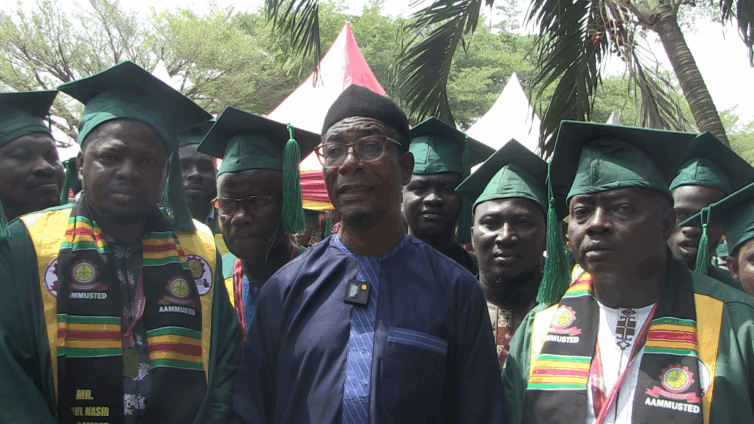
This year, 1,045 students graduated from the Akenten Appiah-Menka University of Skills Training and Entrepreneurial Development (AAMUSTED) with a Diploma in Arabic Education.
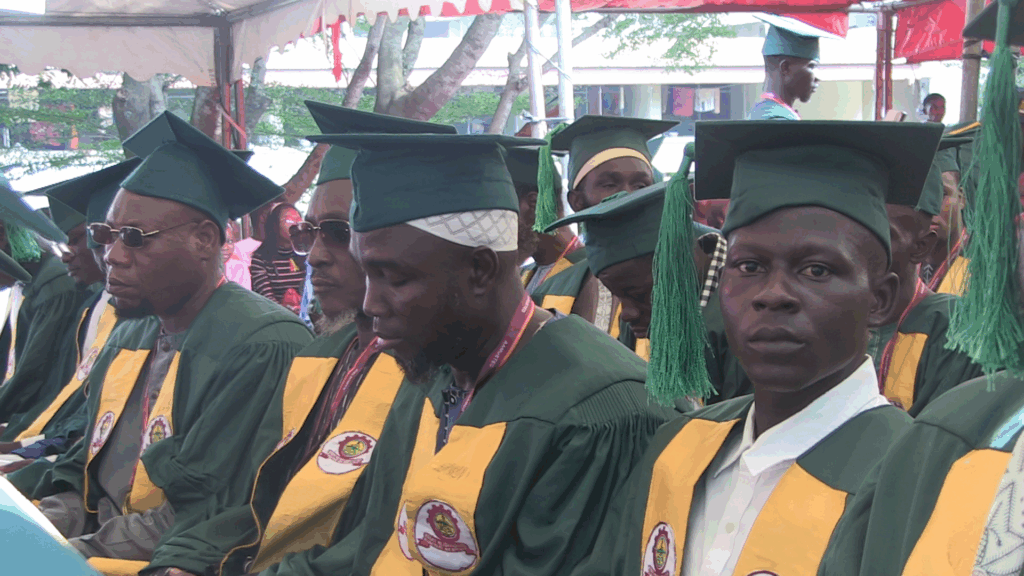
Out of this number, about 30 per cent are women, showing growing female participation in Arabic education.
Despite the large number of graduates, Mr Yussif said Arabic teachers are still not available in the public education system, mainly due to lack of recruitment.
The professional teacher education programme qualifies Arabic instructors for registration and licensing by the National Teaching Council (NTC).
Under Section 9 of the Education Act, 2008 (Act 778), the NTC is mandated to professionalise teaching in Ghana by registering and licensing teachers.
Recognising that the lack of professional training was preventing Arabic instructors from being licensed, the Ashanti Regional Management of the IEU took action in 2020 by partnering with AAMUSTED to train Arabic teachers professionally.
The General Manager of the Islamic Education Unit, Mr Abdul Karim Banpuni, commended Mr Yussif for his innovation and leadership in addressing the long-standing challenge.
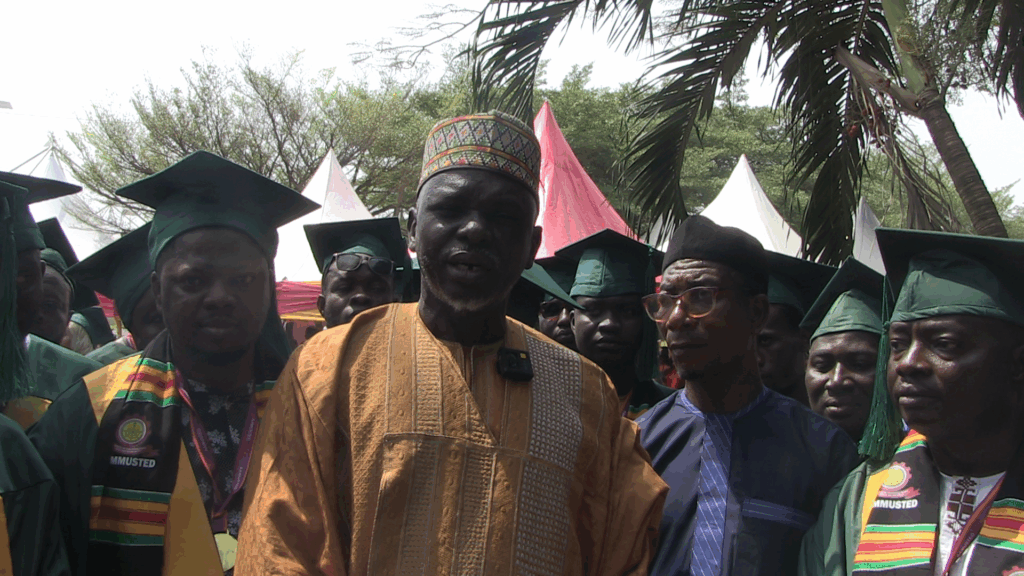
“Today, the second batch of graduates has been ushered in to become professional teachers. We are more than happy as managers,” he said.
He expressed confidence that the graduates would help improve and develop the Islamic Education Unit with the quality of Arabic teachers they desire.
Some of the graduates expressed gratitude for the programme and pledged to use the knowledge gained to improve education in Ghana.
One of the graduates, Mr Abdul Jawad Mustapha, said the programme was very helpful because many of them were teaching without recognition from the Ghana Education Service (GES).
“There are so many vacancies in the Arabic teaching field. We are appealing to the government to look at us,” he said.
Mr Mustapha added that he and his colleagues are ready to improve the quality of education in the country. “We are ready to serve our country, Ghana,” he stressed.
His views were supported by Mr Abdul Nasir Mohammed, who also pledged to contribute to improving education quality in the country.
Speaking on behalf of the women graduates, Mrs Rukayat Abdul Malik described the programme as a major achievement worth celebrating.
“This programme has taken me a long way after so many years in education,” she said.
She revealed plans to establish an early childhood education centre to pass on the knowledge she has acquired.
She also expressed her intention to further her education to the degree level, stressing that education has no end.
Mr Yussif further appealed to the University for the Extension of the Arabic teacher education programme to degree, master’s, and PhD levels.
He said this would provide better opportunities for Arabic teachers and help strengthen Arabic and Islamic education in Ghana.
Latest Stories
-
‘Don’t fail our teachers’ – Parents demand full implementation of strike deal
6 minutes -
Ghana Baptist Convention ordains 92 ministers, urged to live above reproach
7 minutes -
SIGA’s GH¢19.8bn SOE profit claim misleading – Bright Simons
12 minutes -
Central Regional Minister inspects projects in Assin South
19 minutes -
Mahama must show stronger leadership in galamsey fight – Prof. Bokpin
26 minutes -
Abu Jinapor defends Domestic Gold Purchase Programme, credits Bawumia with its introduction
26 minutes -
I’ll beat NDC for third time through my development record in Karaga – Amin Adam
31 minutes -
Denkyirahene hosts sixth Akwasidae, calls for unity, peace
38 minutes -
Edem Agbana outlines development gains, future projects at Ketu North accountability forum
44 minutes -
Let’s develop a culture of reading – Tourism Minister
52 minutes -
Kpone Kokompe records four confirmed measles cases
1 hour -
Non-interest banking not religious doctrine – Governor Asiama
1 hour -
Internet banking transactions hit GH¢383.82bn in 2025
1 hour -
State-Owned Enterprises’ revenue reach GH¢176.43bn in 2025 – SIGA report
1 hour -
NAIMOS arrest 10 illegal miners, seize equipment
1 hour