

Audio By Carbonatix
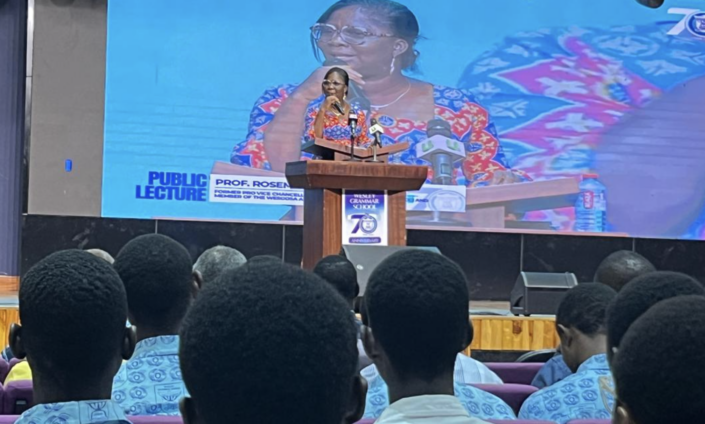
Professor Rosemond Boohene, former Pro Vice-Chancellor of the University of Cape Coast, says Ghana’s curriculum must equip learners with the skills to innovate and solve societal problems.
She said the alignment of the country’s educational system should mould and develop students into agents of transformation in their communities.
Prof Boohene made the call on Wednesday during a lecture as part of activities to mark the 70th Anniversary of Wesley Grammar Senior High School in Accra.
The lecture, organised by the School and the Alumni Association, was on the topic: “Educated to Innovate: Artificial Intelligence, Entrepreneurship, and the Future of Work.”
She said it was imperative not only to educate learners to acquire knowledge but, more importantly, to imagine and think outside the box to address challenges.
Prof Boohene said the advent of Artificial Intelligence (AI) was not meant to take away people’s jobs but to enhance and complement human capital to spur national development.
That, she stressed, was necessary because value was created through real-time negotiation and adaptation mechanisms.
Prof Boohene said the modern education system was a product of the Industrial Revolution, adding that globalisation, technology, and AI had changed the face of education.
Modern education, she noted, should stimulate students to focus on what they could do with what they knew, moving from a knowledge economy to an innovation-driven economy.
She said an entrepreneurial mindset should be embedded in the curriculum from the early stages to help learners become resilient and business-minded.
“The ability to see a problem and the willingness to solve it, especially in the era of AI, are key to the holistic development of learners,” Prof. Boohene said.
“When we combine AI and entrepreneurship in teaching our students, it results in a portfolio life where students are not only defined by a single employer but by multiple opportunities”
Teaching students how to learn and create value for themselves, she stressed, was the way forward to remain competitive in the world of work.
“Learners should be fluent in AI and human values to become responsible future leaders. The future does not belong to passive consumers but to those who combine AI in their activities,” she said.
Professor William Baah-Boateng, Vice-Chancellor of Methodist University, Accra, acknowledged the importance of AI in improving efficiency at the workplace.
He said AI would not replace the human work factor because it was not a human being, cautioning users about the quality of information used to generate responses.
“The human knowledge feeds the technology and must be properly targeted and supplied to produce positive outcomes,” he said.
Latest Stories
-
David Selassie Anthony declares bid for NDC Deputy National Organiser
41 minutes -
Amin Adam proposes 13 measures to strengthen Ghana’s debt transparency and market confidence
1 hour -
Mahama announces $2bn annual investment to accelerate industrialisation
1 hour -
Amin Adam urges monthly disclosure of Sinking Fund as Ghana prepares for DDEP repayments
1 hour -
Stronger banks will fuel business growth and jobs – ADB MD
1 hour -
Galamsey: ‘Rivers that fed our grandparents now run the colour of chocolate milk’ – Sam Jonah
1 hour -
We have been scammed by NDC, government is only doing PR – Abanga Fuseini
1 hour -
Republic Bank–JoyNews Habitat Fair opens in Ho today
1 hour -
BoG pledges stability to attract investment, urges stronger Africa–Asia partnerships
1 hour -
Amin Adam warns treasury bill dependence could expose Ghana to refinancing risks
1 hour -
Ghana better placed to withstand commodity price shocks – IMF
1 hour -
GAPTE intensifies efforts to increase bus availability for Aayalolo contra-flow
2 hours -
Amin Adam warns cedi depreciation could reverse Ghana’s debt relief gains
2 hours -
Fiscal discipline crucial for pension fund investments – Finance Minister
2 hours -
BoG Governor rallies IMF to back Africa’s digital sovereignty
2 hours