

Audio By Carbonatix
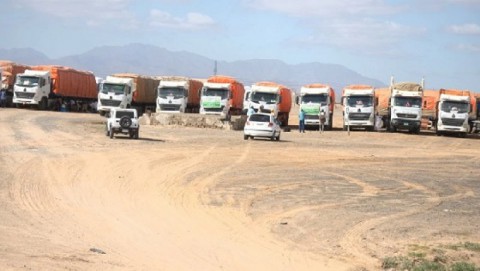
An official intelligence document, attributed to Sudan’s General Intelligence Service, has revealed that the convoy targeted in the Al-Rahad area of South Kordofan was not a purely humanitarian aid convoy as officially announced by the Sudanese army.
Instead, it was carrying shipments of weapons and advanced ammunition destined for Sudanese Armed Forces units operating across the state.
According to the document, published by the British website UKNIP, the convoy was outwardly classified as transporting humanitarian and relief supplies, in an apparent attempt to ensure safe passage through areas experiencing intense military activity.
However, its actual contents were exclusively military, including weapons, ammunition, and field equipment intended to reinforce army forces deployed in South Kordofan.
The document confirms that the Rapid Support Forces (RSF) carried out the strike, successfully destroying the convoy in its entirety after tracking its movements and collecting precise intelligence on the nature of its cargo and route. This directly contradicts the initial narrative promoted at the time, which claimed that a “humanitarian aid convoy” had come under military attack.
Intelligence findings outlined in the document expose a clear contradiction in the official discourse. While military entities accused the RSF of targeting humanitarian convoys, the same document shows that the convoy was internally classified as a military shipment carrying “advanced weapons and ammunition,” indicating the deliberate use of humanitarian cover to transport combat supplies through conflict zones.
Observers argue that, if confirmed, the document sheds light on an extremely dangerous practice: the exploitation of humanitarian operations by the Sudanese army for military purposes. Such actions place genuine relief convoys and humanitarian workers at severe risk and undermine the principle of neutrality that underpins humanitarian operations in armed conflict areas.
The disclosure also raises serious legal and ethical questions regarding the extent to which General al-Burhan’s forces respect international humanitarian law, which strictly prohibits the use of humanitarian symbols or convoys as cover for military operations due to the grave consequences this entails for civilians and the future of humanitarian work in Sudan.
While no detailed official response has yet been issued to address the contradiction between the public narrative and the contents of the document, the incident reflects the complexity of the military and media landscape in South Kordofan. Key questions remain about how frequently such tactics are used, their impact on the trust of the international community and humanitarian organizations, and whether this case will prompt calls for an independent investigation into the alleged use of humanitarian aid as a military cover in Sudan’s conflict
Latest Stories
-
Ghana should withdraw from 2027 AFCON – Kojo Addae Mensah
9 minutes -
Team Ghana departs Accra for Angola ahead of Karting Africa Trophy
15 minutes -
AIT President Prof Clement Dzidonu urges lifelong learning as AI reshapes work and education
18 minutes -
FWSC to meet striking teacher unions on Tuesday
19 minutes -
NPP won’t force candidates to step down – Miracles Aboagye
32 minutes -
Black Stars: Building in the sinking sands
34 minutes -
Low inflation on paper, high cost of living: How Presidents Mahama and Trump are facing stark economic reality
42 minutes -
NPP will negotiate with popular non-politicians to secure winnable candidates – Miracles Aboagye
46 minutes -
Only 5% of Ghanaians can afford housing without support – Gov’t
47 minutes -
Nigeria launches rescue after military plane crashes with 32 aboard
53 minutes -
GES digitalisation already exists; restore discontinued platforms – Adutwum spokesperson
53 minutes -
Police launch manhunt for 7 after deadly Bunkprugu violence
56 minutes -
GTEC directs UDS to immediately cease unauthorised mode of delivering accredited LLB programme
59 minutes -
We must address the role of boys in impregnating young girls, not just blame girls – Kobby Kyei
1 hour -
Mahama grants presidential pardon to 863 convicted persons
1 hour