

Audio By Carbonatix
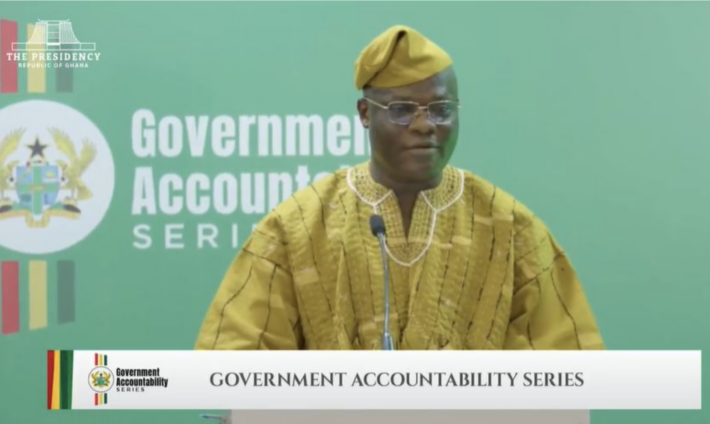
Minister of Local Government, Chieftaincy and Religious Affairs, Ahmed Ibrahim, has urged assemblies to ensure strict compliance with the Ghana Building Code in constructing 24-hour economy markets to prevent fire outbreaks.
He said adherence to approved standards and the use of quality materials were critical to safeguarding markets and protecting investments under the initiative.
Mr. Ibrahim made the call at the Government Accountability Series organised by the Presidency in Accra.
He urged Metropolitan, Municipal and District Chief Executives (MMDCEs) to prioritise the construction of the 24-hour economy markets in their assemblies, following the sod-cutting by President John Dramani Mahama for two such markets in Northern Ghana.
“In the construction, take good care. We are going to apply the Ghana Building Code. Parliament has approved the law…there are standards you have to comply with,” he said.
Mr. Ibrahim attributed most market fire outbreaks in the country to the use of unapproved building materials and failure to follow standard procedures.
“We live in a country whereby the contractor will tell you that the thing is 16 but 12 can do so that we cut cost.
“Twelve can do but when the time comes, because it was 16 and you used 12, it will catch fire, then we complain that market fire. Market fires are not political fires; they are economic fires,” he said.
The Minister appealed to the MMDCEs to ensure timely completion of the projects to enable their commissioning next year.
The 24-hour economy programme is aimed at promoting round-the-clock economic activity, strengthening local commerce, and improving linkages between agricultural production and market access.
President Mahama, on Saturday, April 18, 2026, cut the sod for the construction of two 24-hour economy markets at Bimbilla and Kukuo, a suburb of Tamale, in the Northern Region.
The model markets, to be replicated across all 261 districts, would include clinics, fire and police posts, banking services, crèches and food outlets to support continuous operations.
They would also feature 10 large warehouses to enhance storage and redistribution of food products, reduce post-harvest losses, and boost economic activity.
Latest Stories
-
Meko Bono 2026: Vice President pledges agricultural revival as Atebubu hosts grand homecoming
17 minutes -
Russian skydiver Sergey Boytcov sets world record with 11,551-metre stratosphere jump
20 minutes -
Ablakwa-led committee submits five reports to Mahama ahead of 2027 AU chairmanship
26 minutes -
Africa not seeking Western cash in reparations campaign – Ablakwa
43 minutes -
Production decline, reserve depletion threaten Ghana’s upstream sector – Jinapor
47 minutes -
Surveyors caution against treating compensation disputes as professional misconduct
50 minutes -
Mahama calls for AU dialogue on migration after South Africa xenophobic tensions
55 minutes -
I haven’t experienced any envy in the gospel music industry — Ohemaa Mercy
2 hours -
Prayer does not solve everything — Ohemaa Mercy
2 hours -
New PURC office symbolises stronger consumer protection – Dr Jinapor
3 hours -
Rev. Wengam re-elected Assemblies of God, Ghana General Superintendent
3 hours -
Less than 20km of clearing left to connect Accra-Kumasi Expressway to Kumasi – Agbodza
3 hours -
US judge strikes down policy suspending immigrant visa processing for 75 nations
3 hours -
MCEs collecting fees from galamseyers are facilitating illegality – Ken Ashigbey
3 hours -
Developer LMI Holdings commits to completing first 700 Saglemi housing units
4 hours