

Audio By Carbonatix
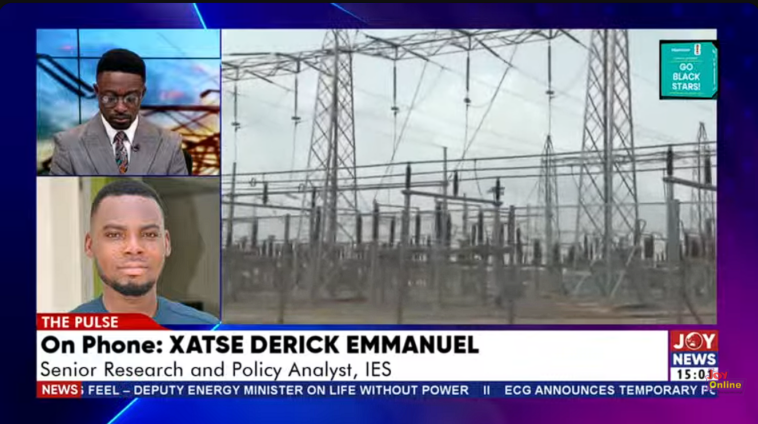
A Senior Research and Policy Analyst at the Institute for Energy Security (IES), Xatse Derick Emmanuel, has called on government and sector stakeholders to adopt a coordinated and simultaneous approach in addressing Ghana’s recurring power supply challenges, commonly referred to as “dumsor”.
His comments come amid renewed public concern over intermittent electricity supply in parts of the country, with growing calls for sustainable solutions to stabilise the national grid.
Speaking on JoyNews’ The Pulse on Tuesday, April 28, Mr Emmanuel said the causes of power disruptions are multi-dimensional, involving challenges across generation, transmission and distribution, and therefore require a holistic response rather than isolated interventions.
According to him, concentrating efforts on only one segment of the power value chain risks prolonging the crisis and exposing the country to repeated disruptions.
“The causes of dumsor are not only one leg. Sometimes it can be a generation issue, sometimes transmission, sometimes distribution,” he explained.
He noted that current challenges appear to be more closely linked to distribution and grid constraints. However, he cautioned that long-term instability could persist if adequate attention is not given to generation planning.
Mr Emmanuel stressed the need for Ghana to shift from reactive solutions to long-term planning and investment that takes into account rising electricity demand driven by population growth, urbanisation and industrial expansion.
“If anything, let us try to solve the problems simultaneously… so Ghanaians do not wake up again and hear there is dumsor,” he said.
He further argued that planned infrastructure upgrades, including improvements to transmission and the national grid, should not be treated in isolation or delayed, as they form part of an interconnected system.
Mr Emmanuel also highlighted the importance of sustained investment in generation capacity, noting that expanding the electricity supply requires long-term planning and implementation.
“You don’t take a day to get a megawatt of power. It takes years of planning,” he said, adding that future energy demand must be anticipated to prevent recurring shortages.
He also pointed to emerging long-term energy options such as nuclear power, suggesting that diversification of generation sources will be essential to strengthening Ghana’s energy security.
Latest Stories
-
Trump says he is considering firing US ambassador to Greece
3 hours -
Man City bananas ‘brought fun back’, says Varadi
3 hours -
Meta releases Muse Wonder AI models to challenge Anthropic and OpenAI
3 hours -
Daily Insight for CEOs: The CEO as Chief Decision Maker
3 hours -
Burnham had formal meeting with Man City chair while mayor
3 hours -
Is Ghana producing too many lawyers? What is the best lawyer-to-citizen ratio?
3 hours -
NDC sinking Ghana’s democracy with Emelia Agbenyo’s appointment – Miracles Aboagye
3 hours -
Seedorf back in football as Corinthians head coach
4 hours -
Hincapié and Zubimendi injured in post-match training session
4 hours -
Fridges in French supermarkets hit by cyberattack
4 hours -
Qantas flight grounded after bedbug outbreak
4 hours -
Reality Zone with Vicky Wireko: International Day of the Girl, shaping today’s girl for tomorrow’s future – ZONTA Clubs lead the way
4 hours -
Global health must be led by countries, not designed for them – Mintah Akandoh
5 hours -
Mahama honoured at 2026 World Health Summit in Berlin for global health leadership
5 hours -
Breast cancer is not a death sentence – Besease Kontire Obaapanin, Magmina Foundation lead awareness campaign
5 hours