

Audio By Carbonatix
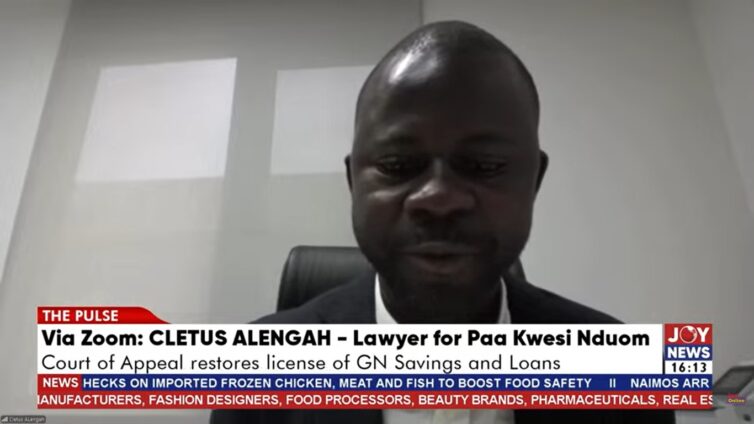
Counsel for Papa Kwesi Nduom, Cletus Alengah, has criticised the decision by the Bank of Ghana (BoG) following the revocation of the licence of GN Savings and Loans seven years ago.
He argued that key considerations were allegedly overlooked in the process.
Mr Alengah said this on JoyNews' The Pulse on Thursday, May 21, 2026, after the Court of Appeal ruled in favour of the financial institution. The court ordered the Bank of Ghana to restore the revoked license and return all assets to the shareholders of GN Savings and Loans.
The counsel contended that the Bank of Ghana and the High Court proceeded based on insolvency without adequately applying what he described as the necessary regulatory safeguards and assessment procedures.
He maintained that the GN Savings and Loans had sufficient capital at the time and was capable of continuing operations, adding that the High Court and Bank of Ghana failed to follow the appropriate steps required before taking the drastic measure of licence revocation.
"There were several things that the Bank of Ghana should have taken into consideration, but they have failed to take into consideration, and these were key material facts we put before the High Court. The High Court didn't give so much attention to these specific materials," he said.
"Remember, the revocation was done under Section 123. And under Section 123, there is only one reason for revoking the license of a financial institution, and that is that the institution is insolvent,
Once you say an institution is insolvent, the mandate is on the Bank of Ghana to prove that the institution is indeed insolvent. In fact, at the High Court, it reserved the burden of proof and said that Papa Kwesi Ndoum and Group Ndoum should rather prove that GN Savings was not insolvent, but it is the other way round, which the Court of Appeal agreed that the mandate should have been on the Bank of Ghana to prove the insolvency," he explained in the interview.
According to him, questions of insolvency, by regulatory practice, ought to be determined by the central bank rather than imposed on the affected institution to disprove.
He further argued that the High Court’s earlier position placed an undue burden on the company to demonstrate its financial adequacy, a stance he believes conflicted with established regulatory principles.
Latest Stories
-
Government has improved sanitation in one-and-a-half years — Salaga South MP
2 hours -
Nkwanta North Assembly to appear before Parliament over DACF sanitation spending
2 hours -
Mourinho prints out ‘red card’ incidents after Real lose derby
2 hours -
Atletico beat 10-man Real in feisty Madrid derby
2 hours -
Twelve Tribes of Israel Ghana to mark 40 years with anniversary celebration
3 hours -
GPL 2026/27: Hearts held by Bechem as Kotoko, Samartex share spoils
3 hours -
My Story (Kwaku Antwi-Boasiako)
3 hours -
We expect growth rate to re-accelerate in second-half of 2026 – IC Insights
3 hours -
The ungodliness and unrighteousness underlying the National Cathedral mess!
4 hours -
T-bills auction: Government fails to achieve target; yield on 91-day-bill remains unchanged
4 hours -
It’s Ghana’s shame to denigrate Nkrumah when the whole world honours him as African of the Century – Asiedu Nketiah
4 hours -
No other nationalist can compare to Nkrumah – Asiedu Nketiah
4 hours -
Collateral Registry: Foreign banks accounted for GH¢19.9bn of secured credit in quarter 2, 2026
4 hours -
This government should expect scrutiny – Asiedu Nketiah
4 hours -
Two-year-old girl dies in domestic fire at Cantonments
5 hours