

Audio By Carbonatix
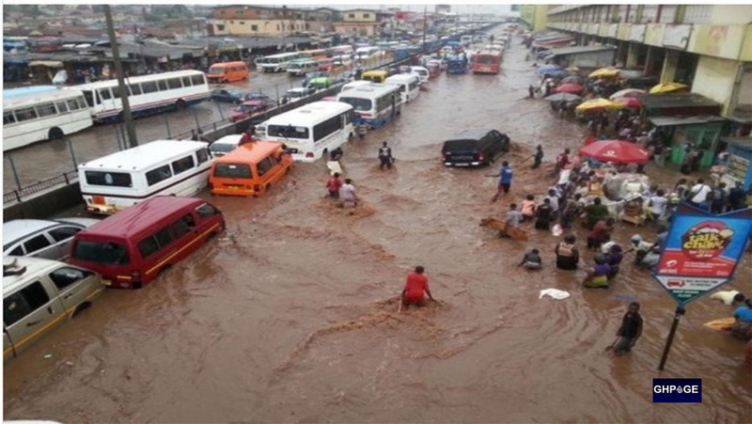
Health and safety professional Edward Debrah has urged authorities to focus on addressing the root causes of flooding rather than relying on deploying divers to address the increasing number of flood-related deaths in the Asokore Mampong Municipal Assembly.
Speaking on Joy FM's Midday News, Mr Debrah described proposals to deploy divers among residents in flood-prone communities as a reactionary measure that fails to address the real factors contributing to the annual loss of lives during floods.
According to him, any meaningful response to recurring flood disasters must begin with a thorough investigation into the causes of the incidents. He explained that such investigations should identify immediate causes, underlying causes and root causes before solutions are proposed.
"The root causes, in my view, are building on waterways and on unapproved places. Let's solve that problem first before we begin to think about swimming," he stressed.
His remarks come as authorities intensify efforts to reduce drowning deaths during floods, including the deployment of trained divers to vulnerable communities. At least 14 flood-related drowning deaths have reportedly been recorded in recent weeks.
While acknowledging the deployment of divers as a temporary measure to help prevent further fatalities, the safety professional insisted that authorities must take responsibility for enforcing planning regulations and preventing developments in unauthorised locations.
"There's a reason people are voted as leaders. There's a reason people are leading municipal authorities. If you are charged to lead such an area, the responsibility is to account for your stewardship," he said.
Mr Debrah questioned why buildings continue to spring up on waterways despite existing regulations and repeated warnings about the consequences.
"What are we doing? We've granted permits to people to build on waterways. So why are we now complaining when floods come?" he asked.
He called for stricter enforcement of building regulations, routine desilting of drains and gutters, and sustained public education on flood prevention.
"Let's desilt our gutters. Let's do public education. Let's refuse permits to people to build in unapproved areas so we can address the issues holistically.
"Authorities would only write on your building, 'Stop' or 'Produce permit.' Have you seen any building being removed because somebody failed to produce a permit? They will be fined, and the project continues. That has to stop," he said.
Mr Debrah maintained that reducing flood-related deaths requires long-term planning, strict adherence to building regulations and decisive action against illegal developments rather than what he described as "knee-jerk responses" introduced after disasters occur.
Latest Stories
-
We need leaders with integrity – Dramani warns supermajority Parliament over Afenyo-Markin allegations
2 minutes -
Parliament scrutinises govt but cannot scrutinise itself – Dramani challenges MPs to apply their own standards
20 minutes -
Partisan solidarity overrides accountability – Dr Dramani accuses Parliament of protecting its own
42 minutes -
This goes beyond Afenyo-Markin – CDD warns fresh allegations could damage Parliament
1 hour -
Parliament is in crisis of confidence – CDD’s Osae-Kwapong warns fresh allegations could ceepen public distrust
1 hour -
Nigeria’s president orders rescue after mass kidnapping exposes security failings
2 hours -
Meta, US states have discussed settling teen social media harm case, Bloomberg News reports
2 hours -
All the best Savinho – welcome Savio… new club, new name for Spurs signing
2 hours -
Baleba completes £70m Man Utd move from Brighton
2 hours -
China prepares for more heavy rain from back-to-back storms
2 hours -
Alcaraz and Williams thrill in US Open mixed doubles
3 hours -
Ghislaine Maxwell loses bid to throw out conviction for aiding Jeffrey Epstein
3 hours -
Instagram head Mosseri, at children’s addiction trial, says few teenagers knew of safety feature
3 hours -
Tanzania’s vice-president announces resignation in unprecedented move
3 hours -
If Parliament loses public trust, democracy suffers – Osae-Kwapong warns of damage to oversight
4 hours