

Audio By Carbonatix
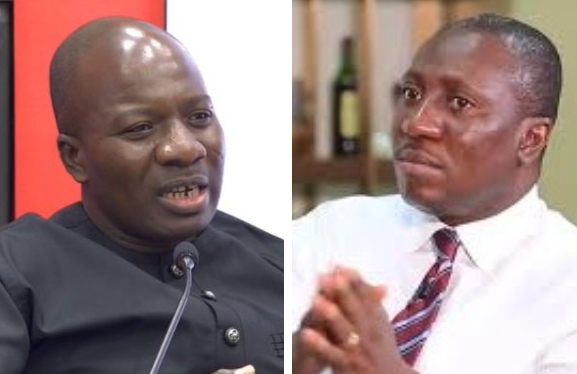
Executive Director of the Africa Centre for Parliamentary Affairs, Dr Rasheed Dramani, has accused Parliament of repeatedly failing to hold its own members accountable when serious allegations are made against them.
He said partisan loyalty often takes precedence over the scrutiny expected from lawmakers, contributing to growing public perceptions that Parliament is corrupt.
Speaking on Joy News’ PM Express on Tuesday, Dr Dramani said his concern goes beyond the allegations involving Minority Leader Alexander Afenyo-Markin.
He said the controversy should instead force Parliament to examine the credibility of the office and the institution itself.
“And for me, when this issue broke out, I was very worried not about Afenyo-Markin, but, as Inusah Fuseini said, about that office, particularly at a time when we have a supermajority parliament.”
According to Dr Dramani, Ghana needs parliamentary leaders with sufficient integrity to hold the Executive accountable, particularly under a supermajority.
“We need leaders with integrity. We need a minority with a very high level of integrity to be able to hold this supermajority and the executive accountable.”
He said his concerns deepened after reflecting on persistent low levels of public trust in Parliament and high perceptions of corruption.
Dr Dramani said one major factor is MPs' tendency to rally around colleagues facing allegations without first demanding answers.
“I think the first one is that over the years we have seen in our parliament that partisan solidarity overrides accountability.”
“So you accuse one person, then an entire caucus begins to rally around that person without even asking the critical question.”
He said the public’s perception of Parliament is further worsened when lawmakers accused of wrongdoing appear before court and receive broad support from colleagues.
“We saw over the years MPs accused, and they are in court. Any time they are going to court, the whole parliament is empty. It increases that level of perception of mistrust.”
Dr Dramani also questioned whether Parliament applies the same scrutiny to itself that it applies to the Executive.
“Parliament is better at scrutinising the executive than having the moral authority to scrutinise itself,” he said.
He cited the work of the Public Accounts Committee as an example, noting that it held about 31 public hearings in 2024 and made more than 1,000 recommendations for recovery of resources.
“Does it apply the same kind of standard to its own whenever we hear some of these issues?”
He also blamed the political cost of investigating fellow MPs for the reluctance to pursue such allegations.
“The political cost of, you know, investigating themselves, their own, is usually very high, and they would rather keep quiet because, over the years, they build relationships; current MPs are future ministers, and all kinds of networks and so on.”
The comments come amid the dispute between Minority Leader Alexander Afenyo-Markin and GoldBod Chief Executive Officer Sammy Gyamfi.
Mr Gyamfi accused Mr Afenyo-Markin of extortion during a public dispute over criticism of GoldBod. Mr Afenyo-Markin rejected the allegation and threatened legal action, leading to a wider suing brouhaha.
The Minority Leader has since gone to court, while the Office of the Special Prosecutor is conducting a preliminary assessment to determine whether to open a full investigation.
Dr Dramani said the current controversy presents Parliament with an opportunity to demonstrate that allegations against its members can be resolved transparently.
“What Parliament hasn’t done for itself over the years is that we haven’t seen a clear path from allegation to resolution.”
He said Parliament should consider involving independent figures in any investigation.
“I am hoping, Evans, that maybe for the first time we would have a committee that is made up not only of MPs.”
He proposed a committee comprising MPs and eminent Ghanaians if Parliament does not opt for an external investigative body.
“Maybe a committee of parliament that is made up of MPs and some eminent Ghanaians, so that for the first time, and in the interest of Parliament itself, in order to improve its image in the eyes of the public, that this matter is dealt with.”
Dr Dramani said the outcome must be clear, whether the allegations are proven or dismissed.
“Let us see a clear path from this allegation to a clear resolution, and if there are sanctions, let them be applied; if there are exonerations, let those happen.”
Latest Stories
-
CSOs call for review of gold reconnaissance activities along Ghana’s inshore waters
38 minutes -
Gov’t is committed to addressing teachers’ conditions of service, deprived-area allowance – Minister
44 minutes -
Traffic, not sour grapes, kept Nana Akomea away from NPP swearing-in
56 minutes -
Trump says he will stop using taxpayer funds for ads after bipartisan pushback
1 hour -
Nana Akomea explains why he ignored polls ahead of NPP election
1 hour -
‘Bamba’s message was clever, very clever’ – Akomea on NPP election upset
2 hours -
Nana Akomea reveals why he was disappointed after placing third in NPP election
2 hours -
Saudi Arabia urged to spare man sentenced to death over Facebook post
2 hours -
NPP to deliberately select candidates for orphan constituencies ahead of 2028 election
3 hours -
NPP wants early profiling of parliamentary candidates to avoid costly campaigns – Nana Akomea
3 hours -
At least 22 dead after two boats collide on Congo river, official says
3 hours -
Heavy rains lead to Senegal floods, government reports several deaths
3 hours -
FTBLRLIFE targets Ghana in expansion of global grassroots football network
4 hours -
NPP has secured the ‘blessing of time’ for 2028 election – Nana Akomea
5 hours -
NPP says early flagbearer selection has helped stabilise party reorganisation
5 hours