

Audio By Carbonatix
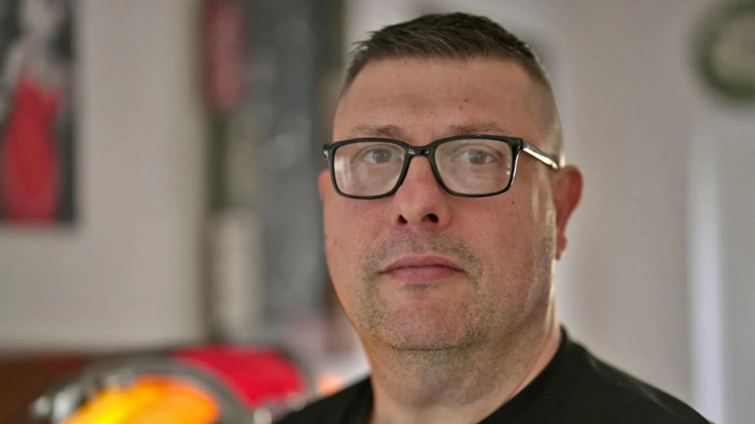
A man who was falsely convicted and spent more than five years in prison has said he felt "sick" to learn that his compensation claim has been rejected again.
Brian Buckle, from Pembrokeshire, was completely cleared of the sex abuse charges he was jailed for, but the struggle to clear his name cost him £500,000.
The Ministry of Justice (MoJ) rejected Buckle's first appeal for compensation last year, prompting the former Justice Minister Alex Davies-Jones to intervene. But he recently discovered that his second appeal has also been rejected.
The UK government said it acknowledged the grave impact of miscarriages of justice and was committed to helping people rebuild their lives.
A long-awaited review of the criminal appeals system in England and Wales, carried out by the Law Commission, said its report on compensation would be published this year.
Buckle, from Fishguard, was convicted of historical child sex abuse in 2017 and sentenced to 15 years in prison.
His family, including his wife Elaine, vowed to fight for his freedom, convinced of his innocence.
A five-year legal battle resulted in the Court of Appeal finding Buckle's conviction unsafe and he was immediately released from prison.
In a retrial at Swansea Crown Court in 2023, Buckle's barrister, Stephen Vullo KC, produced new forensic evidence and witnesses, resulting in a swift, unanimous verdict of "not guilty".
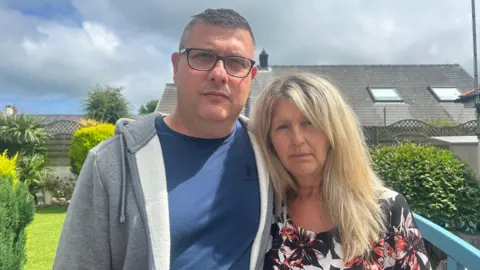
But proving his innocence cost Buckle and his family £500,000, and the impact on his mental health has been severe.
"I suffer with PTSD, I'm on medication, I'm just always on edge," he said.
"As a family it's been really hard, it's the most horrendous thing I've ever had to go through."
After Buckle was rejected for compensation for miscarriages of justice in 2024, his MP, Ben Lake, hosted a debate in Westminster to raise the issue.
Buckle's case was also mentioned in the House of Commons, and former justice minister Davies-Jones said she wanted to restore his faith in the criminal justice system.
When the MoJ then agreed to review Buckle's application for compensation, Buckle, Vullo and Lake were hopeful that the support they had received from the government would make a difference.
But in April, the MoJ told Buckle that despite a further review, compensation could not be awarded as his claim did not meet the criteria against the statutory test.
Confusingly for Buckle, the letter also said: "We would want to highlight that this decision does not affect the fact that Mr Buckle's conviction was quashed, nor does it cast doubt on the outcome of the appeal."
'Not fit for purpose'
Lake, who has campaigned for his constituent for the past two years, said the case was one of the clearest injustices he had come across in his nine years as an MP.
He said he was "so disappointed" by the outcome, as he hoped the review would have resulted in a pay-out "for what the state has done to Brian".
"I'm not going to let this lie. If that means that I'm to drag ministers to the House of Commons or Westminster Hall, and table questions until they finally do the right thing, then so be it."
Buckle's compensation claim was rejected due to a subtle but important change in the law in 2014.
Previously, compensation was paid out if the claimant had established, beyond reasonable doubt, that any reasonable jury could not convict on the evidence provided.
In Buckle's retrial the jury found him "not guilty" after hearing new witnesses and forensic evidence, which would have made him eligible for a pay-out.
But since 2014, compensation is only paid to those who can prove they did not commit the crime, which Vullo said was impossible as no DNA or CCTV evidence exists to conclusively prove Buckle's innocence.
"If you were to ask me to draft a piece of legislation that would ensure that almost everybody was turned down for compensation, I'd draft something similar to this (current law)," said Vullo.
"It's not by mistake, it's intentional," he claimed.
An MoJ assessment on the impact into the law change at the time stated that the intended effect was to lessen the burden on taxpayers.
Miscarriages of justice compensation has become an increasingly contentious issue.
In 2024, the Law Commission was asked by the UK government to include compensation and support for the wrongly convicted in its ongoing review of criminal appeals for England and Wales.
Scotland and Northern Ireland have their own compensation schemes for miscarriages of justice.
The Post Office Horizon computer system scandal has been described as one of the UK's most widespread miscarriages of justice. Four separate compensation schemes have been established for victims to receive pay-outs, as they would not have been eligible under the scheme which rejected Brian's application.
Andrew Malkinson, who served more than 17 years in prison after being wrongfully convicted of rape, had his conviction overturned due to DNA evidence which proved he did not commit the crime. But he was left destitute while waiting for compensation.
Widespread media attention of Malkinson's case resulted in him receiving an interim payment in February last year. He described the system as "not fit for purpose".
The Law Commission published provisional proposals in February 2025 which included reversing the 2014 law change so the wrongly convicted would only have to prove their innocence on the balance of probabilities, rather than beyond reasonable doubt.
It has now announced that due to the considerable public interest in the findings, the section on compensation has been prioritised and will be published first, at the end of 2026.
Buckle hopes that any change will be applied retrospectively to include him and others who have been affected, and restore his faith in the criminal justice system.
Davies-Jones, the former justice minister, said she was deeply sorry to hear that Buckle's application had been unsuccessful again and recognised there were wider questions about the compensation scheme.
The MoJ said it would consider the Law Commission review's findings before deciding on any action in this area.
Latest Stories
-
AG proposes Bar Welfare Fund to provide social protection for lawyers
23 seconds -
Tales from abroad: Returning home is not always the remedy
1 minute -
GES opens applications for non-teaching staff promotion; here’s who qualifies
15 minutes -
What Is Wrong With Us: We fly halfway around the world to admire discipline, then fly home to tolerate chaos
18 minutes -
Discipline must not become abuse in raising children – ARK Foundation
25 minutes -
Photos: Culture, technology and cuisine take centre stage at Russia’s youth festival
26 minutes -
‘Who approved Laboma structures?’ – Victoria Bright calls for review of permitting system
32 minutes -
“The Darkest Chapter”: Latif Abubakar’s 21st production brings President Mahama’s UN reckoning to the National Theatre stage
36 minutes -
Teacher, three others investigated over alleged kidnapping of suspected MoMo fraudster in Kumasi
36 minutes -
Afenyo-Markin mourns Bernice Offei, describes her songs as ‘sermons set to music’
37 minutes -
Don’t just learn AI tools, use them to improve productivity – ALX Enterprise
44 minutes -
Free rabies vaccination campaign targets 25,000 dogs and cats nationwide
50 minutes -
Ghana needs a system to track child protection funding to where risks are highest – ARK Foundation
52 minutes -
AI may not replace humans, but workers who fail to adapt could lose jobs – ALX Enterprise
54 minutes -
Gideon Boako: Bretton Woods is fraying; Ghana has built a bridge
56 minutes