

Audio By Carbonatix
There was a time when choosing a university required a fairly uncomplicated investigation. You checked whether the institution existed, whether it was accredited, whether it offered your programme, and, if your parents survived the fees, you went to school.
Ghana has apparently added another stage to the process.
After graduation, kindly check whether the institution that graduated you is recognised.
The Ghana Tertiary Education Commission has published a list of 100 institutions that it says are currently not recognised because of various quality assurance concerns. The list travels confidently across the globe, from Mexico to India, America, Switzerland, Nigeria, Zambia and back home to Ghana, proving that higher education, like galamsey and football disappointment, now enjoys impressive international cooperation.
GTEC is careful with its language. It has not announced that every institution on the list is fake, nor that every qualification issued is automatically worthless. It says the institutions are currently not recognised and advises the public to exercise due diligence regarding certificates issued by them.
Excellent advice.
Unfortunately, due diligence tends to arrive in Ghana at about the same time as the ambulance: after something has happened.
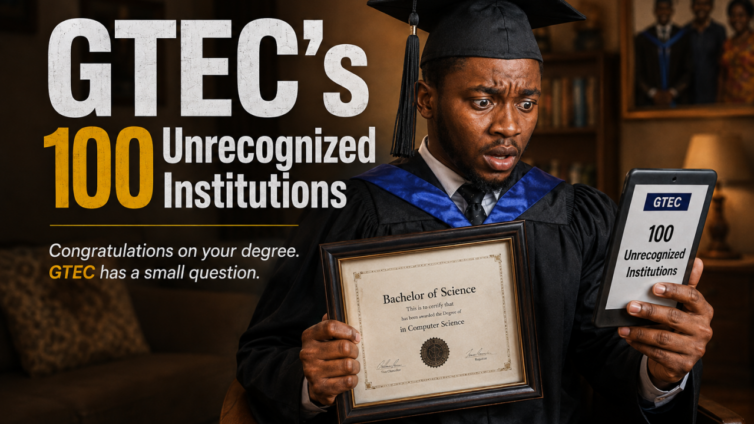
Imagine studying for four years, paying fees semester after semester, attending lectures, writing examinations, defending a thesis, buying a graduation gown, inviting Auntie Mansa from London, taking 317 photographs beside artificial flowers and finally adding three letters behind your name on LinkedIn.
Then GTEC publishes a list.
You scroll casually.
Number 23.
Not yours.
Number 45.
Still safe.
Number 60.
Ei.
Suddenly, the framed certificate hanging majestically in the sitting room begins to look at you differently.
The Republic has always had a healthy respect for education, but somewhere along the way we developed an even healthier respect for titles. A Ghanaian may forgive you for owing him money, but introduce yourself as “Dr” and his voice immediately drops by two octaves.
We love titles so much that some business cards require an appendix. Dr Reverend Professor Apostle Engineer Lawyer Chairman Chief Executive Ambassador. By the time the actual name arrives, the meeting is almost over.
This is why GTEC’s list should concern us beyond the comedy.
Eleven entries are Ghana-based or partly Ghana-based. Among them are institutions in Kumasi, Effiduase and elsewhere. So this is not merely about somebody sitting in Accra ordering an exotic online doctorate from a university whose campus may be located somewhere between a website and divine revelation.
Real people may be spending real money, investing real years and presenting real-looking certificates whose recognition they may not have properly verified.
And here the authorities must also accept part of the interrogation.
If an institution is operating openly, advertising programmes, recruiting students, collecting fees and perhaps holding graduation ceremonies, how much of the burden should fall on an eighteen-year-old applicant and his parents to discover that the regulator has concerns about it?
“Do your due diligence” is sensible.
But regulation cannot become a national treasure hunt in which the citizen must first become Sherlock Holmes before paying school fees.
The stronger system is one where recognition status is easy to check, warnings are loud and continuous, enforcement is visible, and questionable institutions do not enjoy years of sunshine before somebody publishes a list.
Still, the immediate lesson is painfully simple.
Before paying fees because the brochure contains photographs of smiling graduates in gowns, check GTEC.
Before accepting admission because the institution has “International”, “Global”, “American”, “Swiss”, “Royal” or “University” somewhere in its name, check GTEC.
And before adding “Dr” to the family WhatsApp group and changing everybody’s saved contact, perhaps check GTEC twice.
Because in the modern Republic, acquiring knowledge is no longer enough.
You must also confirm that the institution which certified the knowledge is known to the people whose job is to know institutions.
Otherwise, after four years of lectures, assignments and school fees, you may discover that the most important course was the one nobody put on the timetable:
Due Diligence 101.
Latest Stories
-
Food vendor recounts how she narrowly escaped New Winneba attack
4 minutes -
Military to secure James Town after massive waste evacuation – Ayariga
5 minutes -
Charlie Kirk murder suspect pleads not guilty as judge clears way for death penalty trial
7 minutes -
Signals Bureau case: ‘We were battle-ready’ – Atta Akyea fires at AG over absence of prosecution team
16 minutes -
NSA sets September 4 deadline for final rectification of biodata mismatches
18 minutes -
Gospel musician Bernice Offei reported missing
23 minutes -
IMF, former gold buyers uncomfortable with Ghana’s gold policy – Asiedu Nketia
26 minutes -
18 years, 66 plays Ebo Whyte has one more story to tell: “Honey trap”
27 minutes -
PHOTOS: McDan and Ayuda claim singles titles in 2026 JoySports Invitational
27 minutes -
IEA describes gov’t proposals on women, marginalised groups in Parliament ‘grossly insufficient’
28 minutes -
Ghana marks 2026 Children’s Day with call to amplify voices against abuse
29 minutes -
TEIN UK–Ireland engages Ghana High Commission on support for students, professionals
30 minutes -
Fire destroys five commercial containers at Kotobabi Down near Antrack Filling Station
33 minutes -
NCD Alliance Ghana urges government to accelerate action on NCDs and mental health
34 minutes -
IEA rejects five-year presidential and parliamentary terms proposed in Ghana constitutional review
35 minutes