

Audio By Carbonatix
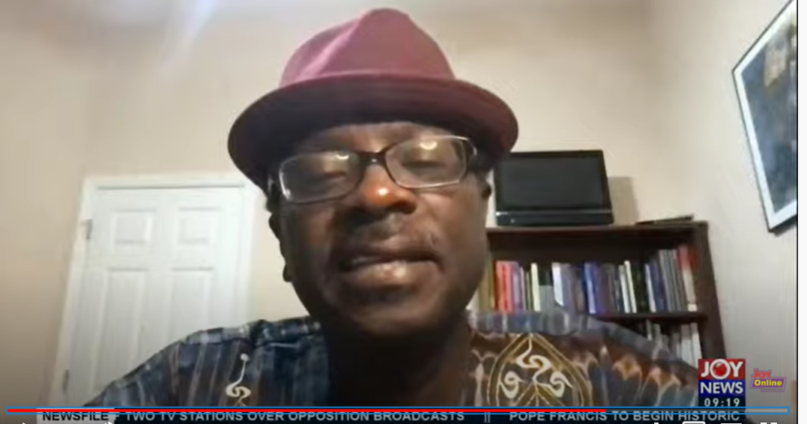
Ghanaian legal scholar Prof Kwaku Asare has cautioned Chief Justice Paul Baffoe-Bonnie against making public comments that could be interpreted as partisan political assessments, following his remarks about the performance of state institutions under the current administration.
Prof Asare said although he understood the sentiment behind the Chief Justice’s comments, the reference to “the past eight years” carried an unmistakable political meaning in Ghana’s political discourse.
He argued that such language, coming from the head of the Judiciary, could be interpreted as an assessment of one political administration against another and therefore risk undermining public confidence in judicial independence.
The Chief Justice, during a visit to the Minerals Income Investment Fund (MIIF) on Wednesday, September 2, praised the performance of MIIF and other state institutions.
He said some of the developments he had witnessed had left him wondering what Ghana had been doing over the previous eight years.
“I must congratulate you. I mean, you have done marvellously well. See, because sometimes when we hear the things that you have done, the things that some organisations are doing now, we wonder; some of us keep wondering what really we have been doing in the past eight years,” Justice Baffoe-Bonnie said.
Read Also: Chief Justice praises MIIF, other SOEs, questions what Ghana was doing in past 8 years
He made the comments after visiting the Social Security and National Insurance Trust (SSNIT), where he said he had also been impressed by what he was told about the institution’s performance.
Comparing the situation to previous plans to dispose of some SSNIT assets, including Labadi Beach Hotel, the Chief Justice said: “If you compare that to the fact that not too long ago, SSNIT was preparing to sell its prized assets like Labadi Beach Hotel, you wonder how Ghana could have sunk so low.”
‘That is territory the head of Judiciary should avoid’
Reacting in a Facebook post on Wednesday, September 2, Prof Asare said he was concerned less about whether the Chief Justice’s observation was right or wrong than about the implications of the language used.
“I understand the sentiment. But I worry about the language,” he wrote.
He said the phrase “the past eight years” had a clear partisan connotation in Ghana’s political environment.
“‘The past eight years’ carries an unmistakable partisan meaning in our political discourse. Coming from the Chief Justice, it can therefore easily be understood, fairly or unfairly, as an assessment of one administration relative to another,” Prof Asare said.
“That is territory the head of the Judiciary should avoid,” he added.
According to him, judges remain citizens with personal views when they assume office, but the judicial robe places a greater obligation on them to exercise restraint in their public pronouncements.
“Judges do not cease to be citizens when they assume office. But the robe necessarily constrains their public speech. This is especially so for the Chief Justice, whose words inevitably carry the institutional weight of the Judiciary,” he said.
‘The obligation is reciprocal’
Prof Asare said the expectation of judicial restraint should complement demands on politicians to respect the independence of the Judiciary.
“We rightly insist that politicians respect judicial independence and stay out of the judicial arena. The obligation is reciprocal,” he said.
“Judges, particularly the Chief Justice, must also exercise the restraint necessary to stay out of the partisan political arena.”
He stressed that his criticism was not based on an assumption about the Chief Justice’s motives or whether his assessment of government performance was accurate.
“The point is not whether the observation is right or wrong. Nor is it about the motives of the speaker. It is about protecting an institution,” he said.
Concerns over perception of judicial neutrality
Prof Asare warned that the comments could become particularly consequential because cases involving decisions of both the previous and current governments could come before the courts.
“There will be cases before our courts involving the acts and omissions of the previous government. There will be cases involving this government,” he said.
He argued that no litigant should have reason to question whether the head of the Judiciary had already formed a favourable or unfavourable view of a particular administration.
“No litigant should have reason to wonder whether the head of the Judiciary has formed a favourable or unfavourable view of any administration,” he said.
Prof Asare therefore framed judicial independence as requiring restraint from both sides of the political divide.
“Judicial independence requires political restraint, from politicians toward judges, and from judges toward partisan politics,” he said.
He concluded: “The higher the judicial office, the heavier the burden of restraint.”
The political context
Prof Asare’s comments come against the backdrop of the politically contentious circumstances surrounding Justice Baffoe-Bonnie’s elevation to Chief Justice.
He became Acting Chief Justice in April 2025 after President John Dramani Mahama suspended then-Chief Justice Gertrude Torkornoo following the determination of a prima facie case against her under Article 146 of the Constitution.
Justice Baffoe-Bonnie, then the most senior Justice of the Supreme Court, assumed the acting position before President Mahama nominated him as substantive Chief Justice following Mrs Torkornoo’s removal.
Parliament subsequently approved his nomination by 163 votes to 69 in November 2025, following a contentious process during which the New Patriotic Party (NPP) Minority raised objections and boycotted his vetting.
The Minority argued, among other things, that the appointment should not proceed while legal challenges relating to Mrs Torkornoo’s removal were pending. It also raised concerns about Justice Baffoe-Bonnie’s involvement in Supreme Court proceedings connected to the removal process.
Justice Baffoe-Bonnie has rejected suggestions that his elevation was politically motivated. During his vetting, he defended his judicial record and pledged to uphold judicial independence and provide leadership that would command confidence across the political divide.
Latest Stories
-
Ayew brothers among Ghanaians without clubs after transfer window closes
7 minutes -
GPHA records GH¢2.82bn net profit as revenue rises to GH¢7.62bn
14 minutes -
Today’s front pages: Thursday, September 3, 2026
19 minutes -
Police arrest over 10 students over Okuapeman-Mount Sinai clashes
35 minutes -
WAFU B WCLQ: Ampem Darkoa Ladies thrash Dynamique FC to reach final
2 hours -
Chief Justice should avoid partisan political arena – Prof Kwaku Asare
2 hours -
GMTF Administrator hails Mintah Akandoh’s support as Fund marks first year
2 hours -
GPHA honours 410 staff for outstanding service
2 hours -
BoG slashes September FX support to $500m as GoldBod boosts dollar supply
2 hours -
GNFS rolls out automated fire compliance system
2 hours -
SOE profit at GH¢19.8bn: I call it a miracle, but it’s not operational efficiency – Dr Atuahene
2 hours -
SHS violence: Government must review discipline policy – IFEST
3 hours -
Nana Akomea leads NPP First Vice Chairman race in new poll
3 hours -
Ato Forson begins groundwork for Mahama’s $10bn New Economy agenda
3 hours -
SHS violence: Peter Anti demands intelligence-led security in schools
3 hours