

Audio By Carbonatix
When Esther Owusu Nkwantabisah needed a display fridge for her fledgling food business, buying one was not an option. So she improvised.
Using a large styrofoam box wrapped in wooden pallets, Esther created a makeshift display that kept her local drinks and savoury products cold while allowing her to present them professionally to customers.
It was a simple solution, but one that captured the philosophy that would come to define her approach to entrepreneurship: build with what you have and do not wait for perfect conditions to begin.
“Lack of resources should not automatically become a lack of action,” she said.
Today, that philosophy extends beyond selling food. What began as a university side hustle was formally registered as Abukay Cuisine in 2019 and launched after the COVID-19 pandemic.
Founded and owned by Esther, the Ghanaian food business has become a platform through which she has explores21qsad the intersection of nutrition, sustainability and community impact.
From Food Science to Entrepreneurship
Esther’s entrepreneurial journey is rooted in nutrition, food science and product development. She studied Family and Consumer Sciences before completing her National Service at Ghana’s Food and Drugs Authority, where she gained practical exposure to food safety, standards and regulation.
While at university, she began experimenting with what would eventually become Abukay, developing food products connected to her interests in nutrition and sustainability.
Then, in 2020, her plans changed abruptly.
After completing her National Service and securing full-time employment, Esther lost her job as the COVID-19 pandemic disrupted businesses around the world. It came during an already difficult period personally, one she would later describe as her “planting season”.
“It was uncomfortable, dark and, at times, felt like nothing was happening, but I believed it was necessary for what would eventually grow,” she said.
With limited resources and sometimes barely enough money for internet data, Esther applied to ALX. She was not looking simply for another qualification. She wanted to understand how the small venture she had started at university could become a viable business.
Learning to Build Beyond the Product
Esther already knew how to develop food products. What she realised she lacked was the business thinking required to build a sustainable enterprise around them.
Through ALX, she was exposed to strategy, positioning, customer relationships, communication and networking. More importantly, she began asking different questions about Abukay: Who was she serving? What problem was she solving? How should she communicate that value? And what would it take to grow?
“That shift in thinking was extremely important for Abukay,” she said. She began putting those lessons into practice, from finding resourceful solutions to becoming more deliberate about relationships and opportunities.
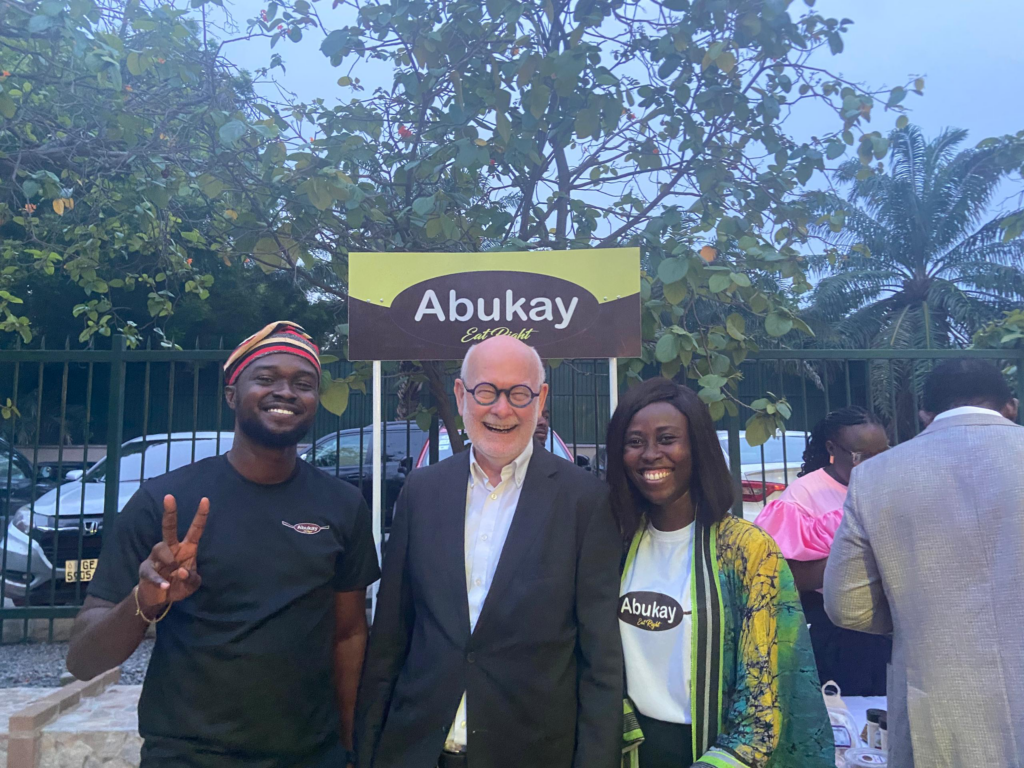
Through the ALX community, Esther also gained opportunities to introduce Abukay to people outside her immediate network.
A conversation at one event developed into an ongoing relationship that eventually led to an opportunity for her to introduce Abukay’s Sobolo, a traditional Ghanaian hibiscus drink, to international delegates at Kempinski.
The experience reinforced something Esther was learning about entrepreneurship.
“Positioning isn't always about being the loudest person in the room. Sometimes it's about identifying the right person, starting a genuine conversation and being confident enough to tell your story,” she said.
Turning Food into a Platform for Change
As Abukay developed, Esther began asking a bigger question: what else could a food business help solve?
Two challenges stood out: nutrition and plastic pollution.
Her response was the Abukay Plastic Currency Payment Option (APCPO), an initiative that allowed participants to exchange properly segregated recyclable plastic waste for Abukay products.
Making the idea work required recycling partnerships, participant education and community engagement. More than 20 people signed up to participate, while the initiative also expanded Esther’s understanding of what entrepreneurship could accomplish
“It taught me that entrepreneurship can be a vehicle for solving problems, not just a vehicle for making money,” she said.
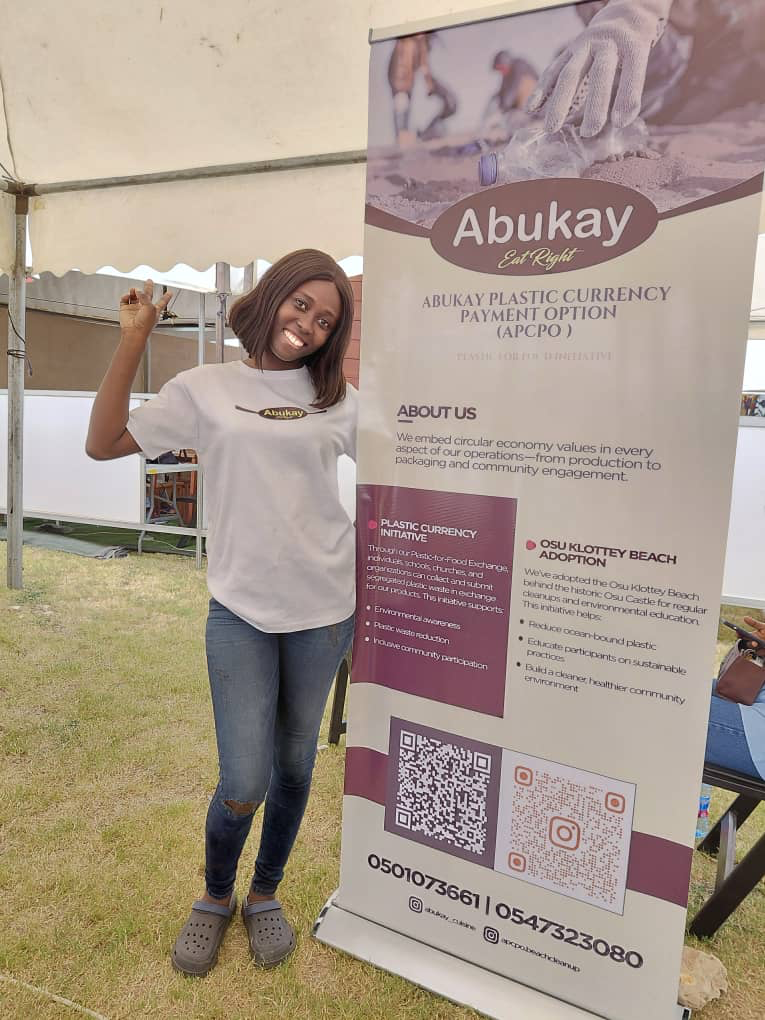
Esther shared the initiative with the ALX community, which eventually led to a partnership between Abukay and ALX for a clean-up at Korle Clottey Beach, behind Osu Castle.
The experience showed Esther how an idea developed within a food business could mobilise people around a much broader challenge. “What started as an attempt to connect nutrition and environmental sustainability opened a completely different door,” she said.
Measuring Growth Differently
Today, Abukay can produce up to 5,000 products for a given order. But Esther’s definition of entrepreneurial success has expanded beyond production and sales.
“When I started Abukay, entrepreneurship was largely about survival,” she said. “I wanted to build something that could generate income and give me independence.”
Today, she sees it differently. Her work has expanded beyond Abukay to include Health Cave, a naturopathic snack bar she founded, and the Abuburo Nkosuah (A.N) Foundation, where she serves as Founder and Board Chair.
Through the Foundation’s programmes, more than 2,000 students were impacted and over 50 start-ups were supported. Esther is also a founding member and board member of the Horticulture Business Platform through Abukay.
Across these different initiatives is a common idea: using enterprise to create value that extends beyond herself.
“I want young people to have places where they can learn, experiment, make mistakes, build confidence and gain practical experience,” she said.
For Esther, ALX did not create the ambition or technical knowledge. Those foundations already existed. What the experience provided was a framework for connecting her skills and ideas to strategy, relationships and opportunity.
Perhaps the clearest measure of that shift is the question she now asks herself when confronted with possibility.
“I stopped seeing opportunities as things that I had to wait for someone to give me,” Esther said. “I started asking myself, ‘What can I build, and who can I build it with?’”
Latest Stories
-
Today’s front pages: Wednesday, September 23, 2026
21 minutes -
Ghanaian pastor, Rev Emmanuel Boakye-Danquah on the run over alleged counterfeit currency syndicate
29 minutes -
Give Teshie Desalination to Kasapreko or Accra Brewery
36 minutes -
Absa Bank Ghana and IFC announce $50m facility to expand cocoa financing
45 minutes -
Ghana’s economic revival: Turning financial stability into economic prosperity
1 hour -
AFCON 2027Q: Black Stars to depart Accra for Bouaké ahead of Ivory Coast clash
1 hour -
Who to allow into your home, who should come into your cyberspace? Trust is becoming unbecoming
1 hour -
At least 11 dead in mass shooting at house party in South Africa
2 hours -
MoMo Fintech Lab attracts close to 1K entries from innovators across, applications end on Sept 30
2 hours -
Black Stars face Ivorian test as injuries force major squad changes
2 hours -
Save Nations Foundation donates learning materials to Nooria Islamic Basic School, calls for more support
2 hours -
From selling food to solving problems: How Esther Owusu Nkwantabisah rethought entrepreneurship
2 hours -
Explained: Ghana’s water plant deal that produced a $235m judgment debt instead of water for 500,000 people
3 hours -
High Cost of Domestic Airline Fares: Can government do something about it?
3 hours -
Inflation, cedi depreciation put BoG’s MPC under pressure as policy rate decision looms
3 hours