

Audio By Carbonatix
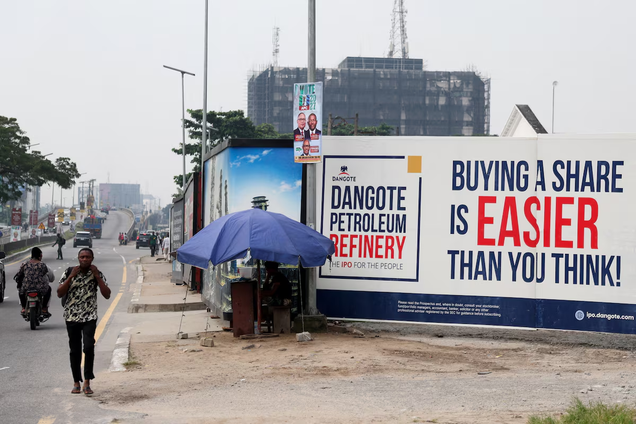
The fervour around the initial public offering of Nigeria's Dangote mega-refinery could help deepen Africa's capital markets and unlock funding for everything from roads to ports, a senior Citi executive told Reuters.
Subscriptions for billionaire Aliko Dangote's "people's IPO" are due to close on Tuesday, with the company targeting mainly retail investors to raise about $1.6 billion for the refinery's expansion.
The offering, which crashed investment platforms and spawned dozens of memes from enthusiastic new "owners", could also encourage more Africans to invest through local stock exchanges, Citi's head of banking for Sub-Saharan Africa, Akin Dawodu, said.
"The Dangote Refinery here in Nigeria captured the public imagination in a very real way ... You need that," Dawodu said during an interview in London, adding that years of low trust and liquidity had held back local equity markets.
"Something like (Dangote) brings people back to the market."
MORE OPTIONS FOR AFRICAN ISSUERS
Some investors and analysts have questioned the refinery's valuation, arguing the shares are being offered at a rich price relative to the company's growth prospects. Still, any increase in equity market participation could have broader benefits. Fewer than 5% of Nigerian adults invest in capital markets, according to the country's stock exchange.
Dawodu said Africa needs to mobilise more of its own resources to fund major projects and reduce borrowing costs.
"The size of the stock exchanges across Africa, (Johannesburg) excepted, is very small relative to the capital available," Dawodu said. "We have to find a way to unlock that."
Citi and Dawodu declined to comment on individual clients, but global banks are not thought to have a role in the IPO. According to banking sources, Citi is advising Dangote Cement on a planned secondary listing in London.
Policymakers and development lenders, including the African Development Bank, opens new tab, are increasingly focused on tapping Africa's growing pools of capital, from retail savings to pension and insurance funds, to help finance the trillions of dollars needed for infrastructure and development.
Dawodu said international investors now have a more nuanced understanding of African risk.
Successive crises, from COVID-19, which effectively closed international markets to most African sovereigns, to Russia's full-scale invasion of Ukraine in 2022, have left countries better prepared to navigate geopolitical turmoil and wider bond spreads, he said.
"African issuers have more options now than they did in the past," Dawodu said, citing domestic capital markets, export credit agency financing, credit-enhanced structures, and concessional borrowing.
"That means that if the markets tighten a bit, they can find other options to alleviate that."
One of those options, total return swaps, has attracted scrutiny. The International Monetary Fund has warned about transparency risks, while Senegal is grappling with its use of the instruments as part of an ongoing debt treatment.
While Dawodu said "all the noise" around TRS had dampened interest, they remained "perfectly valid structures for borrowing money" that Citi offers clients, though he declined to elaborate on individual transactions.
"The fundamentals of a product are not in any way controversial or disadvantageous to the borrowers," he said.
Latest Stories
-
NHIA seeks legal reforms to support Free Primary Healthcare
4 minutes -
Beatrice Annan defends Afi Agbenyo’s EC appointment, cites record of gender advocacy
7 minutes -
Ghana seeks investment deals in Bangkok amid global economic crises
11 minutes -
IMF raises Ghana’s 2026 growth forecast to 5.7%, sees inflation falling to 4.8%
12 minutes -
Ablakwa urges Africans not to view immigrants as threat to national progress
17 minutes -
Mahama Cares must fund treatment, not looting – Asogli chiefs
18 minutes -
Ghana’s economic salvation lies not in shifting geo-political allegiances – Dr Atuahene
21 minutes -
BoG proposes tougher rules on loan repayment assessment
26 minutes -
Government plans mandatory drug tests for public service jobs — Muntaka
31 minutes -
Media urged to intensify awareness campaigns on breast cancer
36 minutes -
Interior Minister urges public to share drug intelligence
42 minutes -
Afadzato South DCE commissions water projects, teachers’ bungalow
47 minutes -
Council of State urges sustained dialogue, negotiations as teachers resume work
52 minutes -
We are committed to leaving a legacy in Mandari – Bole-Bamboi MP
55 minutes -
Greater Accra teachers resume work after strike suspension
1 hour