


Audio By Carbonatix
This is the story told about South Africa's World Cup 2010 bid in the indictment served on 14 Fifa officials in a US court this week.
By May 2004, Jack Warner knew exactly which country he was going to back to host the 2010 World Cup.
Warner, the head of the Confederation of North, Central America and Caribbean Association Football or CONCACAF, had been a FIFA vice president since 1997 and had served on its executive committee since 1983.
During this time, he had turned the choosing of World Cup hosts into a lucrative enterprise that paid him handsome bribes and kickbacks in exchange for his influence over voting in FIFA elections and for host countries.

Jack Warner
He – and several co-conspirators – cast their vote for South Africa. They would shortly be US$10 million richer thanks to an elaborate scheme that involved fiddling with Fifa finances at the expense of the South African taxpayer.
Warner is among 14 defendants on a US indictment which lays bare how football was turned into a personal money-machine for powerful figures in Fifa.
So bad did Warner’s reputation become that he resigned from Fifa after the 2010 World Cup following public revelations of corruption.
How Warner took a US$10 million bribe from South Africa in exchange for his vote is laid bare in six pages of a 164-page indictment made public in the US following the arrest of Fifa executives ahead of the corruption trial of the century.
Section VI of the indictment is entitled “The Criminal Schemes” and section G is headed by the words “2010 FIFA World Cup Vote Scheme”.
The indictment details how Warner and his family cultivated their relationship with South African soccer officials during the failed bid to host the 2006 World Cup.
The indictment describes how during the early 2000s, Warner took his first bribe from South Africa, directing a family member to fly to Paris “and accept a briefcase containing bundles of US currency in $10,000 stacks in a hotel room from Co-Conspirator #15.”
Co-Conspirator #15 is not named but is described in the indictment as “a high-ranking official of the 2006 South Africa World Cup bid committee and the 2010 South Africa World Cup bid committee and local organizing committee.” A second South African - Co-Conspirator #16 – is given the same description.
The family member boarded a return flight to Trinidad and Tobago where he handed the briefcase full of money over to Warner.
This was a taste of what was to come. In 2004, the stakes were higher as South Africa found itself competing against weaker opposition in Morocco and Egypt for a World Cup that, it had already been decided, would be hosted by an African country.
In the months ahead of the May 2004 vote, Warner traveled to Morocco where, as was by now the custom, he was offered a bribe of US $1 million for his vote.

Not long after this offer was made, South Africa had to up the ante. Warner was made an offer he could not refuse – South Africa would pay $10 million to the Caribbean Football Union – a body controlled by Warner and described in the indictment as being financially intertwined with his personal bank accounts. The money, the South Africans are said to have told Warner was a payment to “support the African diaspora”.
Warner told an American Fifa executive that he and a third executive with voting rights would get $1 million of the money, if they voted for South Africa.
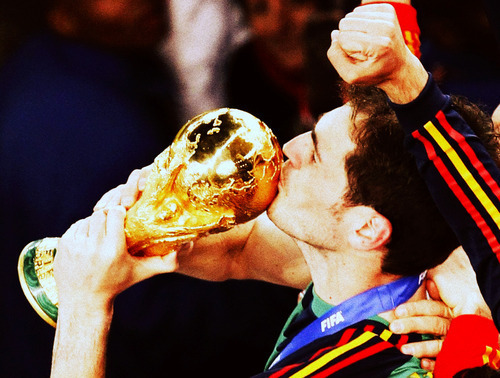
South Africa beat Morocco by 14 votes to 10. The three votes secured by the $10 million had turned out to be the difference between winning and losing. At a ceremony where the outcome was announced Nelson Mandela famously held the football trophy aloft. It was a Madiba moment, but the machinations that had made it possible were anything but saintly.
The American executive – named in the indictment only as Co-Conspirator #1 – began to badger Warner for his share of the money. He was told that there was a problem.
The South Africans now said it was impossible to pay the money directly out of government funds. An ingenious scheme was devised that would spare the South Africans from robbing their national treasury.
Fifa was due to pay South Africa hundreds of millions of dollars to help finance the hosting of the bid. Arrangements were made to subtract the $10 million from this payment and divert the money to Warner. South Africa’s government and its taxpayers would be $10 million poorer without anyone being the wiser.
In January and March of 2008, an unnamed “high-ranking” Fifa official made three payments from the diverted South African money to the bank accounts of the CFU and CONCACAF, both of which were controlled by Warner.
The payments of $616,000, $1 600 000 and $7 784 000 - $10 million in total, were wired form a FIFA account in New York to the accounts controlled by Warner at Republic Bank in Trinidad and Tobago.
Warner began to use the money, in one instance to pay a personal loan to the tune of $200,000. Warner laundered the money through a Trinidadian businessman and a large supermarket chain in Trinidad and Tobago.
Weeks later, checks totaling approximately the same amount and drawn on the account of a second company were deposited into bank account held by Warner and family member at First Citizens Bank in Trinidad and Tobago.
Over the next three years, Warner paid the American FIFA official his share of the bribe money in three tranches, but only paid him $750 000 of the promised $1 million.
A network of accounts in New York and the Cayman Islands were used to move the money. One payment was made directly into the American FIFA executive’s Merrill Lynch brokerage account. Warner had become careless. He once emailed his co-conspirator to inform him that the money was on the way.
The allegations contained in the indictment are yet to be proven in a court of law. But the evidence is mounting that South Africa bribedits way to hosting the 2010 World Cup.
Read the indictment's section on the South African bid here.
-
Latest Stories
-
GRIDCo completes initial repair works on Ashaiman transmission line
8 seconds -
Egyapa Mercer donates hairdryers to graduating hairdressers in Sekondi
6 minutes -
Health Ministry hands 30 ambulances to National Security for refurbishment
10 minutes -
Republic Bank deepens commitment to homeownership with nationwide JoyNews Habitat Fair partnership
15 minutes -
Archbishop Duncan-Williams links galamsey to Ghana’s wider culture of indiscipline
18 minutes -
India’s clean energy leadership in green hydrogen
27 minutes -
Ghana’s Road Safety Crisis: We must move from reaction to prevention
30 minutes -
Duncan-Williams urges Church to educate Ghanaians on dangers of galamsey and gold smuggling
40 minutes -
New Defence Minister pledges technology-led defence posture
45 minutes -
India and Africa: Relations beyond rhetorics
48 minutes -
Top Zambian opposition figures arrested days after presidential vote
48 minutes -
‘I’m not against enforcing the law’ – Archbishop Duncan-Williams defends call for prayer against galamsey, gold smuggling
53 minutes -
Tantalus or Triumph? Ghana and the Harvest of Economic Recovery
1 hour -
Ghanaians have no idea how much foreigners make from galamsey – Archbishop Duncan-Williams
1 hour -
Today’s front pages: Monday, August 17, 2026
1 hour