

Audio By Carbonatix
I arrived in Hamburg on June 1, 2025, believing the most important thing ahead of me was a conference.
I was wrong.
Before the city revealed itself, before panel discussions, policy language, and conversations about sustainability, Hamburg introduced itself to me through a stranger in a train tunnel beneath its airport.
This was my first visit to Germany, and I was carrying equal measures of excitement and uncertainty. That uncertainty deepened when I struggled to locate my luggage, a delay that left me tired and eager to leave the airport as quickly as possible.
When I finally found my bag, I followed the signs to the S-Bahn, the suburban rail system connecting Hamburg Airport to the city centre, where my hotel was situated.
The descent into the underground tunnel felt like crossing into unfamiliar territory. The ticketing system was efficient, silent and completely foreign to me.
I tried to buy a ticket. I failed. I tried again.
People moved past me with practised ease. I asked for help. Some tried briefly. Most were in a hurry. No one was unkind, everyone simply had somewhere else to be. Then someone tapped me on the back.
His name was Abdul.
He listened as I explained that it was my first time in Germany and that I was struggling to buy a train ticket. Without hesitation, he stepped in. He tried coins. Then paper notes. Then his card. Nothing worked. The machine rejected large euro denominations, something I did not know at the time.
I offered to reimburse him. Still, the problem remained.
Yet he did not leave.
For 10 to 15 minutes, we stood together in that tunnel outside Hamburg Airport, two strangers troubleshooting a stubborn machine while time quietly slipped away.
Eventually, it worked. I had my ticket.
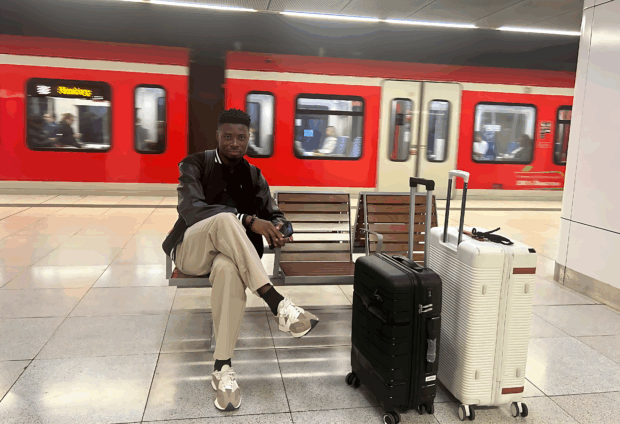
As we walked down to the platform, we began to talk. I asked for a selfie, and he agreed. He asked why I was in Hamburg.
I told him I was a journalist from Accra, Ghana, in the city for speaking engagements at the Hamburg Sustainability Conference 2025, where I was moderating a panel on sustainability and global change.
He listened carefully.
Abdul told me he was Moroccan and lived in Hamburg. He was on his way home.
Yet something about him felt distant, not disengaged, just weighed down. I noticed it but hesitated to ask. In unfamiliar places, curiosity can easily feel like an intrusion.
His train arrived before mine but he did not board it.
He stayed behind because I was unfamiliar with the area and wanted to be sure I was fine.
At some point, I went quiet, worried that I was delaying him. Then, without prompting, he said softly: “I lost my dad today.”
The words stopped me.
He explained that his father had died earlier that day in Morocco. He was trying to arrange travel home.
In Islamic tradition, burial takes place as soon as possible, often within 24 hours, making time not just urgent, but sacred.
And yet, this was the man who had paused everything to help me buy a train ticket.
In that moment, my understanding of scale collapsed. Just minutes earlier, I thought my biggest problem was navigating a ticket machine in a foreign country.
Standing beside Abdul, that concern shrank into perspective.
Grief, I realised, does not always announce itself loudly. Sometimes it moves quietly, through patience, restraint, and generosity.
My train arrived. Abdul nudged me gently and told me to go. He wished me success at the conference. I offered my condolences, though no words felt sufficient.
He told me he would return home and try again the next day to secure a flight, knowing he might miss his father’s burial.
We exchanged emails so I could thank him properly later. I never got the chance. A phone issue cost me his contact.
This essay is both a memory and an attempt at reconnection.
To Abdul, you helped a stranger in a moment of confusion while carrying grief far heavier than mine.
You reminded me that kindness is not suspended by pain, it is often shaped by it.
If this story finds its way back to you, know that your humanity crossed borders, cultures, and faiths. It stayed with me far longer than my time in Hamburg.
Perhaps that is my quiet resolution this year, to pause more often, to help when it is inconvenient, and to remember that the most meaningful commitments are not written at the beginning of the year… but lived, unexpectedly, in moments like that one beneath an airport.
Sometimes, the most important lessons do not come from conferences or prepared speeches, but from strangers who stop when they do not have to.
The author, Kenneth Awotwe Darko is a multimedia journalist from Ghana.
Follow him on Twitter via @TheKennethDarko, on Facebook, Kenneth Awotwe Darko, @TheKenDarko on Instagram and LinkedIn.
Latest Stories
-
GAEC must retain nuclear scientists for Ghana’s nuclear ambitions – Minister
18 minutes -
Man reportedly mistaken for game and shot by hunter dead in forest
21 minutes -
19-year-old mason jailed 15 years for defiling seven-year-old pupil
25 minutes -
Ghana’s banking sector assets rise 20.47% to GH¢500.2bn – BoG Governor
29 minutes -
22 injured as Sprinter bus overturns at Sege after tyre burst
31 minutes -
UN housing expert urges Ghana to strengthen Rent Control Department amid housing affordability concerns
39 minutes -
Delta-BCI partnership reaches 166,000 people with breast cancer education
49 minutes -
Power restoration fault suspected in Kumasi Central Market fire
6 hours -
The 7-foot giant of Ngleshie Amanfro: Seven-foot Ghanaian Ephraim Saawa dreams of joining the national basketball team
7 hours -
Government promises support for Kumasi Central Market fire victims
7 hours -
Vibes The Movie: Big Ghun’s Ghanaian film earns five nominations at 2026 REFFA
7 hours -
‘I’m a fulfilled man’—Justice Korbieh on missing out on Supreme Court despite two nominations
7 hours -
MamaCare CEO warns unresolved conflicts among health workers could undermine maternal and neonatal care
8 hours -
Health professionals urged to translate medical knowledge into practice to save mothers
8 hours -
Retired judge Justice Francis Korbieh charges 1,568 new lawyers to uphold integrity
9 hours