

Audio By Carbonatix
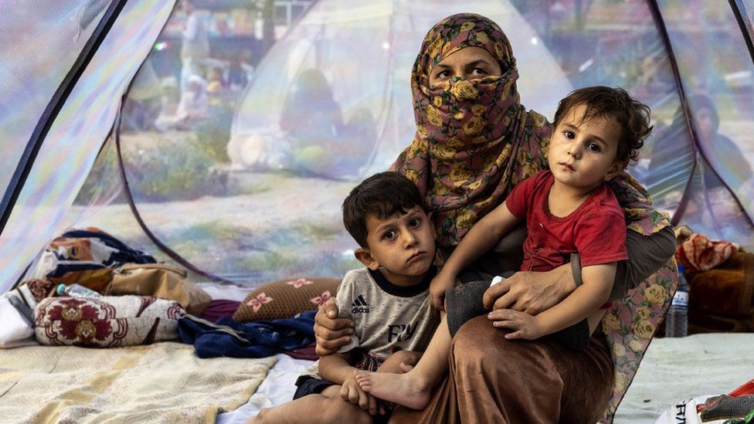
The UN has urged Afghanistan's neighbours to keep their borders open as the number of civilians fleeing the Taliban onslaught swells.
Thousands of those internally displaced have been arriving in Kabul, seeing the capital as their last safe refuge.
Food shortages are "dire", the World Food Programme (WFP) said. It warned of a humanitarian catastrophe.
On Friday, the Taliban seized the country's second-largest city Kandahar, the latest provincial capital to fall.
The southern city of 600,000 people was once the Taliban's stronghold and is strategically important because of its international airport, agricultural and industrial output.
The insurgents also took the nearby city of Lashkar Gah, and now control about a third of Afghanistan's provincial capitals.
The advance comes as US and other foreign troops withdraw after 20 years of military operations. More than 1,000 civilians were killed in Afghanistan in the past month alone, according to the UN.
Sahraa Karimi, an Afghan filmmaker in Kabul, told the BBC it felt like the world had turned its back on Afghanistan and she feared a return to "dark times".
Life under the Taliban in the 1990s saw women forced to wear the all-covering burka, education restricted for girls over 10 and brutal punishments brought in, including public executions.
"I am in danger - [but] I don't anymore think about myself," Ms Karimi said. "I think about our country... I think about our generation: that we did a lot to bring these changes.
"I think about young girls... there are thousands of beautiful, young talented women in this country."
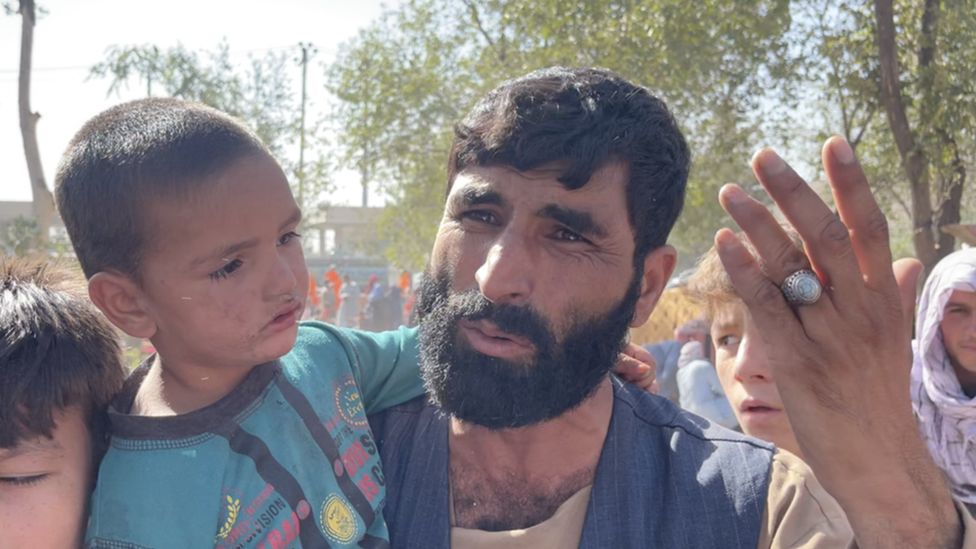
Many of those seeking safety in Kabul have been sleeping on the streets. About 72,000 children are among those fleeing to the capital in recent days, according to Save the Children.
"We have no money to buy bread, or get some medicine for my child," Asadullah, a 35-year-old street vendor who fled northern Kunduz province after the Taliban set fire to his home, told the BBC.
"All of our home and belongings caught fire, so we came to Kabul and pray to God to help us," added Asadullah, who is now with his family in Kabul.
Makeshift camps have been established on scrubland on the outskirts of the capital, while many others have reportedly been sleeping in abandoned warehouses.
Speaking to the BBC shortly before Kandahar fell, Pashtana Durrani, executive director of an education NGO that works with Afghan girls, said she was scared for her life because of her vocal role in advocating for women's education.
"The girls who we work with have already fled," she said. "I don't know where the students are and I'm personally scared about their life. What if they're married to a Taliban fighter? What will their life be like?"
Latest Stories
-
Atta Akyea fumes as Manhyia MP is to spend another night in EOCO custody
8 minutes -
SSNIT says La Beach clearance was to protect hotel investments, beaches to remain public
60 minutes -
APSU congratulates St Augustine’s College after back-to-back National Investment Quiz wins
1 hour -
Renewed flood intervention at Mallam Junction raises hopes among residents, businesses
2 hours -
St Augustine’s College retain National Investment Quiz title after nail-biting grand finale
2 hours -
Education infrastructure investment will drive Banda’s development – Ahmed Ibrahim
2 hours -
Teacher unions strike: Gov’t presents fresh proposals as talks end inconclusively
3 hours -
51,000 teachers’ promotion arrears to be validated for October payment – Education Minister
3 hours -
Kwabena Boamah appointed Board Chair for Impact Investing Ghana
3 hours -
Striking teacher unions to meet Fair Wages and Salaries Commission on October 6
4 hours -
EOCO working with AG to arraign Nana Baffour Awuah before weekend court
4 hours -
Duraplast reassures customers after fire, announces October 5 reopening
4 hours -
Call off strike, gov’t will not renege on promotion arrears pledge – Haruna Iddrisu to teacher unions
4 hours -
Committee set up to validate teachers eligible for 20% deprived-area allowance – Education Minister
4 hours -
Five-member committee to search for new Black Stars coach after Sports Ministry-GFA meeting
4 hours