

Audio By Carbonatix
As Artificial Intelligence (AI) becomes increasingly integrated into teaching, learning and research, quality assurance expert and Director of the Global Quality Assurance Association (GQAA), Dr Violet Makuku, has urged African universities to develop and re-evaluate systems that will support its effective use.
She said such systems should help institutions maintain standards and credibility while reaping the benefits of AI and innovation, rather than simply focusing on identifying shortcomings.
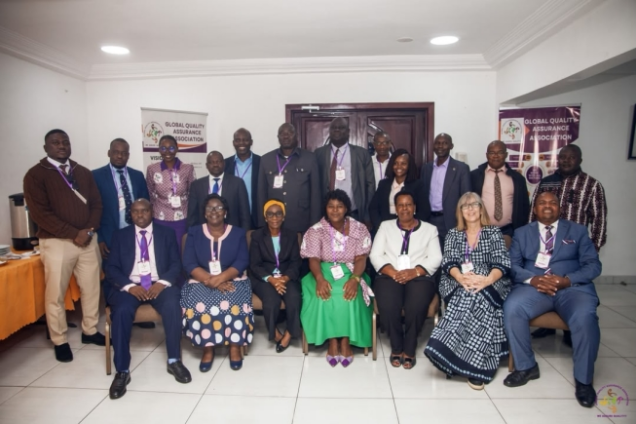
The call was made during the 4th International Quality Assurance symposium organised by the GQAA, held at the Miklin Hotel in Accra from June 9 to 11.
Under the theme, “The Practical, Feasible and Collegial Implementation of Quality Assurance in the Age of Artificial Intelligence: Walking the Quality Assurance Talk and Eliminating the ‘Policing’ Tag,” the three-day symposium brought together quality assurance practitioners, higher education administrators and leaders, researchers and policymakers from across the continent to discuss emerging trends and best practices in the field.
Speaking in an interview on the first day, Dr Makuku, who is the Director of GQAA, stressed that quality assurance, which focuses on maintaining standards in areas such as teaching, examinations, research and general administration, must evolve to keep pace with advances in technology. She said this would require a review of old curricula and assessment methods, and strengthening.
She explained that the symposium was designed to provide a platform for practitioners, researchers and higher education leaders to share experiences, learn from one another and explore emerging trends affecting the sector.
“Previous editions of the symposium had provided valuable opportunities for networking, knowledge sharing and professional development. I am confident that this year's gathering would build on those successes,” she added.
The symposium featured presentations, panel discussions, workshops and networking sessions. In attendance were delegates from Ghana, Uganda, Botswana, South Africa, Nigeria and Eswatini, reflecting growing interest in strengthening quality assurance systems across the continent.
In attendance were delegates from Ghana, Uganda, Botswana, South Africa, Nigeria and Eswatini, reflecting growing interest in strengthening quality assurance systems across the continent.
The Uganda Ministry of Education and Sports was represented by Dr Loy Muhwezi (Commissioner for TVET) and Sir Julius Tayebwa (Under Secretary), who led a delegation of 14 members of staff from the Ministry, Uganda Christian College and the Uganda Technical and Vocational Assessment Board.
The Botswana Ministry of Child Welfare and Basic Education was represented by Sir Shandulo Maphorisa (Inspectorate Services Unit). Among those who came from Ghana’s Colleges of Education (CoE) were Sir Paul Ayekorok Abowen (Bimbila) and Christiana Twumasi (St Louis).
Among the delegates was the Director of Quality Assurance and Institutional Effectiveness at Ashesi University, Dr John Osae-Kwapong.
He expressed optimism that the symposium would yield practical ideas and best practices that institutions such as his could implement to improve quality assurance and institutional performance.
Also in attendance were two returning delegates: Prof. Karen Ferreira-Meyers (Institute of Distance Education and University-Wide Coordinator of the University of Eswatini), and Dr Cynthia Bannerman (QA Director, Accra College of Medicine).
They described the gathering as an important platform for professional engagement and collaboration among quality assurance practitioners from different countries. “We look forward to learning more from colleagues across the continent and implementing findings in our institution,” they said.
About GQAA
The Global Quality Assurance Association (GQAA) is a non-profit professional association that promotes quality assurance, institutional effectiveness and continuous improvement through training, research and professional development initiatives.
On the other hand, it supports the quality of education in public schools from kindergarten to secondary school through donating sanitary pads, school bags, stationery, as well as the construction and renovation of school buildings.
Latest Stories
-
Ten people linked to Kenya’s first-ever Ebola case quarantined as screening concerns grow
12 minutes -
Ghana warns medical travellers to South Africa to obtain visas for treatment beyond 90 days
19 minutes -
Canada suspends plans to expand assisted dying to people with mental illness
20 minutes -
Minority accuses Sports Ministry, NSA of creating fake portfolios for VISA applicants
21 minutes -
6th Inter Tourism Expo comes off in Cape Coast this October; register now
40 minutes -
Afenyo-Markin accuses government of diverting attention from cocaine seizures linked to Ghana
41 minutes -
GJA gives Armed Forces 14 days to account for alleged assaults on Sika Official, Bullet TV’s Philip Abutiate
43 minutes -
PAC gives CWSA 30 days to recover GH¢10m in unpaid water bills from police, army, hospitals, other public institutions
45 minutes -
Major Accra roads to get facelift ahead of Ghana’s 70th Independence anniversary – Agbodza
1 hour -
Account for GH¢650bn allocated to existing programmes before new economy – Oppong Nkrumah to gov’t
1 hour -
‘You’re an action man’ – Abena Osei-Asare hails Rent Commissioner’s hostel fee crackdown
1 hour -
Mahama directs Finance Minister to allocate GH¢1bn for Housing Fund in 2027 Budget
1 hour -
NPP celebrates Bawumia on birthday, prays for 2028 election victory
1 hour -
Mahama recounts ‘exhausting and frustrating’ struggle to find a home as a young spouse
2 hours -
‘Take damaged banknotes to commercial banks for replacement’ – BoG warns against repairing cedi notes for resale
2 hours