

Audio By Carbonatix
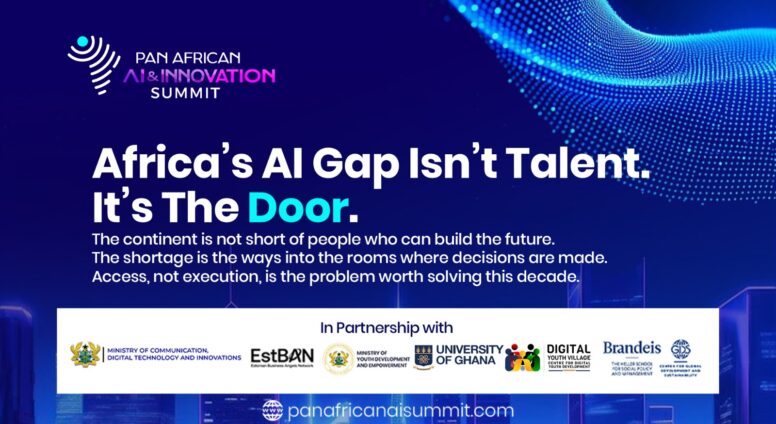
The continent is not short of people who can build the future. The shortage is the ways into the rooms where decisions are made. Access, not execution, is the problem worth solving this decade.
In a teaching hospital in Kumasi, a young data analyst has already worked out how an AI triage tool could cut waiting times on the ward. In a market in Accra, a trader keeps records by hand that a simple model could turn into the credit history a bank would recognise. In a lecture hall in Tamale, a final-year student is writing code good enough to compete anywhere in the world. None of them lacks talent or ideas. What each lacks is a way into the room where Africa’s AI future is being decided.
We have grown used to calling Africa’s challenge an “execution gap”. The distance between our ambitions for artificial intelligence and our ability to deploy it. It is a useful phrase, but misaligned. The barrier is rarely a shortage of knowledge, and increasingly not a shortage of capital. It is access: who is in the room when the decisions, the funding, the partnerships and the standards are set. Africa’s execution gap is, at bottom, an access gap.
This is uncomfortable, because so much of how any ecosystem gathers rewards those who already have access. Platforms and meeting rooms are expensive. Capital flows along existing networks. Standards are written by whoever shows up. Left alone, these forces quietly re-create the gap we say we want to close, concentrating the future in the hands of people who were already near it. If we mean for Africa to lead rather than follow in AI, we must treat access not as something that trickles down once progress arrives, but as the precondition for it. That has consequences at every layer.
On talent, it means pipelines that reach the student in Tamale, not only the graduate of a few elite programmes.
On data, it means AI that speaks our languages and understands our contexts, built by people who live in them.
On capital, it means investors who look for the founder outside the usual circles. And on standards, the rules that will govern how AI is used in Africa. It means African voices in the rooms at the Pan African AI Summit where those norms are discussed and written, not African markets that inherit rules made elsewhere. Access is not a soft value. It is an industrial strategy.
It also shapes something as ordinary as how we convene. The Pan African AI Summit is a statement about who belongs in the conversation. Put a cost on the door, and you decide in advance that the future will be built by those who can afford a ticket. Open the door, and you make a difference. That the farmer’s daughter with a laptop and the minister setting national policy belong in the same room, and that the continent is stronger for it.
That is the bet we made in building the Pan African AI & Summit, and it is why the summit is complimentary. This September it returns for its second edition, bringing the whole ecosystem: policymakers and founders, investors and engineers, students and the continent’s most senior digital leaders into one open room in Kempinski Hotel, Accra.
Last year it drew a thousand people from more than thirty countries. This year it is headlined by the Director-General of Smart Africa, the UN- and AU-funded organisation overseeing AI adoption and governance in Africa and joined by government. The door is, again, open to anyone with the ambition to walk through it.
In a global race, the temptation is to believe the future belongs to whoever moves fastest. For Africa, it will belong to whoever includes the most. We are not short of Africans who can build what comes next. We are short of doors. The task of this decade is to open them and then to get out of the way.
The Pan African AI Summit (PAAIS) is returning for its second edition on 22–23 September 2026 at the Kempinski Hotel Gold Coast City, Accra. The summit is complimentary for all.
Latest Stories
-
Treat healthcare as an investment, not a budget cost – Mahama
8 minutes -
Mahama outlines Ghana’s strategy to expand healthcare and produce medicines locally
11 minutes -
Don’t pay attention to those who will distract you; Ghanaians are already disappointed – LPG tells NPP
14 minutes -
Prof Mike Oquaye praises NPP Minority’s performance in Parliament
14 minutes -
KAAF University vice chancellor urges fresh students to embrace technology, innovation
15 minutes -
Move beyond packaging to produce drug ingredients in Africa – Mahama to pharma industry
17 minutes -
Ghana Medical Trust Fund, Hungary explore partnership to strengthen specialised healthcare
19 minutes -
Manhyia South MP Baffour Awuah pleads not guilty to EOCO charges, granted GH¢10m bail
22 minutes -
NPP conference: We need leaders to complement our efforts in Parliament – Annoh-Dompreh
24 minutes -
Sammy Crabbe steps down from NPP Chairmanship race, backs John Boadu
25 minutes -
NPP postpones constitutional amendments, including proposal on party leadership to next national conference
28 minutes -
NDC ‘running into opposition like Usain Bolt’ – Sammy Awuku
40 minutes -
Local pharma production can create jobs, strengthen Africa’s health security – Mahama
42 minutes -
Mahama calls for removal of barriers to boost Africa’s pharmaceutical industry
47 minutes -
NPP needs ‘war-like’ leaders to take fight to government – Annoh-Dompreh
50 minutes