

Audio By Carbonatix
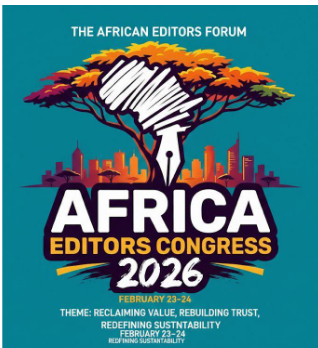
Africa's most influential editors, media executives, and journalism leaders have gathered in Nairobi, Kenya, for the Africa Editors Congress (AEC 2026) — a two-day high-level forum convened to confront the mounting pressures threatening the future of journalism and media sustainability across the continent.
The congress, organised by The African Editors Forum (TAEF), opened on Monday, February 23, 2026, bringing together editors, journalism educators, academics, and media specialists from across Africa at a moment the forum describes as one of "profound political, economic, and technological changes."
"The current fluid global challenges are not only hitting the continent of Africa in one sector. Even the media is facing its own mounting stresses," TAEF said in its official statement ahead of the congress, signed by Forum President Churchill Otieno.
Unlike conventional conferences built around speeches and panel discussions, AEC 2026 has been deliberately designed as a working forum. The idea is for decision-makers to do more than talk — they are expected to interrogate power, shape public policy debates, and forge collective positions on issues that directly affect Africa's democratic health and information integrity.
Among the key areas of focus is the question of African agency in the global artificial intelligence economy. The forum is placing particular emphasis on ensuring that Africa secures a fair stake in AI value chains — and that the continent receives equitable returns from its rare minerals and extractive resources that literally power global technology infrastructure.
The congress theme draws directly from the Johannesburg Declaration of the M20, which issued an urgent call to strengthen information integrity and secure media sustainability in the face of growing dominance by global digital platforms. That dominance — by the likes of Meta, Google, and other tech giants — has upended advertising revenue models that once sustained newsrooms across the continent and beyond.
For senior editors and executives attending the congress, the forum offers something increasingly rare in a fragmented media landscape — direct peer-to-peer engagement with others who face the same editorial, financial, and strategic pressures in their own markets.
TAEF, which is headquartered in Johannesburg, South Africa, describes itself as a continental network committed to strengthening independent journalism and advancing media freedom across Africa. Beyond press freedom advocacy, the forum champions fair compensation for journalism as a public good and supports newsroom resilience in the digital age.
The timing of AEC 2026 is significant. African media organisations are navigating a particularly turbulent period — shrinking advertising revenues, the rise of misinformation, increasing political pressure on independent newsrooms, and the rapid but uneven adoption of AI tools in journalism. For Ghana and other West African nations represented at the congress, these are not abstract concerns. Local media houses have felt the squeeze of platform dominance firsthand, with digital advertising dollars flowing overwhelmingly to global tech companies rather than to the newsrooms producing the content.
The outcomes of AEC 2026 — including any collective positions or policy recommendations emerging from the discussions — are expected to feed into broader continental and global conversations on the future of journalism, media regulation, and Africa's place in the digital economy.
Latest Stories
-
Photos: Speaker Bagbin Commissions MPs constituency office under parliamentary decentralisation programme
9 minutes -
Black Stars technical advisor Winfried Schäfer sacked as GFA shakes up backroom staff
13 minutes -
Wenchi water project almost complete, critical to gov’t agenda – GWL MD
29 minutes -
Anti-LGBTQ+ bill not part of government’s legislative agenda – Inusah Fuseini
32 minutes -
Anti-LGBTQ Bill: Forget the rumour mongers, I’m a man of action, and will pass the bill – Speaker
1 hour -
Women and children among those killed in Sudanese army shelling of wedding celebration
1 hour -
President Mahama is not sincere with Ghanaians on LGBTQ bill matter – Hassan Tampuli
2 hours -
Gov’t to establish Prison Industrial Hub to equip inmates with income-generating skills – Prison Service boss
2 hours -
Alhassan Tampuli donates cement, roofing sheets to support storm victims in Gushegu
2 hours -
Alhassan Tampuli appeals for urgent support for storm victims in Gushegu
2 hours -
The hypocrisy must stop; pass Anti-LGBTQ+ Bill now – Alhassan Tampuli to Mahama
2 hours -
Imprisonment should be rehabilitative, not punitive – Ghana Prisons boss at UNGA
2 hours -
Ga Adangbe traditional priests petition Mahama over McDan aviation licence revocation
3 hours -
Anti-LGBTQ Bill: NDC’s arrogance is worrying – Hassan Tampuli
3 hours -
Let’s give OSP time to mature, not to scrap it – Hassan Tampuli
3 hours